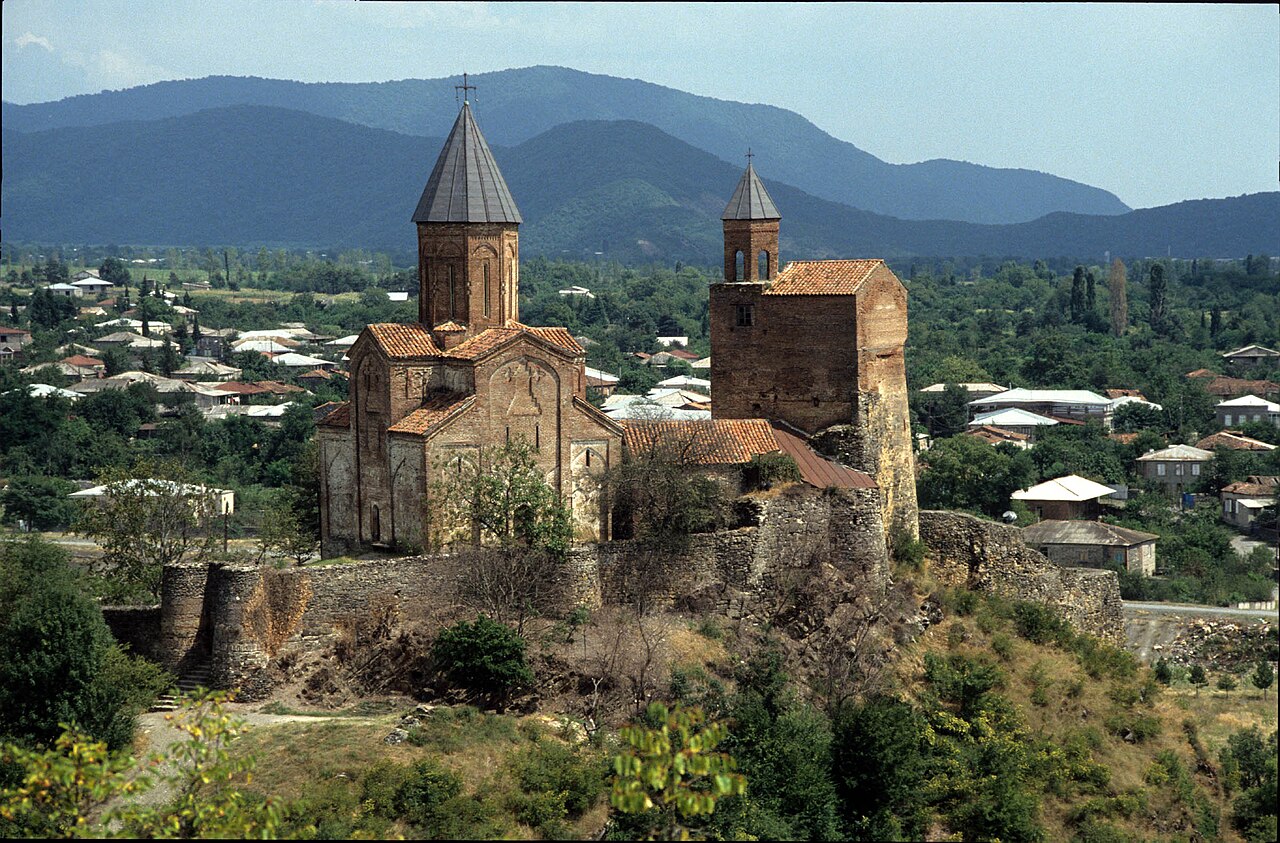
Gremi Castle
Gremi Castle is a significant late medieval fortress located next to the village of Gremi in the Kvareli municipality within the Kakheti region of Georgia. This historic castle complex served as the royal citadel and capital of the Kingdom of Kakheti during the 16th and early 17th centuries. Strategically positioned on a foothill near the confluence of the Bolia and Intsoba rivers, Gremi was an important political, military, and commercial center during its peak.
Historical background and significance
The castle was originally constructed in the 15th century under the reign of King George II of Kakheti. The fortress consisted primarily of a keep with a bell tower, a curtain wall, and a royal residence. In 1565, King Levan of Kakheti commissioned the building of the Church of the Archangels Michael and Gabriel, a cruciform domed church that became the spiritual heart of the complex.
During the 16th century, Gremi flourished as a vibrant trading town along the Silk Road, attracting merchants and craftsmen, including a notable Armenian population. The town covered approximately 40 hectares and was divided into three main parts: the church complex, the royal residence, and the commercial district.
However, the prosperity of Gremi was abruptly ended when the town was attacked and razed by the armies of Shah Abbas I of Persia between 1614 and 1616. The destruction was so severe that Gremi never recovered its former status, leading the Kakheti kings to relocate their capital to Telavi in the mid-17th century.
Architectural features and layout
The keep and defensive structures
The keep of Gremi Castle served as the royal apartments and was the central fortified element of the complex. It is a multi-story stone structure featuring thick defensive walls and narrow windows designed for protection. The keep is attached to a hall and surrounded by a curtain wall fortified with embrasures, turrets, and towers to defend against invaders.
A notable discovery during restoration works in 2011 was the entrance to a secret escape tunnel on the second floor of the keep. This tunnel led down and out of the castle towards the nearby river, providing a concealed exit route in times of siege.
Church of the Archangels
The Church of the Archangels Michael and Gabriel is a fine example of 16th-century Georgian ecclesiastical architecture with influences from contemporary Iranian styles. Built primarily of stone, the church has a cruciform domed design with three entrances facing west, south, and north.
The interior is dominated by a dome supported on an arcaded drum with eight windows, which allows ample natural light. The dome rests on the corners of the sanctuary and two main piers. The façade is divided into three arched sections, adding to the church's architectural harmony.
The church interior is richly decorated with frescoes dating from the late 16th century, depicting religious scenes and figures. These frescoes remain one of the site's most valuable artistic treasures.
Bell tower and additional structures
Near the church stands a fortified bell tower that also functions as a small museum. The museum exhibits archaeological artifacts recovered from the site, including a 16th-century cannon. The walls of the bell tower are adorned with portraits of the kings of Kakheti painted by the modern Georgian artist Levan Chogoshvili in 1985.
The complex also includes a traditional marani (wine cellar), reflecting the region's longstanding viticultural traditions.
Archaeological studies and restoration
Systematic archaeological excavations were conducted at Gremi during the periods 1939-1949 and 1963-1967, revealing extensive remains of the town’s layout and buildings. These studies helped clarify the historical significance and urban structure of the once prosperous settlement.
In 2011, significant restoration efforts were undertaken to preserve the castle and church. The roofs of both the keep and the church were restored, and the discovery of the secret tunnel added to the site's intrigue and historical value.
Since 2007, Gremi has been proposed for inclusion on the UNESCO World Heritage List due to its cultural and historical importance as a medieval capital and trading hub.
Visiting Gremi Castle today
The castle complex is open to visitors, with free access to the church and courtyard areas. Entry to the keep requires a small admission fee, which grants access to the museum housed within and the opportunity to explore the various rooms and staircases.
Visitors can enjoy panoramic views of the surrounding Kakheti countryside from the keep and bell tower. The site offers a tangible connection to Georgia’s medieval past and the legacy of the Kakheti kingdom.
The combination of historic architecture, frescoes, defensive structures, and archaeological artifacts makes Gremi Castle a compelling destination for those interested in medieval history, Georgian culture, and castle architecture.
Frequently asked questions (FAQ)
- What is the historical significance of Gremi Castle?
- Gremi Castle is an important historical site in Georgia, dating back to the 16th century when it served as the capital of the Kingdom of Kakheti. The castle complex includes the Church of the Archangels and various defensive structures, showcasing the architectural style of the period and the region's rich history.
- When is the best time to visit Gremi Castle?
- The best time to visit Gremi Castle is during the spring and autumn months, when the weather is mild and the scenery is particularly beautiful. This allows visitors to enjoy the stunning views of the surrounding landscape and the vibrant colors of the changing seasons.
- Can I access Gremi Castle by public transport?
- Yes, Gremi Castle is accessible by public transport. There are local buses that operate from nearby towns, making it convenient for visitors to reach the castle without needing a car.
- What are the opening hours for Gremi Castle?
- Gremi Castle is open to visitors daily, typically from 10 AM to 6 PM. It is advisable to check the specific hours before your visit, as they may vary seasonally or due to special events.
- Is it possible to take guided tours of Gremi Castle?
- Yes, guided tours of Gremi Castle are available and highly recommended for a more informative experience. Knowledgeable guides provide insights into the castle's history, architecture, and significance, enriching your visit.
- What are the ticket prices for Gremi Castle?
- The ticket prices for Gremi Castle are quite reasonable, making it accessible for most visitors. Children and students often receive discounts, and family packages might be available, so it's worth checking at the entrance for the latest pricing information.
- Are there any nearby attractions to visit while at Gremi Castle?
- Yes, nearby attractions include the picturesque town of Signagi and the Alaverdi Monastery, both of which offer additional cultural and historical experiences. Exploring these sites can enhance your visit to Gremi Castle and provide a deeper understanding of the Kakheti region.
- How do I get to Gremi Castle from Tbilisi?
- To reach Gremi Castle from Tbilisi, you can take a marshrutka (minibus) from the Didube bus station, which will take you to the nearby town of Kvareli. From Kvareli, local transport options or a short taxi ride can take you directly to the castle.
Information
Address
Next to the შ43 road, Georgia
Loading map...
Visitor reviews
No reviews yet. Been here? Write the first review and help other travelers!
Write the first reviewVisited this castle? Share your experience
Your review helps other travelers and adds first-hand knowledge to our encyclopedia.