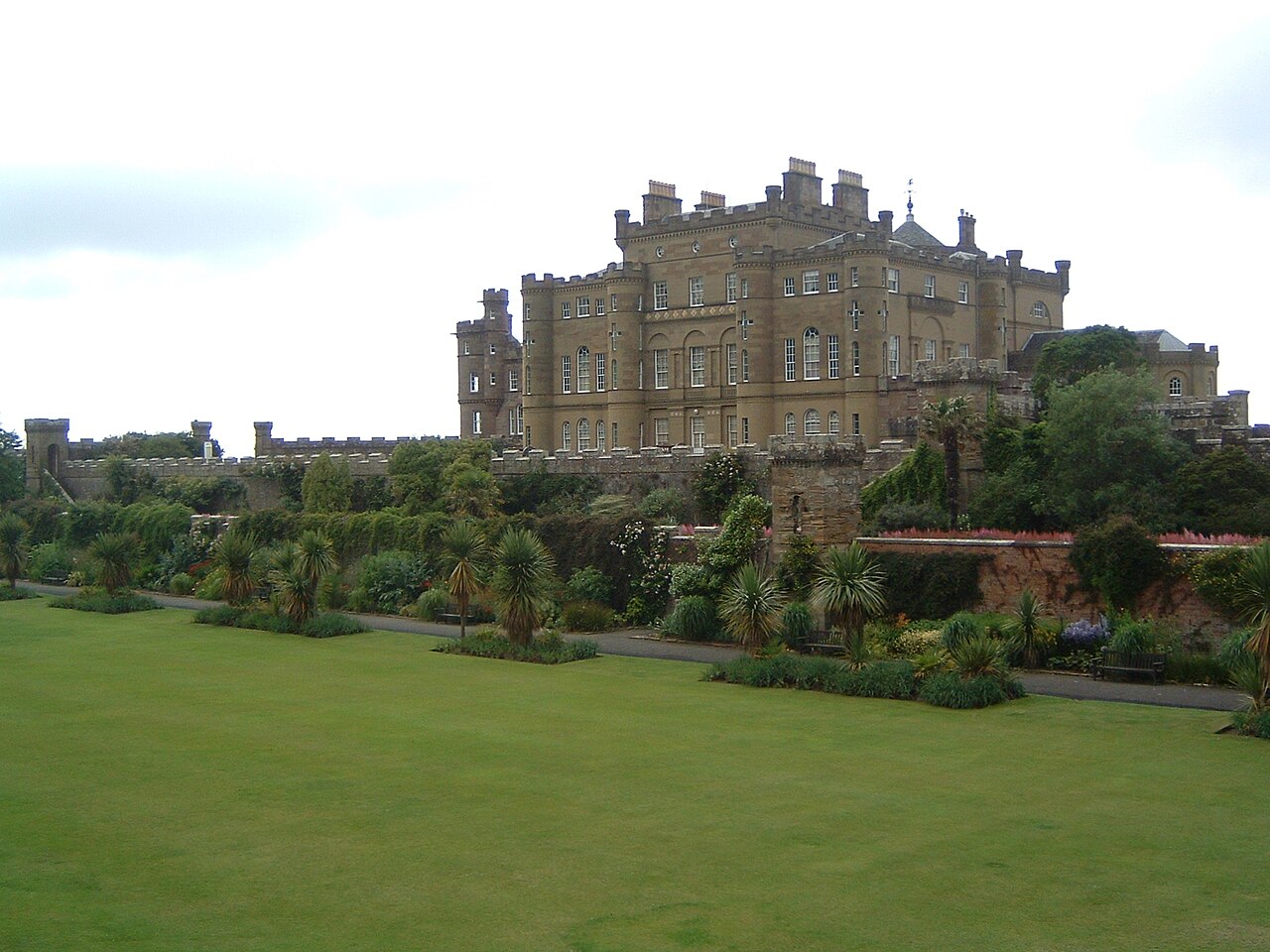
Greenan Castle Ruins
Greenan Castle is a striking example of a 16th-century tower house located approximately 4 kilometres southwest of Ayr in Scotland. Perched dramatically on the edge of a sea cliff, this castle offers a captivating glimpse into Scotland's layered medieval and Renaissance history. The site itself has been fortified since at least the 12th century, evolving from an ancient promontory fort into a motte-and-bailey and later into the stone tower house that stands in ruins today.
The earliest known defensive use of the site was as a promontory fort, likely a fortified farmstead, characterized by four concentric curved ditches each about 3 metres wide, cutting off the headland except for a single causeway providing access. This impressive earthwork system enclosed nearly one acre, demonstrating the strategic importance of the location for controlling access along the coast. The site was reoccupied and adapted in the 12th century as a motte-and-bailey fortification, a common medieval defensive structure featuring a raised earthwork (motte) and an enclosed courtyard (bailey).
Medieval origins and early ownership
Historical records indicate that in 1190, the site was held by Roger de Scalebroc, marking the motte-and-bailey phase of the castle's development. By the 15th century, the castle became associated with the Lords of the Isles, a powerful Scottish clan that controlled extensive territories in western Scotland. During this period, the Davidson family also held possession of the site. However, after John, Earl of Ross and Lord of the Isles, was charged with treason against King James III in 1476, his lands were forfeited. Subsequently, in 1493, King James IV granted the property to William Douglas, reflecting the shifting political alliances and royal consolidation of power in Scotland.
The Renaissance tower house and the Kennedy family
In the late 16th century, the castle entered the hands of the Kennedy family, a prominent Ayrshire clan known for their influence and territorial control. Records confirm the Kennedys' ownership from 1588 onward. It was during this era that the current stone tower house was constructed, measuring approximately 10 by 8 metres and rising to four floors. This tower served as the main residential and defensive structure on the site, embodying the typical features of Scottish Renaissance tower houses with thick stone walls and limited openings for defense.
A notable historical event occurred in 1602 within the castle's courtyard when Sir Thomas Kennedy of Culzean was ambushed and murdered. This tragic incident inspired the famous Scottish writer Sir Walter Scott to pen the play "An Ayrshire Tragedy", embedding Greenan Castle into Scotland's rich cultural heritage. Furthermore, the castle bears an inscription dated 1603 on the entrance lintel, carved with the initials "JK 1603 FMD," representing John Kennedy of Baltersan and his wife Florence MacDowell. This inscription symbolizes the Kennedy family's control over the estate and the valuable fishing rights in the surrounding area at that time.
Architecture and structural features
The surviving tower house is a compact yet formidable structure, characteristic of Scottish Renaissance defensive residences. It comprises four floors, with the ground floor likely used for storage and the upper floors for living quarters and defense. The tower's stone construction provided protection against both human attackers and the harsh coastal weather.
Adjacent to the tower are the remains of a walled courtyard and several outbuildings, which archaeological evidence suggests were used as stables and a kitchen block. The absence of a kitchen within the tower itself indicates that daily domestic activities were conducted in these ancillary buildings, a typical arrangement in Scottish tower houses of this period.
Defensive earthworks
The castle's location on a sea cliff was naturally defensive, augmented by the original promontory fort's earthworks. The four concentric ditches created formidable barriers, isolating the headland and controlling access via a narrow causeway. These earthworks provide valuable insight into early medieval defensive strategies and the adaptation of natural landscapes for fortification.
Later history and decline
Ownership of Greenan Castle remained within various branches of the Kennedy family until 1766, when Thomas Kennedy, Earl of Cassillis, acquired the property. Around this time, the castle ceased to be used as a residence, likely due to changing social and economic circumstances, including the evolution of more modern and comfortable estates.
Following its abandonment as a home, Greenan Castle gradually fell into ruin. By the early 20th century, it was described as a large house with incomplete construction and substantial decay. Despite this, its historical and architectural significance was recognized, and since 1971, Greenan Castle has been protected as a category B listed building, ensuring its preservation as a heritage site.
Greenan Castle today
Today, Greenan Castle stands as a ruined tower house amidst the rugged beauty of the Ayrshire coastline. Visitors can explore the visible stone fragments of the tower and outbuildings, as well as the impressive medieval earthworks that surround the headland. The castle's dramatic cliff-top setting offers panoramic views of the sea and the surrounding landscape, making it a popular destination for history enthusiasts and walkers alike.
The layered history of Greenan Castle—from its origins as a promontory fort and motte-and-bailey to its Renaissance tower house phase—provides a fascinating narrative of Scottish defensive architecture and clan history. Its connections to notable historical figures and events enrich its cultural significance, while its preservation as a ruin allows for ongoing archaeological study and public appreciation.
Frequently asked questions (FAQ)
- What is the historical significance of Greenan Castle Ruins?
- Greenan Castle Ruins, dating back to the 15th century, is a notable example of Scottish castle architecture. It served as a stronghold for the Kennedy family and played a crucial role in the region's history, particularly during the Wars of the Roses and the Scottish Reformation.
- When was Greenan Castle built?
- Greenan Castle was built in the late 15th century, with its construction attributed to the Kennedy family. The castle has undergone various changes over the centuries, reflecting the architectural styles of different periods.
- Can I visit Greenan Castle Ruins?
- Yes, visitors can explore the Greenan Castle Ruins as they are open to the public. However, please be aware that the site is primarily in ruins, so visitors should take care while exploring the grounds.
- What are the opening hours for Greenan Castle?
- Greenan Castle Ruins are accessible year-round, but it’s best to visit during daylight hours for safety and to fully appreciate the views. Specific opening hours may vary seasonally, so checking local resources before your visit is recommended.
- Is it possible to access Greenan Castle by public transport?
- Yes, public transport options are available to reach Greenan Castle. Local buses run from Ayr city center, making it relatively easy for visitors to access the site without a car.
- What is the best time to visit Greenan Castle Ruins?
- The best time to visit Greenan Castle Ruins is during the spring and summer months when the weather is typically mild and conducive for outdoor exploration. This also allows visitors to enjoy the surrounding landscape and coastal views.
- Are there any nearby attractions to visit while at Greenan Castle?
- Yes, there are several nearby attractions, including the picturesque Ayr Beach and the Robert Burns Birthplace Museum. Combining these sites with your visit to Greenan Castle can enhance your experience of Ayr's rich cultural history.
- What are the ticket prices for visiting Greenan Castle?
- Admission to Greenan Castle Ruins is free, allowing visitors to explore the historic site without any cost. However, donations to help maintain the ruins are always appreciated.
- Is Greenan Castle accessible for individuals with mobility challenges?
- The ruins of Greenan Castle are set on a hillside with uneven terrain, which may pose challenges for those with mobility issues. Visitors should take caution and may want to consider bringing someone to assist them if needed.
Information
Loading map...
Visitor reviews
No reviews yet. Been here? Write the first review and help other travelers!
Write the first reviewVisited this castle? Share your experience
Your review helps other travelers and adds first-hand knowledge to our encyclopedia.