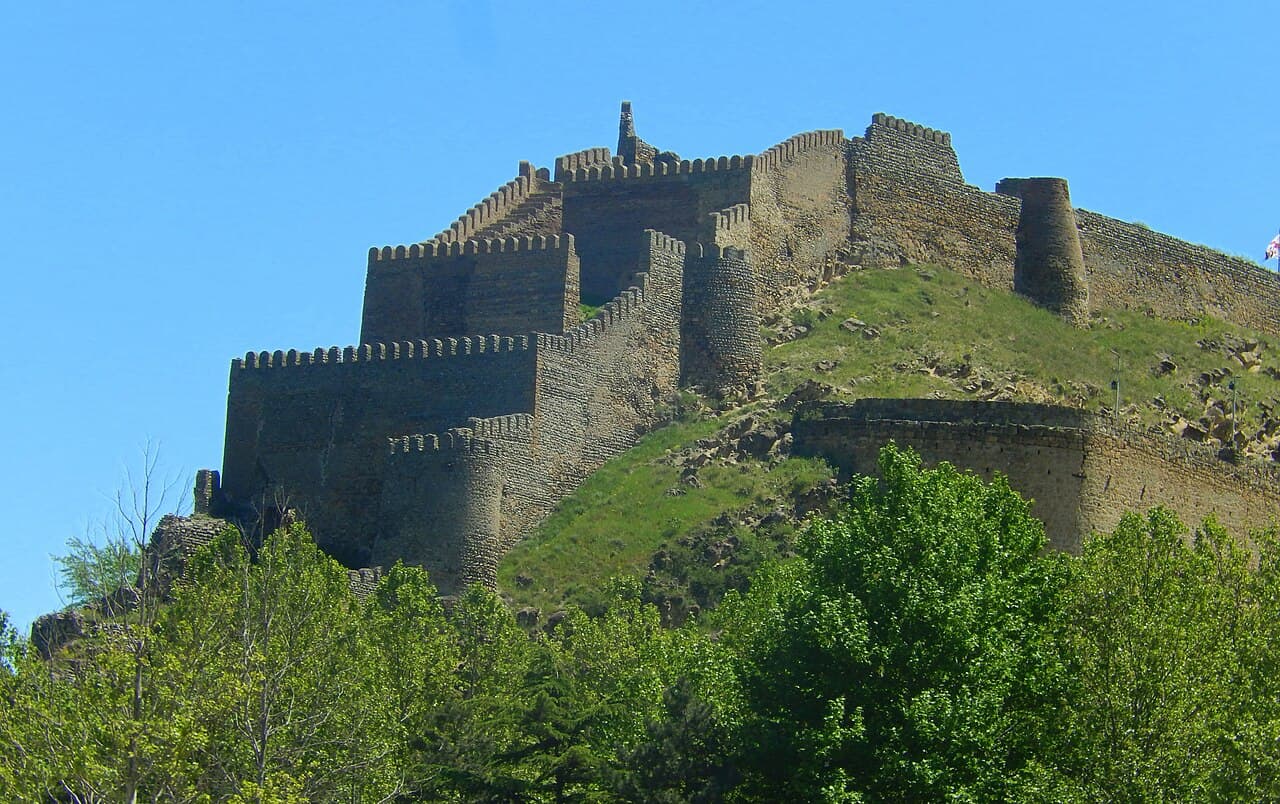
Gori Castle
Gori Castle is a prominent medieval fortress located on a rocky hill overlooking the city of Gori in Georgia's Shida Kartli region. This fortress occupies a commanding position near the confluence of the Liakhvi, Mejuda, and Kura (Mtkvari) rivers, which has historically granted it significant strategic and economic importance. While the castle is first mentioned in written records in the 7th century, archaeological excavations have revealed that the site was fortified as far back as the last centuries BCE, attesting to its long-standing military relevance.
The fortress's irregular, elongated shape follows the natural contours of the hill, with its walls descending steeply to river level on the western side, where the section known as Tskhra-kara (the Nine-gated) stands as the best-preserved part of the complex. Originally, the fortress walls extended down to the river, with an ingenious system diverting water through tunnels, although the river has since shifted course. The castle's fortifications include massive bastioned walls designed to withstand sieges and artillery attacks, reflecting its classification as a bastioned fortress.
Early fortifications and medieval development
Archaeological evidence indicates that the rocky hill of Gori was fortified in the late BCE centuries, long before the castle's first mention in the 7th century. The city of Gori itself was established later, in the 12th century, growing up around the fortress as a vital regional center. Throughout the medieval period, Gori Castle played a key role in controlling trade routes and military movements in the South Caucasus.
Sieges and conflicts in the 13th to 16th centuries
In the late 13th century, the fortress came under the control of the Ossetians, who held it until the early 14th century. King George V of Georgia expelled them after a prolonged three-year siege in the 1320s, reasserting Georgian dominance. The castle's strategic value attracted the attention of regional powers, including the Aq Qoyunlu under Uzun Hasan, who captured it around 1474. It was soon retaken by Constantine II of Georgia in 1479.
The 16th century brought further turmoil as the fortress was contested between the Safavid Empire and the Ottoman Empire. The Safavid Shah Tahmasp I attempted multiple sieges but initially failed to capture the castle. Only on his fourth campaign did he briefly seize it, before the Ottomans took control. Georgian King Simon I of Kartli made several attempts to retake the fortress, culminating in a successful nine-month siege in 1599. This victory was achieved through a clever ruse involving a feigned relaxation of the siege during Lent, followed by a surprise night attack.
17th and 18th centuries: reconstruction and continued conflict
The fortress continued to change hands between Georgian rulers and Persian forces throughout the 17th century. Early in the century, Shah Abbas I of Persia briefly captured Gori Castle, causing significant damage. The Georgian King Rostom of Kartli quickly rebuilt the fortress in the 1630s, giving it much of the form seen today. Rostom also stationed Iranian troops in the castle and commissioned the Italian missionary Cristophoro Castelli to create detailed drawings of the fortress around 1642, which remain valuable historical records.
In the early 18th century, the fortress remained a stronghold under Georgian control, frequently visited by Vakhtang VI of Kartli. However, following his relocation to Russia, the area fell under Ottoman rule. The castle was briefly held by Prince Givi Amilakhvari during a rebellion against Safavid Persian rule in the 1740s but was recaptured by forces loyal to Nader Shah, led by Teimuraz II of Kakheti and Erekle II. In 1774, Erekle II undertook significant rebuilding efforts, further strengthening the fortress.
19th century to present: decline and preservation
After the Russian Empire annexed Georgia in 1801, Gori Castle was garrisoned by a battalion of Russian grenadiers. Over time, its military importance diminished as modern warfare evolved and the strategic landscape changed. By the mid-19th century, the fortress was largely abandoned, with only a chapel in its southeastern corner remaining in use.
The castle suffered severe damage during a powerful earthquake in 1920, which left much of the structure in ruins. Today, Gori Castle stands as a partially preserved bastioned fortress, attracting visitors interested in its rich history and commanding views. Archaeological excavations continue to uncover aspects of its past, including a Soviet-era concrete shelter discovered on the eastern side of the site.
Architectural features and layout
The fortress's design is adapted to the natural topography of the hill, resulting in an irregular, elongated shape. The walls are thick and fortified with bastions to provide defense against artillery, characteristic of a bastioned fortress. The western side features the best-preserved section, Tskhra-kara or "the Nine-gated," which historically controlled access down to the rivers below.
Within the fortress, the plateau is enclosed by inner fortifications, and the walls extend down the slopes to protect against attackers approaching from below. The castle's defensive system originally included water management features, such as tunnels diverting river water, although these are no longer functional due to changes in the river's course.
Despite the castle's current emptiness inside, its imposing ruins convey the scale and strength of this medieval stronghold. The fortress's strategic location and robust construction made it a key military asset in Georgia's turbulent history.
Visiting gori castle today
Gori Castle is freely accessible to the public, offering visitors the chance to explore its extensive ruins and enjoy panoramic views of the city and surrounding landscape. While the interior lacks extensive restoration or furnishing, ongoing archaeological work provides insight into its historical layers.
The site is an important cultural landmark in Georgia, reflecting centuries of conflict, reconstruction, and strategic significance. Visitors can appreciate the fortress's architecture and its role in the region's history, from ancient fortifications to its function during the Ottoman, Persian, and Russian periods.
Nearby attractions include the city of Gori itself, known as the birthplace of Joseph Stalin, and several museums dedicated to Georgian history and culture.
Frequently asked questions (FAQ)
- What is the historical significance of Gori Castle?
- Gori Castle, located in Georgia, dates back to the 12th century and has played a crucial role in the defense of the region against invasions. It is famously associated with the birthplace of Joseph Stalin and offers insights into the medieval history of Georgia.
- When was Gori Castle built?
- Gori Castle was constructed in the 12th century, during the reign of King David IV, also known as David the Builder. The castle has undergone several renovations and expansions over the centuries, reflecting its importance through various historical periods.
- Can I visit Gori Castle year-round?
- Yes, Gori Castle is open to visitors throughout the year. However, it's advisable to check specific opening hours and any seasonal changes that may affect access, particularly during winter months.
- What are the opening hours for Gori Castle?
- Gori Castle typically opens to visitors from 10 AM to 6 PM daily. It may have extended hours during the summer months, so checking the official website for the most current information is recommended.
- Is Gori Castle accessible for visitors with disabilities?
- While Gori Castle is a historical site with uneven terrain and steps, efforts have been made to ensure access for all visitors. It is advisable to contact the site in advance to inquire about specific accessibility accommodations.
- What is the best time to visit Gori Castle?
- The best time to visit Gori Castle is during the spring (April to June) and fall (September to October) when the weather is mild and pleasant. These seasons also offer beautiful scenery, making your visit more enjoyable.
- Can I purchase tickets in advance for Gori Castle?
- Yes, tickets for Gori Castle can often be purchased in advance online or on-site. It is advisable to buy tickets in advance during peak tourist seasons to avoid long lines and ensure availability.
- What nearby attractions can I visit along with Gori Castle?
- Nearby attractions include the Joseph Stalin Museum and Uplistsikhe, an ancient rock-hewn town. Both sites complement a visit to Gori Castle and provide a deeper understanding of Georgia's rich cultural heritage.
- How much do tickets for Gori Castle cost?
- Ticket prices for Gori Castle are generally affordable, with discounts available for students and seniors. It is best to check the official website for the latest pricing and any available promotions before your visit.
Photo gallery

Information
Loading map...
Visitor reviews
No reviews yet. Been here? Write the first review and help other travelers!
Write the first reviewVisited this castle? Share your experience
Your review helps other travelers and adds first-hand knowledge to our encyclopedia.



