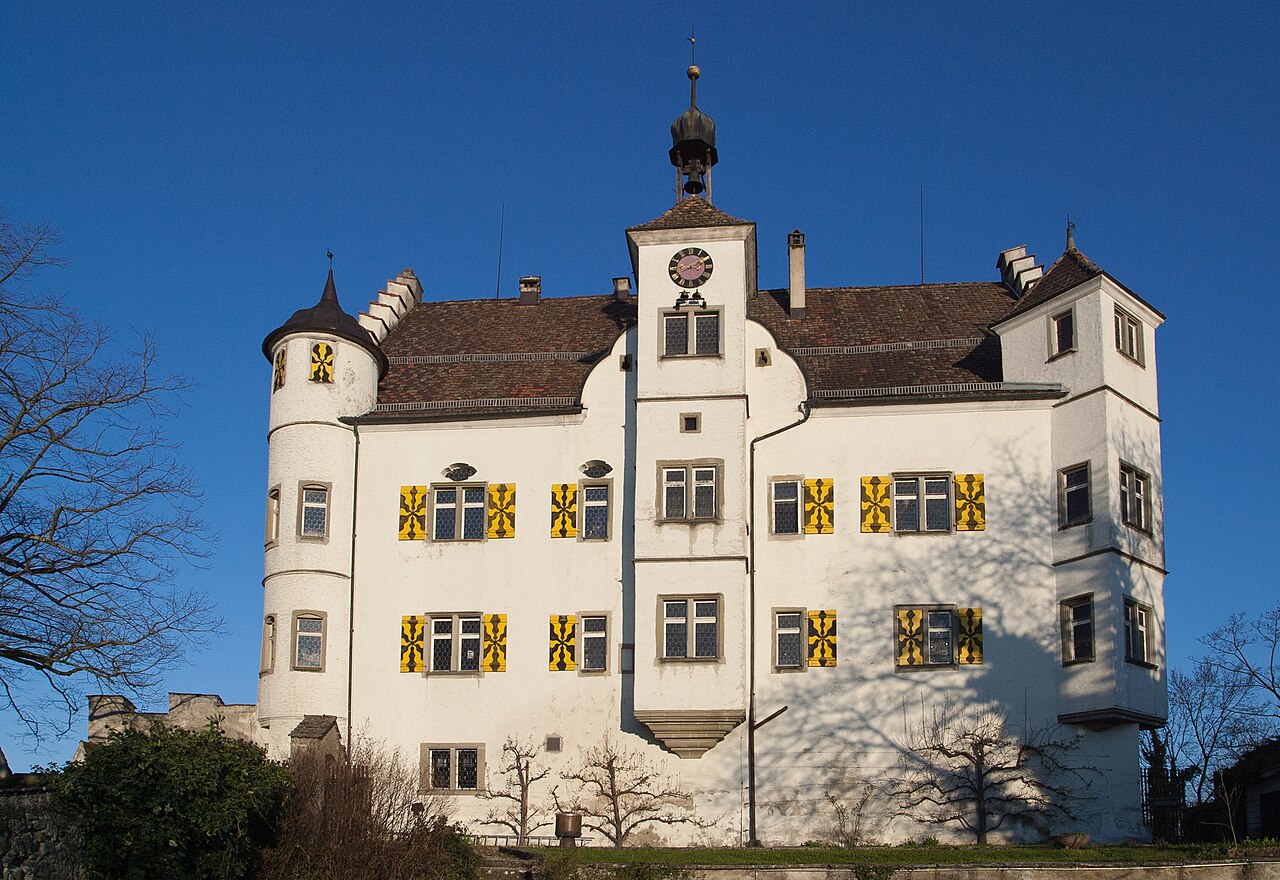
Frauenfeld Castle
Frauenfeld Castle stands as a prominent medieval fortress in the town of Frauenfeld, Switzerland, embodying centuries of regional history and architectural evolution. Founded in the 13th century by the noble Kyburg family, the castle was strategically constructed on a molasse rock overlooking the Murg river, commanding views above the southwestern edge of the historic town center. Its location as a hill castle highlights its defensive importance in securing the Landgraviate of Thurgau during the High Medieval period.
The castle’s centerpiece is its massive bergfried tower, erected around 1227 from large local fieldstones known as Findlinge. Rising approximately 19 meters, this tower originally featured an elevated entrance on the second floor, accessed by a wooden gallery, a defensive design typical for the era. Inside, the tower contains a small heated chamber with thick walls and narrow windows, one of which was later sealed. Dendrochronological analysis of oak beams confirms construction in the early 1230s, underscoring the tower's authenticity and medieval origins.
Architectural features and medieval fortifications
The castle’s original defensive layout included wooden galleries surrounding the bergfried at the second-floor level, evident today through surviving beam holes and vertical posts on the tower’s exterior. Adjacent to the bergfried on the side facing the river stands the Murgturm or Palas, initially a residential structure with a stone base and likely a wooden upper section resembling a blockhouse. Access was through a first-floor entrance connected internally by an opening in the ceiling beams, dating from around 1235.
In the late 13th century, the castle expanded its defenses with the addition of a zwinger — an outer courtyard designed to trap attackers — equipped with battlements and wooden upper structures. The zwinger was later enlarged with a two-story building, parts of whose outer walls remain intact today, offering insight into the castle’s layered defensive system.
By the late Middle Ages, under the ownership of the Hohenlandenberg family, Frauenfeld Castle saw further fortification enhancements. These included a deep surrounding moat and a robust stone curtain wall, in some sections built as a double ring, providing formidable protection. The castle also gained distinctive projecting timber-framed upper floors, a characteristic architectural feature of the period. The ground-level entrance near the bergfried, initially sealed, was reopened and remains in use today, reflecting adaptive changes in castle access over time.
Historical significance and ownership transitions
The Kyburg family, who founded the castle, had maintained dominance in the region since 1094. After their lineage ended in 1264, the castle passed to Rudolf of Habsburg, marking a shift in control to the Habsburg dynasty. Under Habsburg rule, Frauenfeld Castle served as the administrative center for their Austrian-appointed officials, overseeing governance in the region. This era, spanning the late 13th and 14th centuries, saw significant structural enlargements and the construction of the outer ward.
Ownership transitioned to the Hohenlandenberg family toward the end of the 14th century, who further fortified the castle and enhanced its residential and defensive capabilities. The castle’s role evolved through the turbulent 15th century, notably after the Swiss Confederates conquered Thurgau in 1460 and following the Swabian War of 1499. The Swiss Confederacy officially acquired Frauenfeld Castle in 1534, repurposing it as the residence for bailiffs—officials who governed the region in two-year terms from the original seven cantons, and later from Bern after 1712.
During this period, the castle underwent renovations including the enlargement of windows and the establishment of a large courtroom on the second floor. Interior decorations from the 16th century reflect the castle’s administrative and residential functions under Swiss governance.
Post-medieval adaptations and museum conversion
The upheavals of the French Revolution in 1798 ended the bailiffs’ residence at the castle. With the creation of the canton of Thurgau in 1803, Frauenfeld Castle adapted to new roles, serving variously as housing, a temporary prison, a workhouse between 1809 and 1811, government offices, and the state treasury. The 19th century saw modifications to the fortifications, including demolition or reduction of the outer ring wall and filling in of the moat and garden areas, reflecting the castle’s transition from fortress to civic utility.
In 1867, the castle was sold to a private family and used as a residence until the mid-20th century. In 1955, ownership reverted to the canton of Thurgau for use as the Historical Museum of Thurgau. Restoration efforts completed by 1960 coincided with the 500th anniversary of Thurgau joining the Swiss Confederation. Today, the museum exhibits collections spanning from prehistoric times to regional history, including notable artifacts such as the Frauenfeld mitre and displays dedicated to the Bachmann family, enriching cultural heritage and public education.
Castle layout and surviving structures
The castle’s layout is centered around the imposing bergfried tower, surrounded by defensive walls and remnants of the former moat. The double-ring curtain walls and the deep moat constructed in the late Middle Ages remain key features, although parts have been reduced or filled in over time. The projecting timber-framed upper stories and the two-story outer ward building survive as distinctive architectural elements, illustrating the castle’s evolution from a medieval fortress to an administrative residence.
Additional structures historically included a chapel, later converted for residential use, and a barn near the present town hall. A 19th-century remise (coach house) built in the courtyard incorporates part of the medieval city wall, demonstrating adaptive reuse of the castle’s fabric. The bergfried’s adaptation to house the state treasury in the 19th century further exemplifies the castle’s functional shifts.
Frauenfeld Castle today is recognized as a site of national cultural significance in Switzerland. Its well-preserved medieval architecture, layered historical narratives, and role as a museum make it a vital destination for understanding the region’s past and the broader history of Swiss confederacy governance.
Interactive museum experience
The Thurgau History Museum housed within Frauenfeld Castle offers a modern, multimedia tour that brings the Middle Ages to life. Interactive animations and carefully curated artwork provide visitors of all ages with an engaging and educational experience. The exhibits focus on the period after 1415, a crucial era when the Swiss Confederacy expanded and modern boundaries were established, highlighting the turbulent transition in governance and society.
This blend of historical architecture and contemporary museum technology creates a unique cultural attraction, making Frauenfeld Castle not only a monument of medieval fortification but also a vibrant center for historical education and community engagement.
Frequently asked questions (FAQ)
- How do I visit Frauenfeld Castle and the Thurgau History Museum?
- Frauenfeld Castle is open to visitors as the home of the Thurgau History Museum. Check the museum's official website for current opening hours and ticket prices. Guided tours and multimedia exhibits provide a comprehensive experience.
- What is the historical significance of Frauenfeld Castle?
- Frauenfeld Castle was founded in the 13th century by the Kyburg family and later served as an administrative center under Habsburg and Swiss Confederacy rule, reflecting key regional historical transitions.
- Can I see medieval architectural features at Frauenfeld Castle?
- Yes, the castle retains its original bergfried tower, curtain walls, moat remnants, and timber-framed upper floors, showcasing medieval defensive and residential architecture.
- Is Frauenfeld Castle accessible for families and children?
- The Thurgau History Museum offers interactive and playful exhibits suitable for children and adults, making Frauenfeld Castle a family-friendly destination.
- When is the best time to visit Frauenfeld Castle?
- The castle and museum are open year-round, but spring through autumn offers pleasant weather for exploring the castle grounds and town of Frauenfeld.
Information
Current owner
Canton of Thurgau
Loading map...
Visitor reviews
No reviews yet. Been here? Write the first review and help other travelers!
Write the first reviewVisited this castle? Share your experience
Your review helps other travelers and adds first-hand knowledge to our encyclopedia.