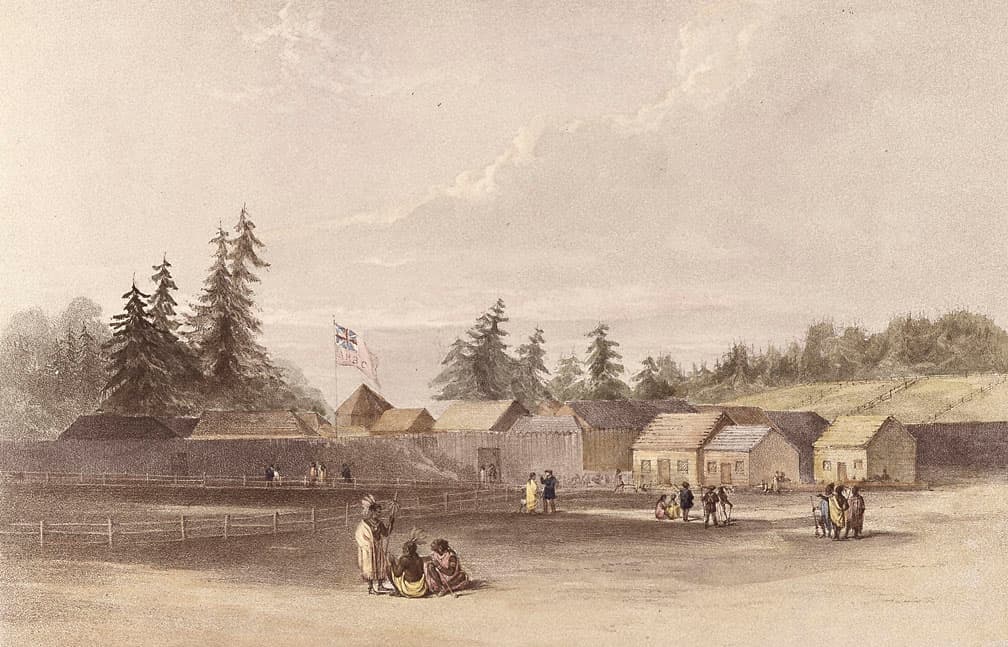
Fort Vancouver
Fort Vancouver was established in the early 19th century as a British fur trading post, strategically located on the northern bank of the Columbia River in the disputed region known as the Oregon Country. Founded during the winter of 1824–1825, it served as the principal settlement for the Hudson's Bay Company (HBC) within the expansive Columbia Department. The fort was named in honor of Captain George Vancouver, a Royal Navy officer and explorer who led the Vancouver Expedition along the Pacific Coast in the late 18th century.
Strategic importance and role in the fur trade
Fort Vancouver was a critical hub in the regional fur trade network of the Pacific Northwest. It functioned as the administrative and operational center for a vast trading empire that included 34 outposts, 24 ports, six ships, and employed approximately 600 people at its peak. The fort received trade goods and supplies annually from London, transported either by sea across the Pacific Ocean or overland from Hudson Bay via the York Factory Express. Indigenous peoples from surrounding areas traded valuable fur pelts at the fort, exchanging them for manufactured goods and supplies brought by the HBC.
The furs collected at Fort Vancouver were exported globally, including shipments to the Qing dynasty in China through the port of Guangzhou. There, furs were exchanged for Chinese manufactured goods that were subsequently sold in Britain, illustrating the fort's role in international trade networks.
Architectural and defensive features
As a bastioned fortress, Fort Vancouver was designed with defensive considerations typical of early 19th-century military architecture. The fort featured earthwork bastions at its corners, which allowed defenders to cover all approaches with overlapping fields of fire, a common characteristic of bastioned fortifications. The perimeter was enclosed by sturdy wooden palisades, and the layout included essential structures such as storehouses, officers' quarters, workshops, and trade halls. These facilities supported both the commercial and defensive functions of the fort.
Transition to United States control and legacy
The geopolitical landscape shifted significantly with the signing of the Oregon Treaty in 1846, which resolved the boundary dispute between Great Britain and the United States by ceding the land around Fort Vancouver to the United States. Although the treaty allowed the Hudson's Bay Company to continue trading operations for a time, the change in sovereignty effectively ended the fort's role as a British trading post. The fort ceased operations shortly thereafter.
Today, Fort Vancouver is located in Vancouver, Washington, and has been preserved as the Fort Vancouver National Historic Site. The site includes a full-scale replica of the original Hudson's Bay Company outpost, which is open to the public and serves as an educational resource illustrating the fort's historical significance in the fur trade and regional development of the Pacific Northwest.
Historical significance and cultural impact
Fort Vancouver played a pivotal role in shaping the economic and cultural landscape of the Pacific Northwest during the early 19th century. It was a focal point for interaction between European traders and Indigenous peoples, facilitating not only commerce but also cultural exchange. The fort's extensive network of outposts and maritime connections underscored its importance in global trade routes of the era.
The preservation of Fort Vancouver as a national historic site allows visitors to explore the architectural features and historical context of a bastioned fortress that was central to the British fur trade presence in North America. Its legacy continues to inform understanding of colonial expansion, trade dynamics, and Indigenous relations during a formative period in the region's history.
Frequently asked questions (FAQ)
- What is the historical significance of Fort Vancouver?
- Fort Vancouver served as the headquarters of the Hudson's Bay Company in the Pacific Northwest during the mid-19th century. It played a crucial role in the fur trade and the settlement of the region, becoming a pivotal point for trade and cultural exchange between Native Americans, European settlers, and fur traders.
- When was Fort Vancouver established?
- Fort Vancouver was established in 1825 and operated until 1860. It was reconstructed as a National Historic Site in the 1970s, allowing visitors to experience its historical context and architecture.
- What are the opening hours of Fort Vancouver?
- Fort Vancouver is typically open from 9 AM to 5 PM daily, but hours may vary during holidays or special events. It is advisable to check the official website for the most current information before your visit.
- Can I visit Fort Vancouver year-round?
- Yes, Fort Vancouver is open year-round, although certain facilities may have limited access during the winter months. The best time to visit is during the spring and summer when outdoor activities and programs are in full swing.
- Is Fort Vancouver accessible for visitors with disabilities?
- Yes, Fort Vancouver is committed to providing accessibility for all visitors. The site features accessible pathways and facilities, making it easier for guests with mobility challenges to explore the historic grounds.
- What are the ticket prices for Fort Vancouver?
- Admission to Fort Vancouver is free for all visitors, however, some special programs and events may have a fee. It’s best to check the official website for details on any upcoming events that may require tickets.
- What nearby attractions can I explore after visiting Fort Vancouver?
- After visiting Fort Vancouver, guests can explore the nearby Pearson Field, a historic airfield, and Fort Vancouver National Historic Site's Visitor Center. Additionally, the vibrant waterfront area offers dining, shopping, and scenic views of the Columbia River.
- How do I get to Fort Vancouver?
- Fort Vancouver is located just off Interstate 5, making it easily accessible by car. Public transportation options, including buses, also serve the area, providing visitors with convenient access to this historical site.
Photo gallery

Photo by Lt. Herny Warre•Public domain
Information
Loading map...
Visitor reviews
No reviews yet. Been here? Write the first review and help other travelers!
Write the first reviewVisited this castle? Share your experience
Your review helps other travelers and adds first-hand knowledge to our encyclopedia.


