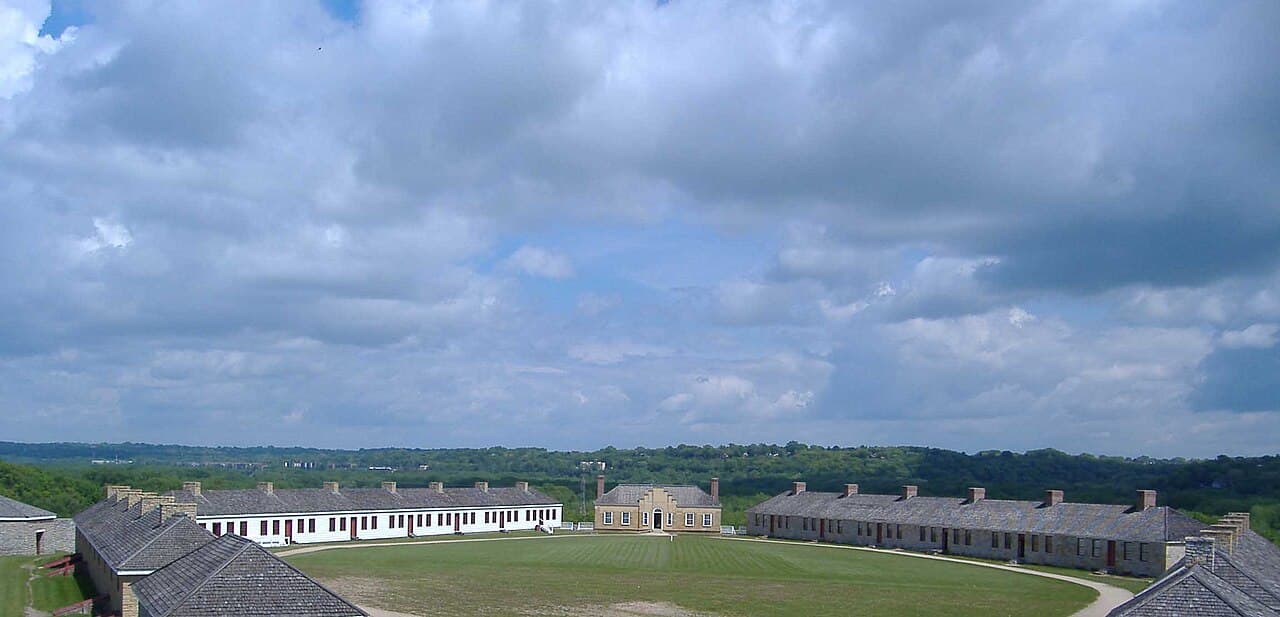
Fort Snelling
Fort Snelling is a significant 19th-century bastioned fortress located in the U.S. state of Minnesota, strategically positioned on the bluffs overlooking the confluence of the Minnesota and Mississippi Rivers. Originally named Fort Saint Anthony, the fort was renamed Fort Snelling upon its completion in 1825. It served as a crucial military installation for the United States Army through much of the 19th and early 20th centuries.
Early construction and military significance
The fort was constructed as a bastioned fortress, a style characterized by angular bastions projecting from the curtain walls to provide defensive fire in multiple directions. This design was typical of military architecture in the early 19th century, reflecting advances in artillery and fortification techniques. Fort Snelling's location was chosen for its commanding views and control over river traffic, making it a vital strategic point for the U.S. military in the upper Midwest.
Architectural features
The original fort complex included a lower post situated on the river bluffs and an upper post on higher ground. The lower post featured prominent round and hexagonal towers, which served as key defensive structures. The fort's walls were constructed from locally quarried limestone, providing robust protection against attacks. The upper post contained essential military buildings such as barracks, officers' quarters, a hospital, and supply depots. Over time, many of these structures have been preserved or restored, although some remain in disrepair.
Historical context and notable events
Fort Snelling played a pivotal role in several historical events. Before the American Civil War, the fort was a site where the U.S. Army permitted soldiers and fur traders to bring enslaved African Americans, including Dred Scott and Harriet Robinson Scott. The Scotts lived at the fort in the 1830s and later sued for their freedom in the landmark Dred Scott v. Sandford Supreme Court case, which had profound implications for slavery and civil rights in the United States. Slavery at the fort ended shortly before Minnesota's statehood in 1858.
During the Dakota War of 1862, Fort Snelling served as the primary center for U.S. government forces. It was also the site of a concentration camp where eastern Dakota and Ho-Chunk non-combatants were held before forced removal from Minnesota. This somber chapter highlights the fort's complex role in Native American history and U.S. military operations.
Military use through the 20th century
Following the Civil War, Fort Snelling continued to serve as a recruiting and training station during the Spanish–American War and both World Wars. The fort was decommissioned in 1946 after World War II, leading to a period of neglect and disrepair. Restoration efforts began in 1965, focusing on the lower post to return it to its original appearance. Despite these efforts, some buildings on the upper post remain unrestored.
Current status and preservation
Today, Fort Snelling is recognized as a National Historic Landmark and is administered by the Minnesota Historical Society. The fort is part of the Mississippi National River and Recreation Area, a unit of the National Park Service. The surrounding land includes Fort Snelling State Park, managed by the Minnesota Department of Natural Resources, which was once part of the fort's original territory.
As of early 2026, some federal buildings within the fort are utilized by United States Customs and Border Protection and Immigration and Customs Enforcement for housing federal agents and detaining individuals involved in immigration enforcement operations. Multiple government agencies own different portions of the fort, reflecting its continued strategic and administrative importance.
Cultural and heritage significance
Fort Snelling is cited as a "National Treasure" by the National Trust for Historic Preservation due to its rich history and well-preserved military architecture. The fort's layered history encompasses early American frontier defense, the complex legacies of slavery and Native American displacement, and its role in multiple American wars. Its preservation allows visitors to explore these themes through its surviving structures, exhibits, and educational programs.
Visitors to Fort Snelling can explore the restored bastioned fortress, including the defensive towers, barracks, and historic grounds. The site offers a tangible connection to key moments in U.S. history and military architecture, making it an important destination for historians, architects, and the general public interested in America's past.
Frequently asked questions (FAQ)
- How do I visit Fort Snelling and what are the opening hours?
- Fort Snelling is open to the public year-round with varying hours depending on the season. It is best to check the Minnesota Historical Society's website for the most current visiting hours and any special event schedules.
- What historical events is Fort Snelling known for?
- Fort Snelling is notable for its role in the Dred Scott case, the Dakota War of 1862, and its use as a military recruiting station through multiple American wars.
- Can I tour the restored parts of Fort Snelling?
- Yes, visitors can tour the restored lower post, including the bastioned walls, towers, and several historic buildings maintained by the Minnesota Historical Society.
- Is Fort Snelling accessible for people with disabilities?
- Efforts have been made to improve accessibility at Fort Snelling, but some historic areas may have limited access due to preservation constraints. Visitors are encouraged to contact the site ahead of their visit for specific accessibility information.
- Are there nearby attractions to visit along with Fort Snelling?
- Fort Snelling State Park, located nearby, offers hiking trails, picnic areas, and natural scenery. The Mississippi National River and Recreation Area also provides opportunities for outdoor activities and learning about the region's natural history.
Photo gallery

Information
Loading map...
Visitor reviews
No reviews yet. Been here? Write the first review and help other travelers!
Write the first reviewVisited this castle? Share your experience
Your review helps other travelers and adds first-hand knowledge to our encyclopedia.


