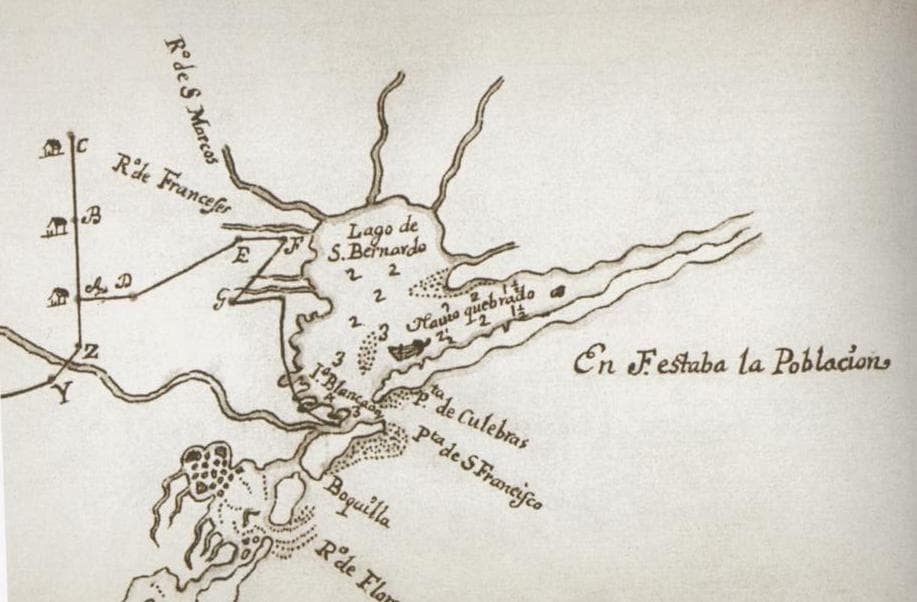
Fort Saint Louis
Fort Saint-Louis in Texas was established in 1685 by the French explorer René-Robert Cavelier de La Salle and members of his expedition, including the Jesuit missionary Zenobius Membre. The fort was located on the banks of Garcitas Creek, a few kilometers inland from the mouth of the Lavaca River. La Salle had originally intended to establish a colony at the mouth of the Mississippi River, but due to inaccurate charts and navigational errors, his ships landed over 600 kilometers west on the Texas coast. This misplacement marked the beginning of France's short-lived but historically significant presence in the region.
Foundation and strategic purpose
The establishment of Fort Saint-Louis was part of La Salle's larger mission to expand French influence in North America by creating a foothold near the Gulf of Mexico. The fort was designed as a bastioned fortress, a common military architectural style of the Renaissance period, featuring angled bastions that allowed defenders to cover all approaches with gunfire. This design was intended to protect the colonists from potential attacks by indigenous groups and rival European powers, notably Spain, which claimed sovereignty over the territory as part of New Spain.
Challenges and hardships
The colony faced numerous difficulties from the outset. The settlers contended with hostile relations with native tribes, including the Karankawa people, who were wary of the French presence. Additionally, the colonists suffered from epidemics and the harsh climatic conditions of the Texas coastal environment. Supply shortages became critical after the colony's last ship was destroyed in 1686, cutting off resupply routes from French Caribbean possessions. These hardships severely undermined the colony's viability.
La Salle's expeditions
Despite these challenges, La Salle remained committed to his original goal of locating the Mississippi River. He led several expeditions into the interior, exploring much of the Río Grande and eastern Texas. His efforts to find the river were also motivated by the hope of securing supplies and reinforcements. However, during his final expedition in early 1687 along the Brazos River, La Salle and five of his men were killed due to internal rivalries within his group, further destabilizing the colony.
Spanish response and aftermath
News of the French colony reached Spanish authorities in 1686, alarming them due to the potential threat to their territorial claims in North America. Spain promptly organized expeditions to locate and eliminate the French settlement. In the spring of 1689, a Spanish expedition led by Alonso de León discovered the ruins of Fort Saint-Louis. By this time, most of the French colonists had been killed by the Karankawas, except for five children who were taken captive.
Legacy and historical significance
Although Fort Saint-Louis existed for only about three years, its establishment had lasting implications. It allowed France to assert a claim over Texas, which later influenced territorial disputes involving Spain and the United States. The United States used the French claim as part of its justification for acquiring Texas in the Louisiana Purchase. The fort's history provides valuable insight into early colonial competition in North America and the complex interactions between European powers and indigenous peoples.
Architectural features and fortifications
The fort's design as a bastioned fortress reflected contemporary military engineering principles. The angled bastions provided overlapping fields of fire, enhancing the fort's defensive capabilities against attackers. The fort likely included a palisade wall, barracks, a chapel, and storage facilities, arranged around a central courtyard. The site was chosen for its strategic location near navigable waterways, facilitating communication and supply routes, although these were ultimately compromised.
Archaeological investigations and preservation
Modern archaeological efforts have sought to locate and study the remains of Fort Saint-Louis. Excavations have uncovered artifacts that shed light on the daily lives of the settlers, their material culture, and the fort's layout. Preservation of the site remains a challenge due to natural erosion and limited historical records. Nonetheless, the fort remains an important cultural heritage site that illustrates early European colonization attempts in what is now the United States.
Frequently asked questions (FAQ)
- When was Fort Saint-Louis founded and by whom?
- Fort Saint-Louis was founded in 1685 by French explorer René-Robert Cavelier de La Salle and members of his expedition, including Jesuit missionary Zenobius Membre.
- What challenges did the colony at Fort Saint-Louis face?
- The colony faced hostile relations with native tribes, epidemics, harsh climate, and supply shortages after the destruction of its last ship in 1686.
- How did Spain respond to the establishment of Fort Saint-Louis?
- Spain launched expeditions to find and destroy the French colony, with Alonso de León discovering the fort's remains in 1689 after most colonists were killed by the Karankawas.
- What was the architectural style of Fort Saint-Louis?
- Fort Saint-Louis was built as a bastioned fortress, a Renaissance military design featuring angled bastions for improved defense.
- What is the historical significance of Fort Saint-Louis?
- Though short-lived, Fort Saint-Louis enabled France to claim Texas, influencing later territorial disputes and the United States' claims following the Louisiana Purchase.
Photo gallery

Photo by Carlos de Sigüenza y Góngora•Public domain
Information
Loading map...
Visitor reviews
No reviews yet. Been here? Write the first review and help other travelers!
Write the first reviewVisited this castle? Share your experience
Your review helps other travelers and adds first-hand knowledge to our encyclopedia.



