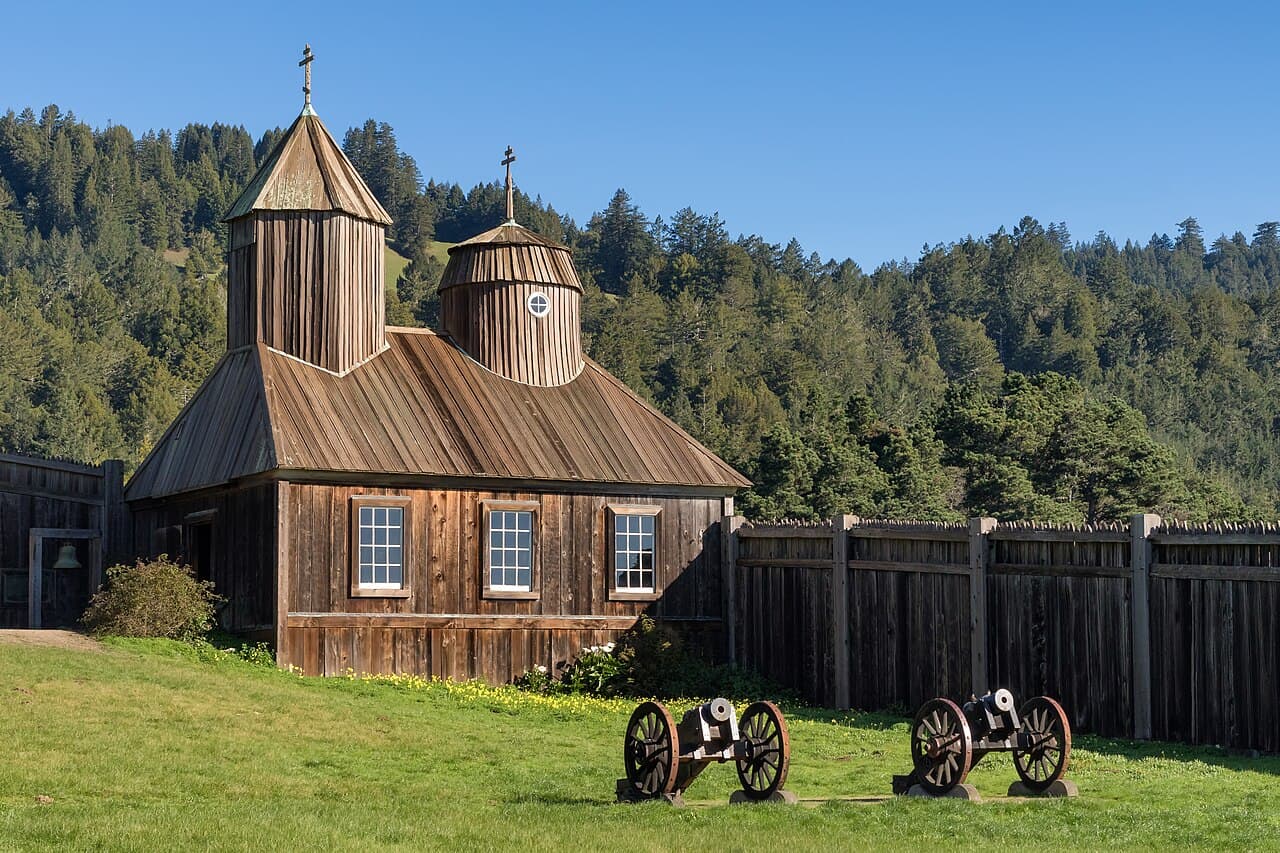
Fort Ross
Fort Ross stands as a significant 19th-century bastioned fortress located on the west coast of North America in what is now Sonoma County, California. Established by the Russian-American Company in 1812, it served as the southernmost outpost of Russian settlements in North America until 1841. Fort Ross was not only a military installation but also a vibrant multi-ethnic community that included Native Californians, Native Alaskans, Russians, Finns, and Swedes. This diverse population contributed to the unique cultural and social fabric of the fort, distinguishing it from other colonial settlements of the period.
Historical context and significance
The establishment of Fort Ross was part of Russia's broader strategy to expand its influence and trade networks along the Pacific coast during the early 19th century. The fort functioned as a key center for the fur trade, particularly sea otter pelts, which were highly valued in international markets. Its location was strategically chosen for access to the Pacific Ocean and proximity to indigenous communities, facilitating trade and resource extraction.
Fort Ross also played a diplomatic role, interacting with Spanish missions to the south and indigenous groups in the region. The fort's presence marked the northernmost extent of Spanish colonial influence, creating a complex frontier zone of competing interests among European powers and Native peoples.
Architectural features and fortifications
The fortress was constructed with bastioned defensive walls, characteristic of military architecture designed to withstand artillery attacks. Its layout included wooden palisades reinforced with earthworks and bastions at key points to provide overlapping fields of fire. The fort's design reflected contemporary European military engineering adapted to the materials and conditions of the California coast.
Within the fort's enclosure were residential buildings, storehouses, workshops, and a chapel, accommodating both military personnel and civilian settlers. The structures were primarily built from local timber, with some elements imported from Russian settlements in Alaska. The fort's buildings were arranged around a central courtyard, facilitating defense and communal activities.
Defensive layout
The bastioned walls formed a roughly quadrilateral shape, with bastions positioned at the corners to allow defenders to cover the adjacent walls with gunfire. This design was intended to eliminate blind spots and enhance the fort's defensive capabilities against potential attackers, including hostile indigenous groups or rival colonial forces.
Supporting infrastructure
Fort Ross included facilities for shipbuilding and repair, reflecting its role as a maritime hub. The nearby cove provided sheltered anchorage for vessels engaged in the fur trade and supply runs. Additionally, the fort maintained agricultural fields and livestock pens outside the walls to support its population, highlighting its semi-self-sufficient nature.
Multicultural community and daily life
The population of Fort Ross was notably diverse, comprising several ethnic groups who coexisted and collaborated. Native Californians, including the Kashia Pomo people, contributed local knowledge and labor, while Native Alaskans brought expertise in hunting and fur processing. Russian settlers provided administrative and military leadership, and European immigrants like Finns and Swedes added to the cultural mix.
Daily life at Fort Ross involved a combination of military duties, fur trading, agriculture, and craft production. The fort's inhabitants engaged in hunting, fishing, farming, and artisanal work such as blacksmithing and carpentry. Religious observances were conducted in the fort's chapel, reflecting the Orthodox Christian faith of the Russian settlers.
Decline and legacy
By the late 1830s, the fur trade declined due to overhunting and changing economic conditions, reducing Fort Ross's strategic importance. In 1841, the Russian-American Company sold the fort to John Sutter, a prominent California settler, marking the end of Russian presence in the region.
Today, Fort Ross is preserved as part of California's Fort Ross State Historic Park. It has been extensively studied through archaeological investigations that have uncovered artifacts illuminating the daily lives of its diverse inhabitants. The site is recognized as a California Historical Landmark, a National Historic Landmark, and is listed on the National Register of Historic Places.
Visitors to Fort Ross can explore the reconstructed bastioned walls, original building foundations, and interpretive exhibits that detail the fort's unique role in North American colonial history. The site offers insights into the cross-cultural interactions and military architecture of the early 19th century on the Pacific coast.
Frequently asked questions (FAQ)
- What is Fort Ross and why is it historically important?
- Fort Ross was a Russian fort and settlement established in 1812 in California. It served as the southernmost Russian outpost in North America and was a hub for the fur trade and multicultural community.
- Can I visit Fort Ross today?
- Yes, Fort Ross is part of California's Fort Ross State Historic Park and is open daily from 10:00 to 17:00. Visitors can explore reconstructed fortifications and historical exhibits.
- What architectural features define Fort Ross?
- Fort Ross features bastioned defensive walls typical of early 19th-century military architecture, including wooden palisades and earthworks arranged in a quadrilateral layout with corner bastions.
- Who lived at Fort Ross during its operation?
- The fort was home to a diverse population including Native Californians, Native Alaskans, Russians, Finns, and Swedes, reflecting its role as a multi-ethnic community.
- Why did Fort Ross decline and cease Russian operation?
- The decline of the fur trade in the late 1830s reduced the fort's economic viability, leading to its sale in 1841 to John Sutter and the end of Russian presence in California.
Photo gallery

Information
Opening hours
10:00-17:00, daily
Ticket prices
Free
Current owner
California Department of Parks and Recreation
Loading map...
Visitor reviews
No reviews yet. Been here? Write the first review and help other travelers!
Write the first reviewVisited this castle? Share your experience
Your review helps other travelers and adds first-hand knowledge to our encyclopedia.



