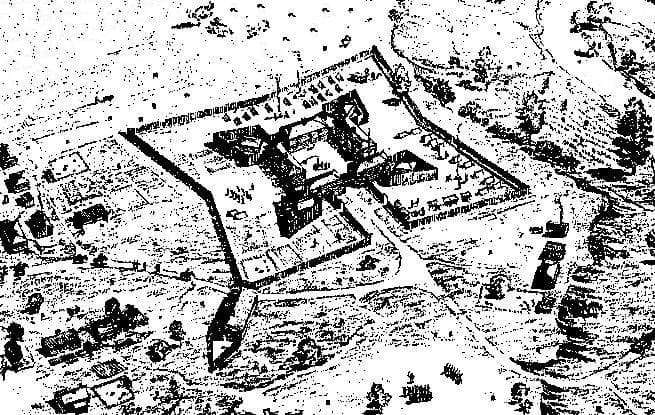
Fort Le Boeuf
Fort Le Bœuf, also known as Fort de la Rivière au Bœuf, was a significant bastioned fortress constructed by the French in 1753 during the post-Renaissance period. Located in what is now Waterford, Pennsylvania, the fort was strategically positioned on a fork of French Creek, part of the drainage basin of the Ohio River. This location was crucial for controlling access to the interior waterways of North America, which were vital for trade and military movements.
Strategic importance and location
The fort was situated approximately 15 miles (24 km) from Lake Erie on the banks of LeBoeuf Creek, from which it takes its name. This proximity to Lake Erie allowed the French to use the fort as a key point in a network of forts that included Fort Presque Isle, Fort Machault, and Fort Duquesne. Supplies and trade goods were transported from Lake Erie overland to Fort Le Bœuf, then by raft and canoe down French Creek to the Allegheny River, continuing to the Ohio River and eventually the Mississippi River. This route was essential for the French to maintain their influence and trade dominance in the Ohio Valley and beyond.
Architectural features and fortifications
Fort Le Bœuf was designed as a bastioned fortress, a style that emerged in the post-Renaissance era and was characterized by angular bastions projecting from the main walls to provide overlapping fields of fire against attackers. This design was influenced by the military engineering principles developed by Sébastien Le Prestre de Vauban, which emphasized strong defensive walls, low and thick ramparts, and bastions that eliminated blind spots.
The fort's layout included wooden palisades reinforced with earthworks, bastions at the corners, and a central courtyard. Within the fort were barracks, storehouses, and powder magazines, all arranged to support a garrison tasked with controlling the surrounding territory and protecting French trade routes.
Historical context and military significance
Constructed during a period of escalating tensions between the French and British empires in North America, Fort Le Bœuf played a pivotal role in the early stages of the French and Indian War (1754–1763). It was one of the first French forts built to assert control over the Ohio Country, a region contested by both colonial powers.
In 1753, a young George Washington was sent by the British colonial government of Virginia to deliver a message to the French at Fort Le Bœuf, demanding their withdrawal from the Ohio Valley. This diplomatic mission marked a significant prelude to the outbreak of hostilities. The fort was later captured by British forces in 1759 during their campaign to seize French territories in the region.
Legacy and present-day site
Today, the original site of Fort Le Bœuf is preserved as the Fort LeBoeuf Museum, operated by the Fort LeBoeuf Historical Society. The museum includes a reconstructed fort and exhibits that interpret the site's history, the French colonial presence, and the broader context of 18th-century North American conflicts.
The fort's remains and the museum serve as educational resources, illustrating the military architecture of the period and the strategic importance of the Ohio Valley in colonial North America. Visitors can explore the reconstructed bastions, palisades, and other features that reflect the fort's original design and function.
Fort Le Bœuf in the network of French colonial forts
Fort Le Bœuf was part of a defensive chain that secured French interests along key waterways. Its connection to Fort Presque Isle on Lake Erie, Fort Machault at the confluence of French Creek and the Allegheny River, and Fort Duquesne at the strategic forks of the Ohio River created a corridor that facilitated movement of troops and goods.
This network was vital for maintaining French control over the vast interior regions and for countering British expansion. The forts were equipped to withstand sieges and to project power into contested territories.
Trade and military logistics
The fort's location allowed the French to efficiently manage the transport of furs and other trade goods from the interior to markets accessible via the Great Lakes and the Mississippi River system. It also served as a staging ground for military expeditions aimed at defending French claims and disrupting British colonial advances.
Design adaptations to the frontier environment
Unlike European stone fortresses, Fort Le Bœuf was primarily constructed using timber and earthworks, materials readily available in the frontier environment. This choice reflected practical considerations such as speed of construction and the logistical challenges of transporting heavy materials over long distances.
Visiting Fort Le Bœuf today
The Fort LeBoeuf Museum offers visitors a chance to experience the history of this important colonial site. The museum features guided tours, educational programs, and reenactments that bring to life the daily life of soldiers and traders in the mid-18th century.
Visitors can walk the grounds to see the reconstructed bastioned walls, palisades, and other fortifications. The museum also provides insights into the broader geopolitical struggles between France and Britain that shaped the region's history.
Frequently asked questions (FAQ)
- When was Fort Le Bœuf built and by whom?
- Fort Le Bœuf was built in 1753 by the French as part of their efforts to control the Ohio Valley during the colonial period.
- What was the strategic importance of Fort Le Bœuf?
- The fort was strategically located near Lake Erie to control trade routes and military access to the Ohio River and beyond.
- Can visitors tour the Fort Le Bœuf site today?
- Yes, the Fort LeBoeuf Museum operates on the original site and offers tours, educational programs, and historical reenactments.
- What architectural style characterizes Fort Le Bœuf?
- Fort Le Bœuf is a bastioned fortress featuring wooden palisades and earthworks typical of post-Renaissance military engineering.
- How is Fort Le Bœuf connected to other French forts?
- It was part of a network including Fort Presque Isle, Fort Machault, and Fort Duquesne, securing French control over key waterways.
Photo gallery

Photo by Charles M. Stotz ?•Public domain
Information
Current owner
Fort LeBoeuf Historical Society
Loading map...
Visitor reviews
No reviews yet. Been here? Write the first review and help other travelers!
Write the first reviewVisited this castle? Share your experience
Your review helps other travelers and adds first-hand knowledge to our encyclopedia.


