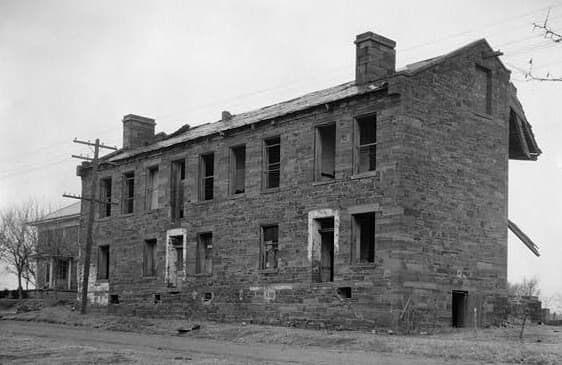
Fort Gibson
Fort Gibson is a significant historic military fortification located near the modern city of Fort Gibson in Muskogee County, Oklahoma. Established in 1824, it was constructed as a strategic bastioned fortress to guard the western frontier of the United States during a period of rapid expansion and settlement. At the time of its founding, Fort Gibson was the westernmost military post in the country, playing a crucial role in securing the southwestern border of the Louisiana Purchase.
Historical context and strategic importance
The fort was part of a larger network of military installations forming a north–south chain of forts designed to maintain peace on the volatile frontier of the American West. This chain was essential in enforcing U.S. policies and protecting settlers and Native American tribes during a time of frequent conflict and territorial disputes. Fort Gibson’s primary mission was to serve as a peacekeeping post in the Indian Territory, where tensions between Native American tribes, settlers, and the U.S. government were high.
Remarkably, Fort Gibson fulfilled its peacekeeping role for over six decades, from its establishment in 1824 until its decommissioning in 1888, without any recorded massacres or battles occurring on its grounds. This peaceful record is notable given the turbulent history of the American frontier during the 19th century.
Architectural features and military design
Fort Gibson was designed as a bastioned fortress, a style characterized by angular bastions projecting outward from the main walls, allowing defenders to cover adjacent walls with gunfire and eliminate blind spots. This design was common in military architecture of the period, providing enhanced defensive capabilities against potential attacks.
The fort complex included several key structures typical of military forts of the era, such as barracks, officers’ quarters, storehouses, stables, and parade grounds. The buildings were primarily constructed from wood and locally sourced materials, reflecting the practical constraints of frontier construction. Defensive features included and wooden palisades, supplemented by the bastions which allowed for a robust defense.
Layout and fortifications
The layout of Fort Gibson was planned to optimize both defense and daily military operations. The bastions were positioned at the corners of the fort’s perimeter, providing overlapping fields of fire. The interior was organized around a central parade ground, which served as a space for drills, ceremonies, and gatherings.
Additional defensive measures included a moat and earthen ramparts, which enhanced the fort's ability to withstand sieges or attacks. The fort’s location near the confluence of the Grand and Arkansas Rivers also provided a natural defensive advantage and access to vital transportation routes.
Role in American frontier history
Fort Gibson played a pivotal role in the enforcement of U.S. Indian policy during the 19th century. It served as a base for military operations aimed at managing relations with various Native American tribes forcibly relocated to the Indian Territory, including the Cherokee, Creek, Seminole, Chickasaw, and Choctaw nations.
The fort also functioned as a supply and communication hub, supporting other military posts in the region and facilitating the movement of troops and goods across the frontier. Its presence helped to stabilize the area during periods of conflict and transition, including the Civil War, when it was occupied by both Union and Confederate forces at different times.
Civil War significance
During the American Civil War, Fort Gibson was strategically important due to its location in Indian Territory. It changed hands between Union and Confederate forces, reflecting the divided loyalties of the Native American tribes and settlers in the region. The fort was the site of several skirmishes, but no major battles took place within its walls.
Preservation and current status
Today, Fort Gibson is preserved as the Fort Gibson Historical Site, managed by the Oklahoma Historical Society. It has been designated a National Historic Landmark in recognition of its historical and cultural significance. The site includes reconstructed buildings and exhibits that interpret the fort’s history and its role in frontier military strategy.
Visitors to the site can explore the fort’s layout, learn about the daily lives of soldiers stationed there, and understand the complex interactions between the U.S. military and Native American tribes during the 19th century. The preservation efforts aim to maintain the fort’s structural integrity and provide educational opportunities about this important chapter in American history.
Visitor information
The Fort Gibson Historical Site offers guided tours, reenactments, and educational programs that highlight the fort’s architecture and historical context. The site is open seasonally, with hours varying throughout the year. Visitors are encouraged to check with the Oklahoma Historical Society for current visiting hours and ticket information.
Frequently asked questions (FAQ)
- When was Fort Gibson built and what was its purpose?
- Fort Gibson was built in 1824 as a bastioned fortress to protect the western frontier of the United States and maintain peace in Indian Territory.
- What architectural style characterizes Fort Gibson?
- Fort Gibson is designed as a bastioned fortress, featuring angular bastions for enhanced defense, common in 19th-century military architecture.
- Is Fort Gibson open to the public for visits?
- Yes, Fort Gibson is managed by the Oklahoma Historical Society and is open to visitors with guided tours and educational programs.
- Did any battles occur at Fort Gibson?
- No major battles or massacres occurred at Fort Gibson during its active years, despite its strategic frontier location.
- What role did Fort Gibson play during the Civil War?
- During the Civil War, Fort Gibson was occupied by both Union and Confederate forces and was the site of minor skirmishes reflecting regional divided loyalties.
Photo gallery

Photo by Fred Q. Casler, Photographer•Public domain
Information
Current owner
Oklahoma Historical Society
Loading map...
Visitor reviews
No reviews yet. Been here? Write the first review and help other travelers!
Write the first reviewVisited this castle? Share your experience
Your review helps other travelers and adds first-hand knowledge to our encyclopedia.


