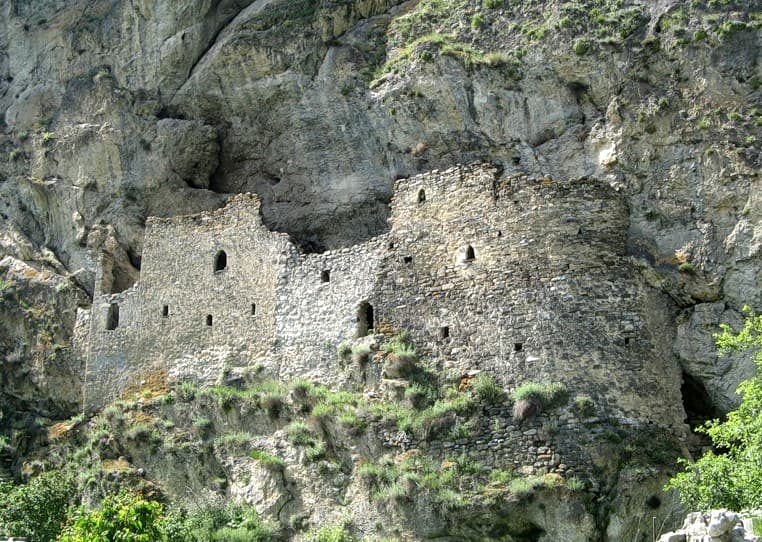
Dzivgis Cave Fortress
Dzivgis Cave Fortress stands as a remarkable example of ancient defensive architecture uniquely integrated into the natural landscape of North Ossetia–Alania Republic, Russia. Nestled within the Kurtatin Gorge near the village of Dzivgis, this hill castle utilizes the rugged limestone cliffs and natural caves to form a fortified complex that served both military and residential purposes. The fortress's origins trace back to a period before the 16th century, although exact construction dates remain elusive, highlighting the long-standing strategic importance of this site in the Caucasus region.
Historical significance and strategic role
The fortress was built by local communities inhabiting the Kurtatin Gorge, capitalizing on the natural terrain's defensive advantages. Its location on steep, rocky slopes provided a formidable barrier against invading forces. Local tradition credits Dzivgis Cave Fortress with playing a pivotal role during the early 17th century when the forces of Shah Abbas I of Persia attempted to penetrate the gorge. The defenders' successful resistance forced the Persian army to retreat, underscoring the fortress's military effectiveness.
In the early 20th century, the fortress was documented by researchers including Esaul F. S. Pankratov, who contributed valuable records under the pseudonym Grebenets. These early studies preserved knowledge of Dzivgis during a time when the surrounding population was diminishing, ensuring its historical legacy endured despite the fortress's gradual abandonment.
Architectural features and construction
Integration with natural caves
The fortress comprises six primary cave dwellings carved into natural limestone cavities formed by millennia of water and wind erosion. These dwellings, or residential towers, vary in size and could shelter up to one hundred inhabitants each. The builders skillfully enhanced the natural caves with stone walls made from local materials and durable mortar, creating fortified living spaces that blend seamlessly with the surrounding rock formations of the mountain known as Kariukhok.
Defensive design and layout
The fortress is arranged across different elevations but remains largely on a single plane, with movement between towers facilitated by rock-carved pathways and suspended ladders. These ladders could be retracted during attacks, isolating each tower as an independent stronghold and strengthening the overall defense. This multi-tiered fallback system allowed defenders to resist sieges effectively.
The main fortification is situated at the lowest level of the complex and is accessed via a stone staircase, remnants of which survive today. This principal tower extends into a deep limestone niche approximately 65 meters above the gorge base, ending in a dead end that enhanced its defensibility by limiting access points.
Current condition and preservation
Today, Dzivgis Cave Fortress remains partially preserved. Several sections retain their original stonework, including walls and staircases, while other areas show signs of natural decay and overgrowth. Dense vegetation covers much of the fortress, further camouflaging its man-made structures within the natural environment. Despite its partial ruinous state, the fortress continues to offer valuable insights into the adaptive use of natural caves for fortified residential purposes in mountainous regions.
Architectural and cultural importance
Dzivgis Cave Fortress exemplifies a rare form of rock castle architecture, where natural geological features are transformed into defensible living quarters. This approach reflects the ingenuity of the local communities in utilizing their environment for protection and habitation. The fortress's enduring presence highlights the historical resilience of the region's inhabitants and their strategic responses to external threats over several centuries.
Its unique combination of natural and man-made elements offers scholars and visitors a tangible connection to the early defensive systems of the Caucasus. The site remains a significant cultural landmark within North Ossetia, symbolizing both the historical challenges and architectural innovation of the area.
Visiting Dzivgis Cave Fortress
While Dzivgis Cave Fortress is not a heavily commercialized tourist destination, it attracts visitors interested in history, architecture, and nature. The fortress's remote location and rugged terrain require careful planning for access, typically involving hiking through the Kurtatin Gorge. Visitors can explore the remaining cave dwellings, pathways, and fortifications, gaining a firsthand experience of this ancient defensive complex.
Preservation efforts are limited, so visitors should exercise caution when navigating the site. The fortress's integration with the natural landscape offers a striking visual experience, particularly for those fascinated by the intersection of human ingenuity and natural formations.
Frequently asked questions (FAQ)
- How do I get to Dzivgis Cave Fortress?
- Dzivgis Cave Fortress is located near the village of Dzivgis in North Ossetia–Alania Republic, Russia. Access typically requires hiking through the Kurtatin Gorge, so visitors should be prepared for rugged terrain and plan accordingly.
- What is the historical significance of Dzivgis Cave Fortress?
- The fortress played a crucial role in regional defense, notably resisting the forces of Shah Abbas I of Persia in the early 17th century. It exemplifies the strategic use of natural caves for military and residential purposes in the Caucasus.
- Can I explore the cave dwellings at Dzivgis Cave Fortress?
- Yes, visitors can explore the six cave dwellings carved into limestone formations. However, the site is partially preserved and involves navigating uneven pathways, so caution is advised.
- When was Dzivgis Cave Fortress built?
- The fortress dates back to before the 16th century, though exact construction dates are unclear due to its organic development and use of natural caves.
- Is Dzivgis Cave Fortress suitable for family visits?
- Due to its rugged location and uneven terrain, the fortress is better suited for visitors with some hiking experience. Families with young children should consider safety and accessibility before visiting.
Photo gallery

Photo by Ahsartag•Public domain
Information
Loading map...
Visitor reviews
No reviews yet. Been here? Write the first review and help other travelers!
Write the first reviewVisited this castle? Share your experience
Your review helps other travelers and adds first-hand knowledge to our encyclopedia.



