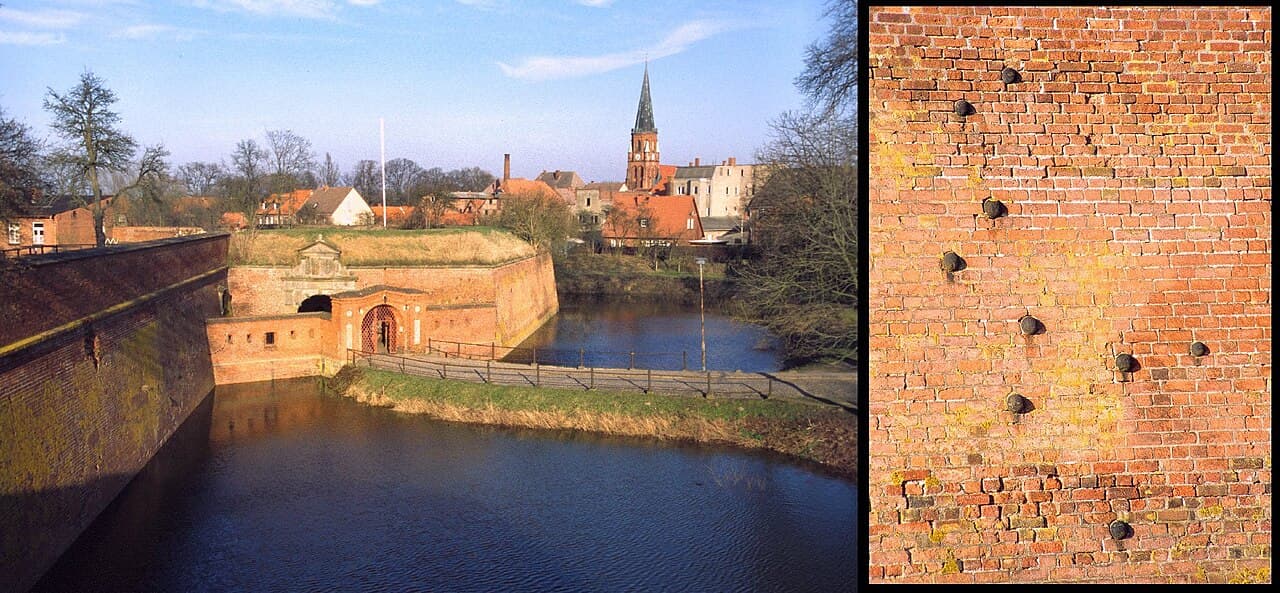
Domitz Fortress
Domitz Fortress stands as a remarkable example of a 16th-century Renaissance star fort, strategically located in Domitz, Germany. Constructed between 1559 and 1565 under the commission of John Albert I, Duke of Mecklenburg-Güstrow, it was designed to secure the southwestern border of the Duchy of Mecklenburg and to control the crucial Elbe River crossings. This pentagon-shaped flatland fortress is among the few well-preserved military fortifications of its kind in Northern Europe, showcasing the advanced defensive architectural principles of the Renaissance period.
Historical context and strategic significance
The fortress was built during a time of shifting political and military tensions in the Holy Roman Empire. The mid-16th century saw increasing threats from neighboring states and the need to protect territorial borders. John Albert I recognized the importance of controlling the Elbe River, a vital trade and military route, and established Domitz Fortress as both a defensive stronghold and a customs point where duties could be levied on river traffic.
Its location on the flatlands near the Elbe was carefully chosen to maximize control over the border region and to serve as a deterrent against incursions. The fortress's robust construction and star-shaped design reflected contemporary military engineering advances aimed at resisting artillery fire and improving defensive coverage.
Architectural design and features
Renaissance star fort layout
Domitz Fortress exemplifies the Renaissance military architectural style known as the star fort or trace italienne, characterized by angled bastions projecting from the main walls to eliminate blind spots and allow overlapping fields of fire. Its pentagonal shape includes five bastions, each equipped to mount artillery and defend the curtain walls between them.
The fortress was designed by Francesco a Bornau, an Italian architect, whose expertise in fortification design brought the latest Italian innovations to Mecklenburg. The thick earthen ramparts absorbed cannon fire, while the low, angled walls reduced the chance of damage from direct hits.
Internal structures and facilities
Inside the fortress, the layout included casemates—vaulted chambers within the walls used for storage and troop accommodation—as well as a gunpowder magazine for safely storing munitions. The commander’s house served as the administrative center and residence for the fortress's commanding officer.
From the ramparts, visitors today can gain panoramic views of the entire complex and the surrounding landscape, appreciating the strategic placement and thoughtful design of the fortification.
Military history and later uses
Domitz Fortress played an active role in several significant conflicts, including the Thirty Years' War (1618–1648) and the Napoleonic Wars in the early 19th century. Throughout these turbulent periods, the fortress served as a defensive bastion guarding Mecklenburg's borders.
By the 18th century, the military importance of the fortress diminished, and it was repurposed as a prison. One of its most notable prisoners was the Mecklenburg author Fritz Reuter, who was incarcerated here during the 19th century. This transition from military fortification to penal institution reflects broader changes in military technology and political stability in the region.
Preservation and museum status
Remarkably, Domitz Fortress has survived the centuries largely intact, avoiding significant damage or destruction. In 1894, it was officially decommissioned as a military installation. Since 1953, the fortress has been operated as a museum, offering visitors a chance to explore its extensive fortifications and learn about its history.
In 1975, the fortress was declared a protected monument, ensuring its preservation for future generations. Today, many parts of the fortress, including the ramparts, casemates, gunpowder magazine, and commander’s house, are accessible to the public. Exhibitions detail the fortress's military history, its role in regional trade and defense, and the lives of its prisoners.
Visitor experience and cultural significance
Visitors to Domitz Fortress can immerse themselves in the atmosphere of a Renaissance military stronghold. Walking along the fortified walls provides a tangible sense of the defensive strategies employed during its active years. The casemates offer a glimpse into the harsh conditions endured by prisoners, while the museum exhibits enrich understanding of the fortress’s multifaceted history.
The fortress remains a significant cultural landmark in Mecklenburg, symbolizing the region's historical resilience and architectural heritage. Its preservation as one of Northern Europe's best-maintained 16th-century flatland forts makes it a unique destination for those interested in military architecture, Renaissance history, and German heritage.
Frequently asked questions (FAQ)
- How do I visit Domitz Fortress?
- Domitz Fortress is open to visitors with accessible pathways along the ramparts and interior areas. It is advisable to check the official museum website for current opening hours and guided tour availability.
- What is the historical significance of Domitz Fortress?
- Domitz Fortress was built in the mid-16th century to protect Mecklenburg's southwestern border and control the Elbe River crossings. It played roles in the Thirty Years' War and Napoleonic Wars, reflecting Renaissance military architecture.
- Can I explore the interior of the fortress?
- Yes, visitors can explore many parts of Domitz Fortress including the casemates, gunpowder magazine, and commander’s house, which feature exhibitions on the fortress's history and its prisoners.
- When was Domitz Fortress built?
- The fortress was constructed between 1559 and 1565 by order of John Albert I, Duke of Mecklenburg-Güstrow.
- Why is Domitz Fortress considered architecturally important?
- Domitz Fortress is a well-preserved example of a Renaissance star fort designed by Italian architect Francesco a Bornau, showcasing advanced fortification techniques of the 16th century.
Photo gallery

Information
Sources & official resources
Verify the information above using these authoritative references.
Loading map...
Visitor reviews
No reviews yet. Been here? Write the first review and help other travelers!
Write the first reviewVisited this castle? Share your experience
Your review helps other travelers and adds first-hand knowledge to our encyclopedia.


