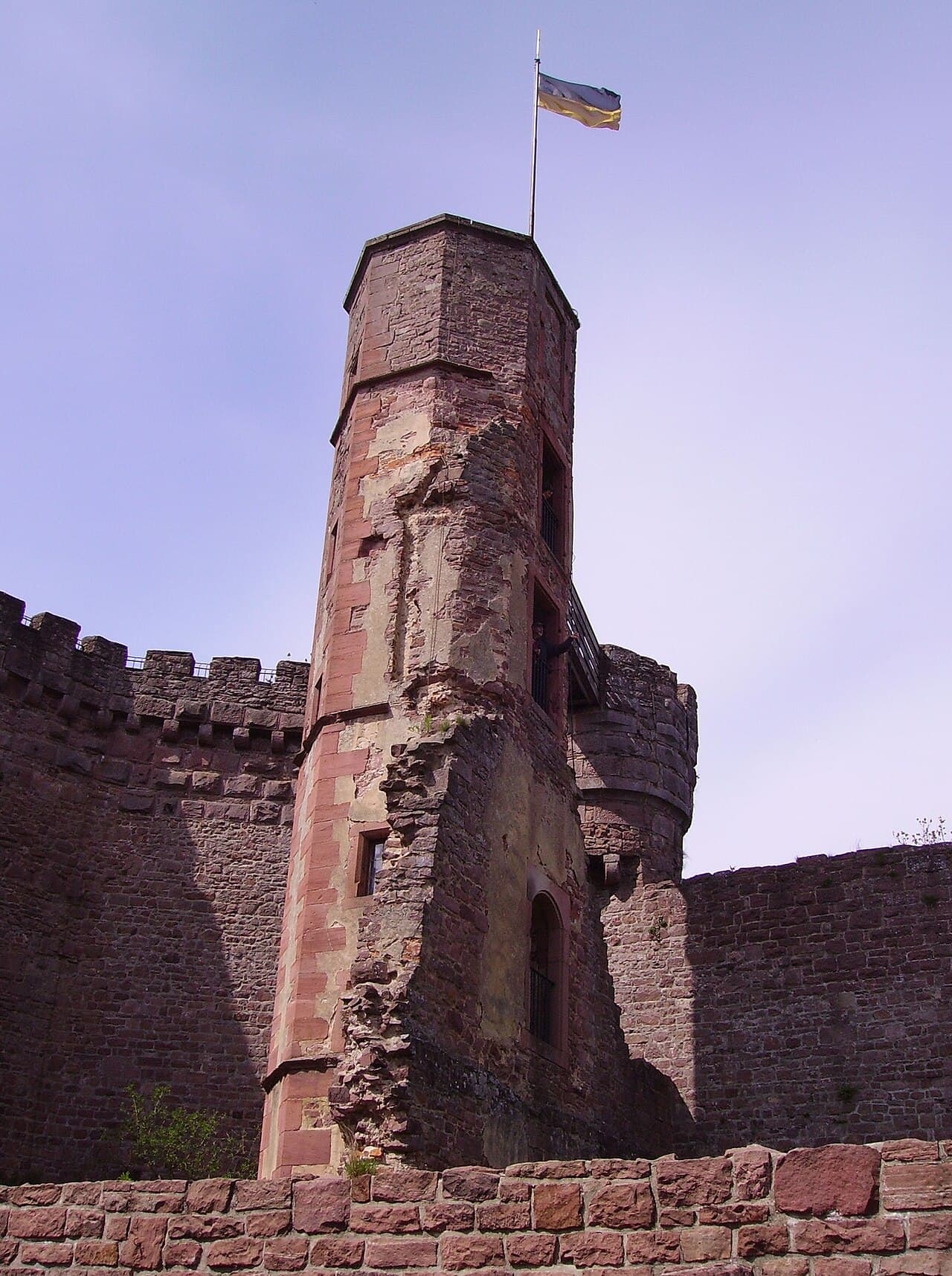
Dilsberg Castle
Dilsberg Castle stands prominently on a hill above the River Neckar in Germany, embodying a rich history that dates back to the 12th century. Constructed originally by the Counts of Lauffen, this hill castle exemplifies the strategic and architectural developments of the High Medieval period. Its commanding position provided both defensive advantages and territorial control east of Heidelberg, making it a significant stronghold in the region.
Early history and construction
The initial construction phase of Dilsberg Castle likely began between 1150 and 1200, starting as a residential tower that marked the Counts of Lauffen's influence. The earliest documented reference to the fortress dates from 1208, associating it with Boppo von Lauffen, who inherited it from his brother Konrad. Throughout the 13th century, the fortress served as a symbol of power amidst competing regional forces, including the Electorate of the Palatinate based in nearby Heidelberg.
Following the extinction of the male line of the Counts of Lauffen, the castle passed to the Counts of Dürn, who adopted the title Counts of Dilsberg from 1252. Around 1300, the castle became part of the Electorate of the Palatinate, which initiated significant expansions and fortifications from the 1330s onward, enhancing its defensive and residential structures.
Medieval expansion and town rights
In 1347, the settlement at Dilsberg was granted town rights, reflecting its growing importance as a fortified community. The town walls formed a protective hilltop crown (Bergkrone) around the outer bailey and the settlement, integrating the castle's defenses with the town's fortifications. The Electorate of the Palatinate required the townspeople to maintain the castle garrison and support the court entourage during peace and wartime, underscoring the castle's role as a regional power center.
Fortress architecture and layout
Dilsberg Castle's layout is characterized by a classic two-part design: an outer bailey (Vorburg) and an inner bailey (Hauptburg). The outer bailey once housed key buildings such as the Invalidenkaserne (now a garden), a tithe barn, stables with a granary, and the Commandant's House, dating from around 1550. This house has survived demolition and now functions as a cultural center.
Access to the inner bailey was secured by two flanking towers guarding the gateway. The inner bailey was enclosed by a ring wall originally up to 16 meters high, although parts have been lost over time. Within this enclosure stood a prominent five-story palas, demolished in 1794, with only its vaulted cellar, known as the Witch's Cellar (Hexenkeller), remaining. This cellar later served as a student detention room (Karzer) for Heidelberg University and a military prison.
One of the castle's most distinctive architectural features is the octagonal sandstone stair tower, approximately 19 meters tall and divided into four levels. It contains a spiral staircase with 95 steps leading to an observation platform about 18 meters above ground. This tower connects to the curtain wall, which rises to approximately 16 meters, offering expansive views over the town and the Neckar valley.
The castle's well is a remarkable engineering achievement, plunging some 46 meters deep. Initially dug to about 21.5 meters around 1150, it was deepened and widened between 1650 and 1680 to support a larger garrison. The well's water was reserved exclusively for the castle inhabitants, while villagers sourced water elsewhere.
Additionally, an underground tunnel known as the Burgstollen extends roughly 78 meters into the hill. Carved following natural rock fissures, it was intended to connect the castle to the well shaft but missed its target, making it longer than planned. The tunnel likely served ventilation purposes rather than as a secret escape route. Filled in after disuse, it became the subject of local legends, including a supposed secret passage beneath the Neckar River, famously mentioned by Mark Twain in "A Tramp Abroad."
Military history and sieges
Dilsberg Castle's military history is marked by resilience and strategic significance. During the Thirty Years' War, it was considered nearly impregnable until Imperial forces under Johann T’Serclaes von Tilly captured it in 1622 after a prolonged siege. The castle changed hands multiple times during the conflict, with Swedish troops retaking it in 1633 and Imperial forces reclaiming it in 1635. Despite these turbulent events, the fortress was never taken by direct storming nor completely destroyed, underscoring its robust fortifications.
In 1799, French forces attempted to storm the castle but failed, aided by the defenders' access to water from the deep well. The castle's defensive design and natural resources contributed significantly to its endurance against sieges.
Religious and penal uses
Beyond its military role, Dilsberg Castle also functioned as a place of religious imprisonment. In 1572, it detained Matthias Vehe-Glirius and Jacob Suter, Unitarians persecuted for their non-Trinitarian beliefs, reflecting the castle's role in enforcing religious orthodoxy during the Reformation.
After the dissolution of the Electorate of the Palatinate in 1803, the fortress became part of Baden and was repurposed as a state prison. By 1822, it was abandoned and slated for demolition, with its stones quarried for local construction.
Modern preservation and cultural significance
Interest in Dilsberg Castle revived in the late 19th and early 20th centuries through archaeological efforts. Notable discoveries included an approximately 80-meter underground tunnel unearthed by Fritz von Briesen in 1896 and the well shaft exposed in 1926. These findings contributed to a greater understanding of the castle's complex structure and history.
Today, the castle is managed by the Staatliche Schlösser und Gärten Baden-Württemberg and serves as a popular tourist attraction. Its combination of ruins and restored elements offers visitors a tangible connection to the medieval past and the region's historical heritage. The castle's cultural center, housed in the preserved Commandant's House, hosts various events, further enriching its role within the community.
Dilsberg Castle remains a testament to medieval military architecture, regional power dynamics, and the enduring legacy of the High Middle Ages in Germany.
Frequently asked questions (FAQ)
- How do I get to Dilsberg Castle?
- Dilsberg Castle is located in the town of Dilsberg in Baden-Württemberg, Germany. It can be reached by car or local public transport from nearby Heidelberg. The castle sits on a hill, so visitors should be prepared for a short uphill walk from the town center.
- What are the opening hours for visiting Dilsberg Castle?
- The castle grounds are generally open to the public year-round during daylight hours. Specific buildings or exhibitions may have limited opening times, so it is advisable to check with the Staatliche Schlösser und Gärten Baden-Württemberg for current visitor information.
- Is Dilsberg Castle wheelchair accessible?
- Due to its hilltop location and medieval structure, Dilsberg Castle has limited wheelchair accessibility. Visitors with mobility issues should contact the management in advance to discuss possible accommodations.
- What is the historical significance of Dilsberg Castle?
- Dilsberg Castle is a significant example of a High Medieval hilltop fortress with a rich military history, including sieges during the Thirty Years' War. It also reflects the political and religious history of the Electorate of the Palatinate region.
- Can I visit the underground tunnel at Dilsberg Castle?
- The underground tunnel, known as the Burgstollen, is not generally open to the public due to safety concerns. However, guided tours or special events may occasionally provide access. Visitors should inquire locally for availability.
Photo gallery

Photo by Immanuel Giel•Public domain
Information
Sources & official resources
Verify the information above using these authoritative references.
Loading map...
Visitor reviews
No reviews yet. Been here? Write the first review and help other travelers!
Write the first reviewVisited this castle? Share your experience
Your review helps other travelers and adds first-hand knowledge to our encyclopedia.


