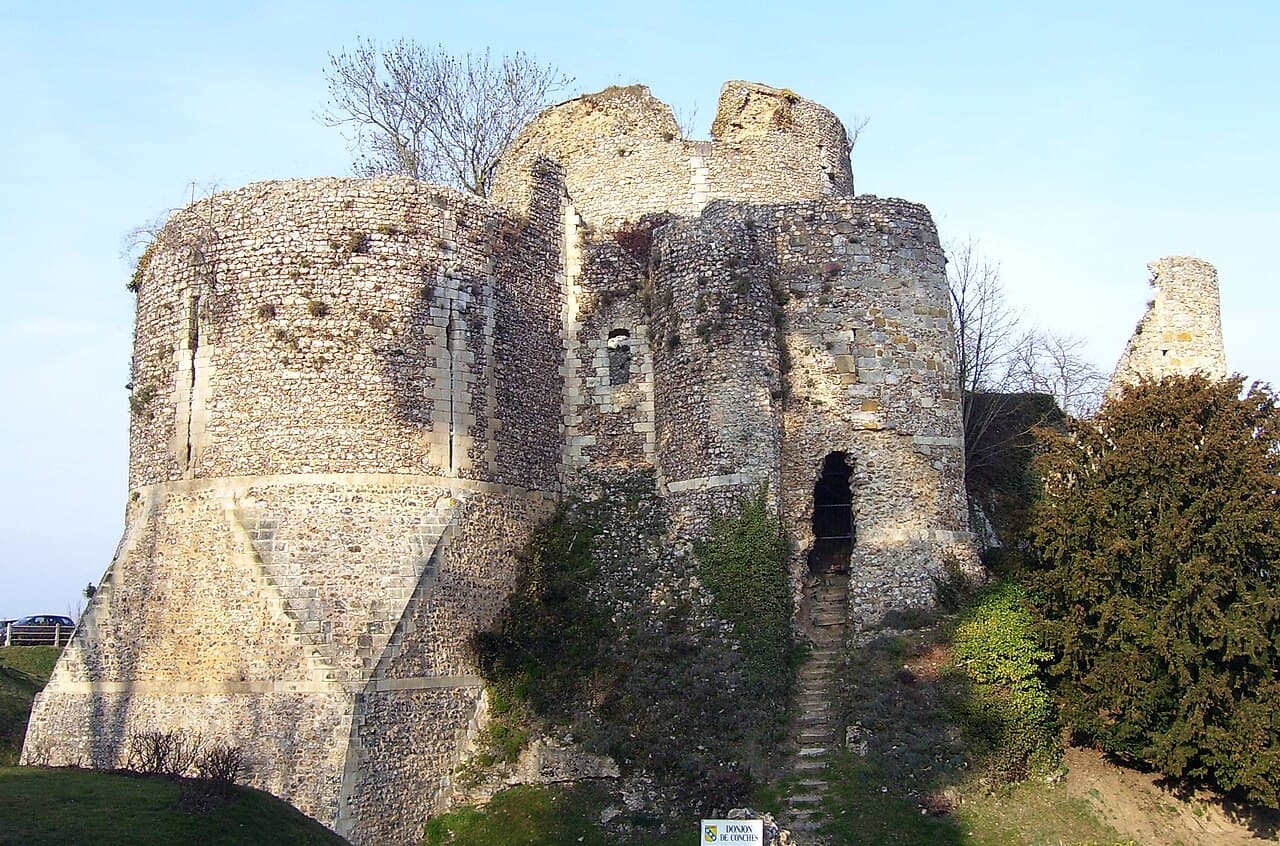
Conches-en-Ouche Castle
Conches-en-Ouche Castle, also known locally as the Château de Conches-en-Ouche or Donjon de Conches-en-Ouche, is a significant high medieval fortress ruin located in the town of Conches-en-Ouche in the Eure department of Normandy, France. Founded in 1034 by the Norman nobleman Roger I of Tosny, the castle has witnessed centuries of military, political, and religious upheaval, reflecting the turbulent history of Normandy and France.
Perched strategically atop a motte on the edge of a ridge overlooking the Rouloir valley and the town, the castle was originally constructed as a formidable hill castle designed to control the surrounding region. Its cylindrical donjon (keep), surrounded by a chemise or low curtain wall reinforced with semicircular towers, was a pioneering defensive design attributed to Roger VI de Tosny around 1175. This architectural innovation anticipated later developments seen in castles such as Château-Gaillard.
Founding and early history
The castle's origins trace back to the early 11th century when Roger I of Tosny, a Norman lord known for his participation in the Iberian Reconquista, established the fortress in 1034. At the time, the site was known by its Latin name Castellio, indicating its role as a defensive stronghold.
Throughout the 12th century, the castle remained under the control of the Tosny family, who enhanced its fortifications and maintained its strategic importance in Normandy.
Expansion under royal authority
In 1199, the castle was seized by Philip II of France (Philip Augustus), marking a shift from Norman noble control to direct royal authority. In 1202, Philip entrusted the castle to his cousin Robert of Courtenay, Lord of Champignelles, who undertook significant expansions. Robert added flanking towers to the outer enclosure, strengthening the castle's defenses in line with evolving military architecture of the period.
Robert’s enhancements included the addition of a strong round tower on a square base, known as the Capital Tower, which served as a second keep and was constructed in 1363.
Role during the hundred years' war
The castle played a pivotal role during the Hundred Years' War between England and France, frequently changing hands due to its strategic location. By the 14th century, the lordship of Conches was held by the House of Artois, notably Robert III of Artois, whose political actions contributed to the outbreak of the war.
In 1354, following the Treaty of Mantes, the castle was granted by John II of France to Charles II of Navarre, who delegated control to Jean III de Grailly and subsequently to his uncle Archambaud. The castle endured a raid in 1356 by Henry of Grosmont, 1st Duke of Lancaster.
In January 1371, the fortress was besieged by the French commander Bertrand du Guesclin due to Jean III de Grailly’s allegiance to the English. The siege ended with the surrender and evacuation of Navarrese forces, sparing the castle from destruction during subsequent French conquests.
Later, the castle was captured by Henry V of England in 1420. It was retaken by the French in 1440, lost again to the English in 1441, and finally reclaimed by the French in 1449 under Robert de Flocques, bailiff of Évreux.
The castle during the french wars of religion and decline
In 1591, during the French Wars of Religion, the castle served as a refuge for members of the Catholic League. Recognizing its potential as a base for enemies of the monarchy, the castle was deliberately slighted—partially demolished—to prevent future military use against the French Crown.
Architectural features and remains
The castle originally featured a round keep rising at least three stories high, situated on the motte. The keep was encircled by a curtain wall with several flanking towers and the notable Capital Tower on a square base, added in the 14th century as a secondary stronghold.
The outer enclosure’s main surviving element is the gate building, which provided access from the town. The castle’s defensive layout included a bailey and a parish enclosure with a church, indicating the integration of religious and domestic functions within its walls.
Today, the ruined outer enclosure is accessible to the public and houses municipal buildings such as a library and the town hall. The surrounding grounds have been landscaped into a small public park, inviting visitors to explore the historic site.
The inner keep remains closed to the public due to safety concerns over falling masonry, but its imposing ruins still testify to the castle’s former grandeur and military significance.
Preservation and cultural significance
The castle was officially classified as a monument historique by the French Ministry of Culture in 1886, recognizing its heritage value. Further protection was granted in 1940 to the historic garden and entrance gate as part of a classified site.
Restoration efforts led by volunteers between 2007 and 2016 focused on stabilizing the ramparts and donjon ruins, ensuring the survival of this important medieval monument for future generations.
Today, Conches-en-Ouche Castle stands as a remarkable example of Norman military architecture and medieval fortification design. Its layered history from the early 11th century through the Hundred Years' War and the French Wars of Religion makes it a valuable cultural landmark in Normandy.
Frequently asked questions (FAQ)
- What is the historical significance of Conches-en-Ouche Castle?
- Conches-en-Ouche Castle, located in the Normandy region of France, dates back to the 12th century and played a crucial role during the medieval period. It has witnessed various historical events, including conflicts during the Hundred Years' War, making it a significant monument in French history.
- When was Conches-en-Ouche Castle built?
- The construction of Conches-en-Ouche Castle began in the 12th century, with modifications and expansions occurring in subsequent centuries. Its architecture reflects the styles of different eras, showcasing the evolution of medieval fortifications.
- Can I visit Conches-en-Ouche Castle?
- Yes, visitors are welcome to explore Conches-en-Ouche Castle. Guided tours are available, allowing guests to learn about its rich history and architectural features while enjoying the scenic surroundings.
- What are the opening hours of Conches-en-Ouche Castle?
- Conches-en-Ouche Castle is typically open to visitors from 10 AM to 6 PM, but it is advisable to check the official website for seasonal variations and special events. During peak tourist season, extended hours may be offered.
- Is it possible to access Conches-en-Ouche Castle with mobility issues?
- The castle has made efforts to improve accessibility for visitors with mobility challenges. While some areas may still present difficulties due to the historical nature of the site, staff is available to assist and provide information on accessible routes.
- What is the best time to visit Conches-en-Ouche Castle?
- The best time to visit Conches-en-Ouche Castle is during the spring and early autumn when the weather is pleasant, and the gardens are in full bloom. These seasons also tend to have fewer crowds, allowing for a more enjoyable experience.
- Are there nearby attractions to visit when in Conches-en-Ouche?
- Yes, there are several nearby attractions, including the charming medieval town of Conches-en-Ouche itself, with its picturesque streets and local shops. Additionally, visitors can explore other historical sites and natural parks in the surrounding Normandy region.
- What are the ticket prices for Conches-en-Ouche Castle?
- Ticket prices for Conches-en-Ouche Castle vary depending on age and the type of tour selected. Generally, adult tickets are priced around €8, while discounts are available for students and children, making it an affordable option for families.
Photo gallery

Information
Sources & official resources
Verify the information above using these authoritative references.
Loading map...
Visitor reviews
No reviews yet. Been here? Write the first review and help other travelers!
Write the first reviewVisited this castle? Share your experience
Your review helps other travelers and adds first-hand knowledge to our encyclopedia.


