
Château de Noirmoutier
Château de Noirmoutier stands as a remarkable example of 12th-century medieval military architecture on the island of Noirmoutier, located in the Vendée département of France. This well-preserved fortress dominates the town of Noirmoutier-en-l'Île with its imposing nearly 20-meter-high rectangular keep, a symbol of feudal power and defensive ingenuity. The castle's origins trace back to a fortified castrum established in 830 by Abbot Hilbold of the Saint-Philbert monastery, built to protect the island's inhabitants and monks from Viking raids. Over the centuries, Château de Noirmoutier evolved from a wooden stronghold into a formidable stone fortress, reflecting the shifting military and political landscape of medieval France.
Early history and construction
The initial fortification on the site was a simple castrum, constructed in the early 9th century as a defensive refuge. By the 12th century, the need for a stronger, more permanent structure led the feudal lords of the region, particularly the barons of La Garnache, to rebuild the castle in stone. The central donjon or keep was commissioned by Pierre IV of La Garnache, who established the core of the castle that still stands today. This keep, built of coarse rubble stone, is a solid rectangular tower with three floors, including the lord's residence on the top level. It features numerous murder holes and defensive turrets at its corners, designed to provide overlapping fields of fire and protect the castle's defenders.
Fortifications and layout
Surrounding the keep is a roughly rectangular curtain wall or enceinte, approximately 100 meters long and 50 meters wide, enclosing the lower courtyard. This wall is reinforced with two main towers and two smaller watch turrets called échauguettes positioned at the corners, offering elevated observation points and defensive positions for archers. The wall includes a single main gate, which historically would have been heavily fortified to withstand sieges.
The castle's defensive design also incorporates a chemin de ronde, a raised walkway along the curtain wall that allowed defenders to patrol and defend the perimeter effectively. The moat surrounding the castle, now filled with grass rather than water, added an extra layer of defense by hindering direct assaults on the walls.
Historical significance and military engagements
Throughout its history, Château de Noirmoutier played a crucial role in regional defense and witnessed numerous military confrontations. The castle successfully resisted English attacks during the Hundred Years' War in 1342, 1360, and 1386, the latter under the command of the Earl of Arundel. In the 16th century, it withstood sieges by Spanish forces in 1524 and 1588, reflecting its strategic importance in controlling the Atlantic coast.
Despite its strong defenses, the castle fell to the Dutch troops led by Admiral Tromp in 1674 during the Franco-Dutch War, marking a significant event in its military history. The castle's resilience and strategic location made it a coveted military asset for various powers over the centuries.
Ownership and functional changes
Ownership of the castle shifted among prominent noble families, including the La Trémoille family, viscounts of Thouars, in the 16th century. In 1720, it was sold to Louis IV Henri de Bourbon-Condé and later resold to King Louis XV in 1767. These transfers reflect the castle's continued importance as both a military stronghold and a noble residence.
During the French Revolution, the château was repurposed as a military prison, notably detaining General d’Elbée before his execution. The castle's role as a prison continued through the 19th century and into the 20th century, including during the Paris Commune in 1871 and both World Wars.
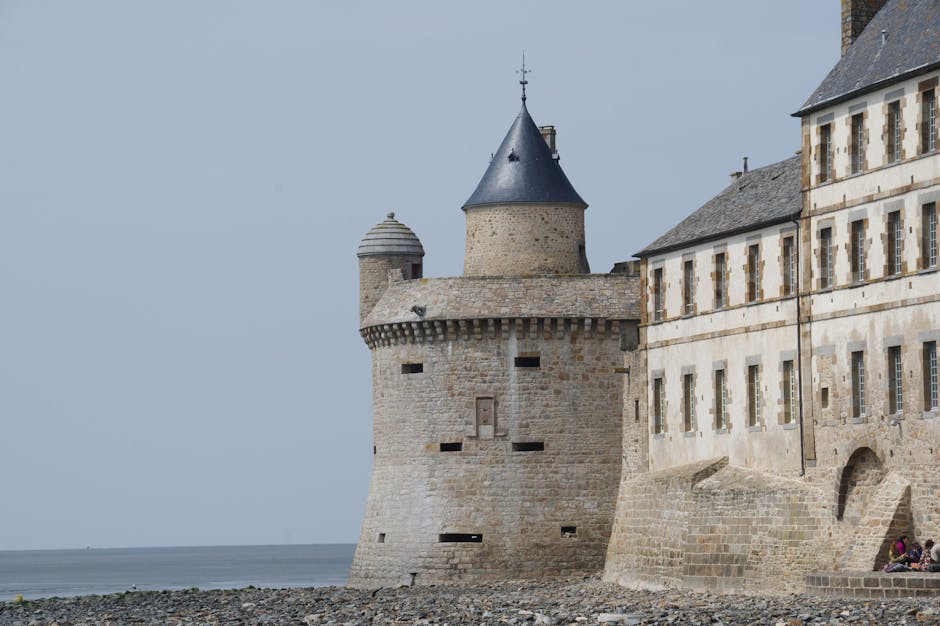
Photo by Jean-Paul Wettstein
Architectural adaptations and restorations
In response to evolving military technology, especially the advent of artillery, the castle underwent significant modifications. At the beginning of the 18th century, the towers were reconstructed to better accommodate cannon fire and enhance the fortress's defensive capabilities. Openings were added to the keep to allow more light, signaling a shift towards residential comfort alongside military utility.
The courtyard within the castle walls has seen various additions, including a house built in 1960 by the governor of the island, integrating modern habitation within the historic site. Despite these changes, the castle retains much of its medieval character and defensive features.
Architectural features of the keep
The central keep is a massive rectangular tower measuring approximately 19 by 15 meters. Its walls are built from rough rubble stone, originally plastered, with semicylindrical buttresses at mid-height on each face. These buttresses support wide arrow slits designed for flanking defense. The keep's four corner turrets, two of which are topped with distinctive conical "pepperpot" roofs, contain narrow vertical arrow slits or archères for archers to defend the castle while remaining protected.
Inside, the keep comprises three floors. The lower two floors were originally windowless to maximize defense, while the top floor served as the lord's residence, divided by a thick longitudinal wall. The castle also features functional elements such as latrine openings integrated into the watch turrets and built-in window seats known as coussièges, reflecting the daily life and comfort considerations of its medieval inhabitants.
Cultural heritage and modern use
Today, Château de Noirmoutier is owned by the commune of Noirmoutier-en-l'Île and functions as a cultural and historical monument. Since 1993, it has hosted various cultural events, including local festivals that celebrate the island's heritage. The castle's keep houses the Noirmoutier Museum, which exhibits archaeological artifacts, marine objects, local historical collections, and faience pottery from nearby Jersey.
The site was officially classified as a historic monument on 18 July 1994, ensuring its preservation and recognition as a significant part of France's architectural and cultural landscape. This designation protects the castle's medieval structures and promotes its role in educating visitors about the island's rich history.
Visitor experience
Visitors to Château de Noirmoutier can explore the imposing keep, the fortified enceinte with its towers and watch turrets, and the surrounding grounds that evoke centuries of military and domestic history. The museum inside the keep provides detailed insights into the castle's past and the island's cultural heritage. The castle's well-preserved state offers a vivid glimpse into medieval fortification architecture and the strategic importance of coastal castles in France.
Frequently asked questions (FAQ)
- What is the historical significance of Château de Noirmoutier?
- Château de Noirmoutier is a historic fortress that dates back to the 12th century, playing a crucial role in the defense of the island against invasions. It has witnessed numerous historical events, including conflicts during the Hundred Years' War and has served various purposes over the centuries, from a royal residence to a military stronghold.
- When was Château de Noirmoutier built?
- Construction of Château de Noirmoutier began in the 12th century, with significant modifications made in the following centuries. The castle showcases a blend of architectural styles that reflect its long and varied history, making it a fascinating site for visitors interested in medieval architecture.
- How do I get to Château de Noirmoutier?
- Château de Noirmoutier is located on Noirmoutier-en-l'Île, which is accessible by car or public transport. Visitors can reach the island via the bridge from the mainland or by taking a ferry, with parking available nearby for those driving.
- Is it possible to visit Château de Noirmoutier year-round?
- Yes, Château de Noirmoutier is open to the public throughout the year, but opening hours may vary seasonally. It is advisable to check the official website for current visiting hours and any special events that may affect access.
- Can I take guided tours of the castle?
- Yes, guided tours are available for visitors who wish to learn more about the history and architecture of Château de Noirmoutier. These tours provide in-depth insights and are a great way to enhance your experience while exploring the castle's grounds.
- What are the ticket prices for Château de Noirmoutier?
- Ticket prices for Château de Noirmoutier are generally affordable, with discounts available for students, seniors, and groups. Children under a certain age may enter for free, but it's best to check the official website for the most current pricing details.
- When is the best time to visit Château de Noirmoutier?
- The best time to visit Château de Noirmoutier is during the spring and early autumn when the weather is mild and pleasant for outdoor exploration. Visiting during these seasons also allows you to enjoy the beautiful gardens and surrounding landscapes at their best.
- What nearby attractions should I visit while in Noirmoutier-en-l'Île?
- While visiting Château de Noirmoutier, consider exploring other nearby attractions such as the picturesque beaches, the historic village of Noirmoutier, and the scenic salt marshes. These sites offer a wonderful complement to your castle experience and showcase the island's natural beauty.
- Is the Château de Noirmoutier accessible for visitors with mobility challenges?
- Yes, efforts have been made to ensure that Château de Noirmoutier is accessible to visitors with mobility challenges. There are pathways and facilities designed to accommodate those who may require assistance, making it easier for everyone to enjoy the historical site.
Photo gallery

Photo by Jean-Paul Wettstein
Information
Website
Visit websiteLoading map...
Visitor reviews
No reviews yet. Be the first to share your experience!