Château de Montrottier
The Château de Montrottier stands as an imposing medieval fortress in the commune of Lovagny, France, renowned for its strategic location atop a rocky hill overlooking the valley and the Fier river. Constructed originally in the mid-13th century, this castle exemplifies the military architecture of the High Medieval period with later additions reflecting Renaissance influences and 19th-century restorations. Its commanding position allowed it to control a critical route between Chambéry and Geneva, making it a significant stronghold in the region.
While the current stone structures date primarily from the 13th century onward, historical research suggests that the site may have hosted earlier fortifications, possibly a Roman watchtower or an early medieval military post during the 8th-century Arab incursions, although no archaeological evidence remains to confirm this. The earliest documented mention of the castle is from 1263, associated with the de Montrottier family, vassals under the Counts of Geneva or the Lords of Pontverre. Ownership soon passed to the de Grésy family in 1266.
Medieval origins and early ownership
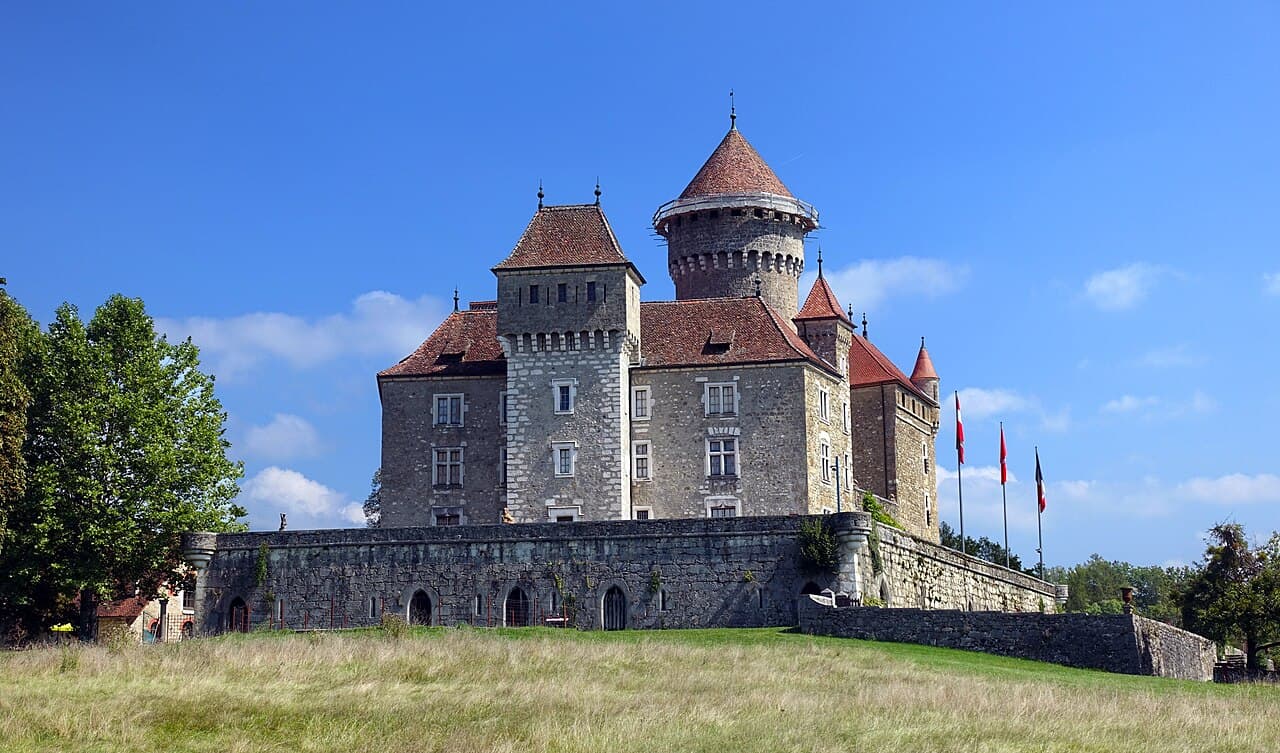
The castle's initial construction as a stone fortress atop the hill was a typical defensive strategy of the High Medieval era, utilizing the natural topography for protection. The pentagonal layout of the castle walls closely follows the contours of the rocky outcrop, maximizing defensibility. The southern side is naturally protected by steep gorges carved by the Fier river, reducing the need for extensive fortifications on that flank.
In the 15th century, the castle entered an important phase of its history when it came under the control of Duke Amadeus VIII of Savoy in 1425. Two years later, the fortress was sold to Pierre de Menthon, a notable Savoyard official and diplomat. The Menthon-Montrottier family maintained possession for centuries, elevating the estate's status to baronial rank in 1596 and later to a county in 1632 by decree of Duke Victor Amadeus I.
Architectural features and fortifications
Defensive structures
The castle's defenses are anchored by two main towers on the northern side. The most prominent is the cylindrical donjon, constructed around 1425 by Pierre de Menthon. This towering keep rises to 35.6 meters with base walls over three meters thick, designed for resilience against siege warfare. Access to the donjon is through a high entrance approximately four meters above ground level, connected by a wooden bridge to the adjacent Logis des Comtes (Counts' residence). The donjon features machicolations, stone projections in the battlements that allowed defenders to drop projectiles on attackers below. Some machicolations incorporate circular openings adapted as early gun ports, reflecting the evolution of military technology in the late medieval period.
Residential buildings
The castle includes two significant Renaissance-era residential buildings: the Logis des Comtes and the Logis des Chevaliers (Knights' residence). Both are three stories high and feature characteristic mullioned windows with stone bars dividing the glass panes. Interior elements date back to the 14th and 15th centuries, showcasing the transition from medieval fortress to noble residence.
The Salle des Chevaliers within the Knights' residence is a grand reception hall measuring approximately 8.5 by 17.5 meters. Its walls are nearly two meters thick, and the wooden ceiling is divided into eighteen decorative panels. A large fireplace anchors the room, and a doorway lintel once bore the date 1344, confirming the medieval origins of this space.
The tour des religieuses
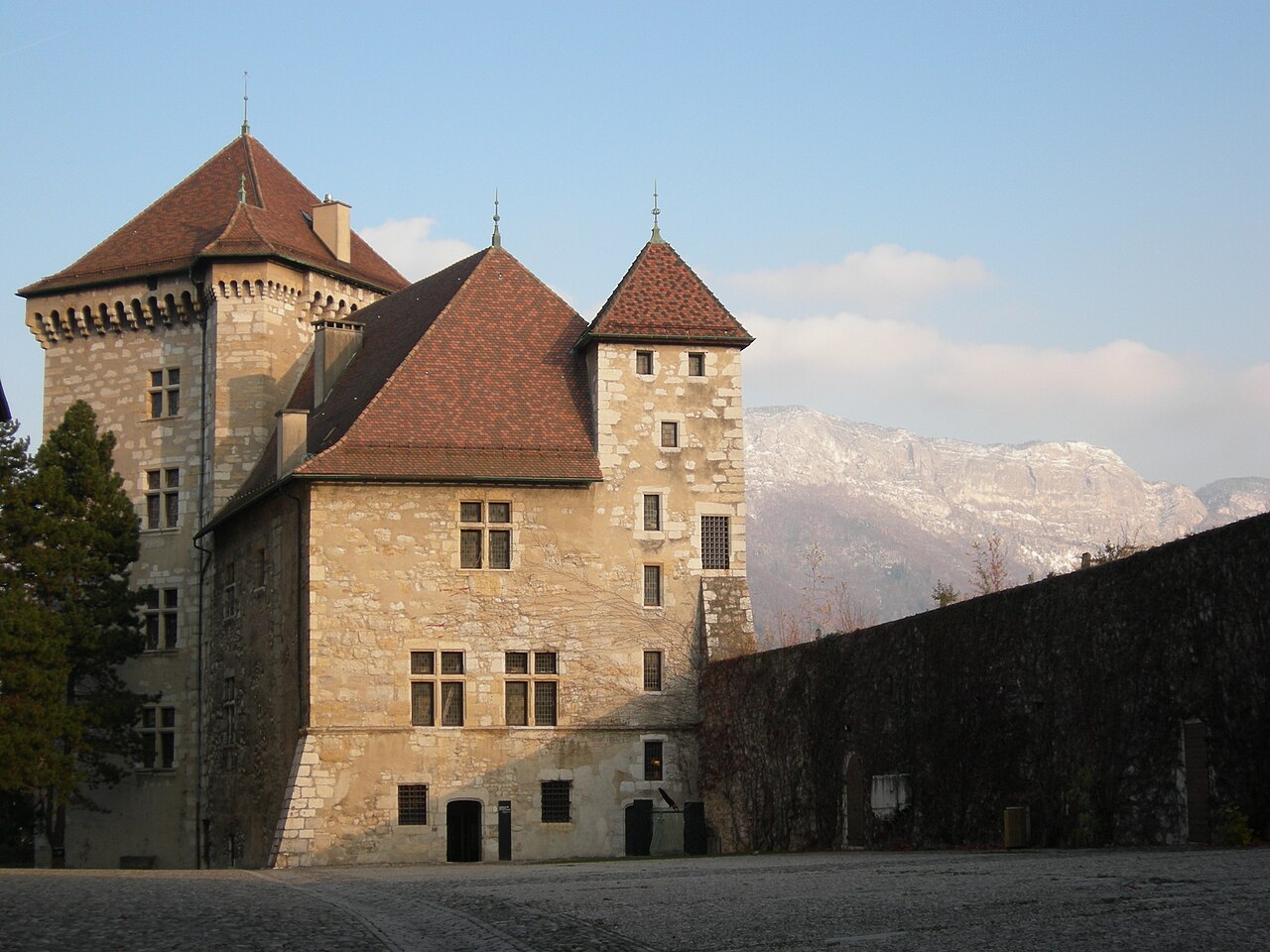
The Tour des Religieuses, a square tower dating to the 13th or 14th century, is possibly the oldest structure in the castle. Measuring roughly 8.5 by 12.5 meters, it is protected by crenellated walls up to three meters thick. A distinctive feature of this tower is its angled turret containing a suspended stringer staircase, a type of spiral stone staircase added in the 14th century that appears to float without central support. Historically, this tower housed guardrooms and artillery storage on the lower floors, with the commander's quarters above. The external walls include large arrow slits and an ogival (pointed arch) doorway, indicative of Gothic architectural influence.
Later history and restorations
Following the French Revolution, the castle was sold as national property in 1796 and passed through several owners, including the Dufour family and Baron Jules de Rochette. The Rochette family undertook significant interior renovations in the 19th century, including the addition of an elaborate grand staircase and the opening of parts of the courtyard to enhance accessibility. Under their stewardship, a park and terraced gardens were developed with the help of landscape architect Francis Delimoges, contributing to the estate's aesthetic appeal.
In 1876, industrialist Victor Frèrejean acquired the castle and completed further lavish refurbishments of the interiors. Upon the death of Marie-Louise Marès in 1906, ownership passed to her brother Léon Marès, an influential art collector who donated the property to the Académie florimontane in 1919. The castle was transformed into a museum, preserving its extensive collections through World War II and gaining official recognition as a Musée de France in 2003.
Museum collections and cultural significance
Today, the Château de Montrottier houses a rich collection of arms, armor, ceramics, tapestries, furniture, lace, and exotic artifacts from Asia and Africa assembled by Léon Marès. Highlights include four 16th-century German Renaissance bronze bas-reliefs by Peter and Hans Vicher, five 18th-century Brussels tapestries depicting hunting scenes, and several polychrome wooden Pietà statues from the 15th century. Among the oldest pieces is a polychrome statue of the Virgin Mary dating from the 13th or 14th century. A 15th-century chest bearing the royal arms of France adds to the historical narrative preserved within the castle walls.
The castle remains a significant cultural landmark in the region, attracting visitors interested in medieval architecture, Renaissance art, and French history. Its well-preserved structures and curated collections provide insight into the evolution of noble residences and military fortifications over several centuries.
Frequently asked questions (FAQ)
- How do I get to Château de Montrottier?
- Château de Montrottier is located in Lovagny, France, just a short drive from Annecy. The castle is accessible by car, and there are parking facilities available on-site. Public transport options may also be available, so check local schedules for the best routes.
- What are the opening hours of Château de Montrottier?
- The castle is typically open to visitors from April to October, with varying hours throughout the week. It's best to check the official website for the most current hours and any seasonal changes. Guided tours may have specific times, so plan accordingly.
- Can I take photographs inside the castle?
- Yes, photography is allowed in most areas of Château de Montrottier, but be mindful of any restrictions in specific rooms or during guided tours. Capturing the stunning architecture and beautiful surroundings is highly encouraged. Just remember to respect other visitors and the preservation of the site.
- When was Château de Montrottier built?
- Château de Montrottier was constructed in the 13th century, showcasing a rich history that reflects the architectural styles of the time. The castle has undergone various renovations over the centuries, adding to its charm and historical significance. Visitors can appreciate both its medieval roots and later enhancements during their tour.
- Is it possible to access Château de Montrottier with a wheelchair?
- Château de Montrottier aims to be accessible to all visitors, though some areas may pose challenges due to the historic nature of the building. It's recommended to contact the castle directly to inquire about specific accessibility options and any assistance available for visitors with mobility issues.
- What is the ticket price for visiting the castle?
- Ticket prices for Château de Montrottier are generally affordable, with discounts available for students, seniors, and children. Family tickets may also be offered, making it a great option for groups. Check the official website for current pricing and any special events that may include additional fees.
- Why is Château de Montrottier historically significant?
- Château de Montrottier is significant not only for its stunning architecture but also for its role in local history, serving as a noble residence for centuries. It provides insights into feudal life and the medieval period in the region. The castle houses a collection of artifacts and exhibitions that highlight its rich heritage.
- What is the best time to visit Château de Montrottier?
- The best time to visit is during the late spring and early autumn months when the weather is pleasant, and the gardens are in full bloom. Additionally, visiting during weekdays can provide a quieter experience, allowing for more enjoyment of the castle's beauty. Special events and exhibitions may also be more frequent during these seasons.
- Are there any nearby attractions to visit after Château de Montrottier?
- Yes, there are several attractions near Château de Montrottier that visitors can explore, including the beautiful Lake Annecy, which is ideal for outdoor activities. The charming town of Annecy itself boasts stunning canals and a historic old town. Other nearby castles and nature parks also make for great day trips.
Photo gallery

Information
Website
Visit websiteSources & official resources
Verify the information above using these authoritative references.
Loading map...
Visitor reviews
No reviews yet. Been here? Write the first review and help other travelers!
Write the first reviewVisited this castle? Share your experience
Your review helps other travelers and adds first-hand knowledge to our encyclopedia.