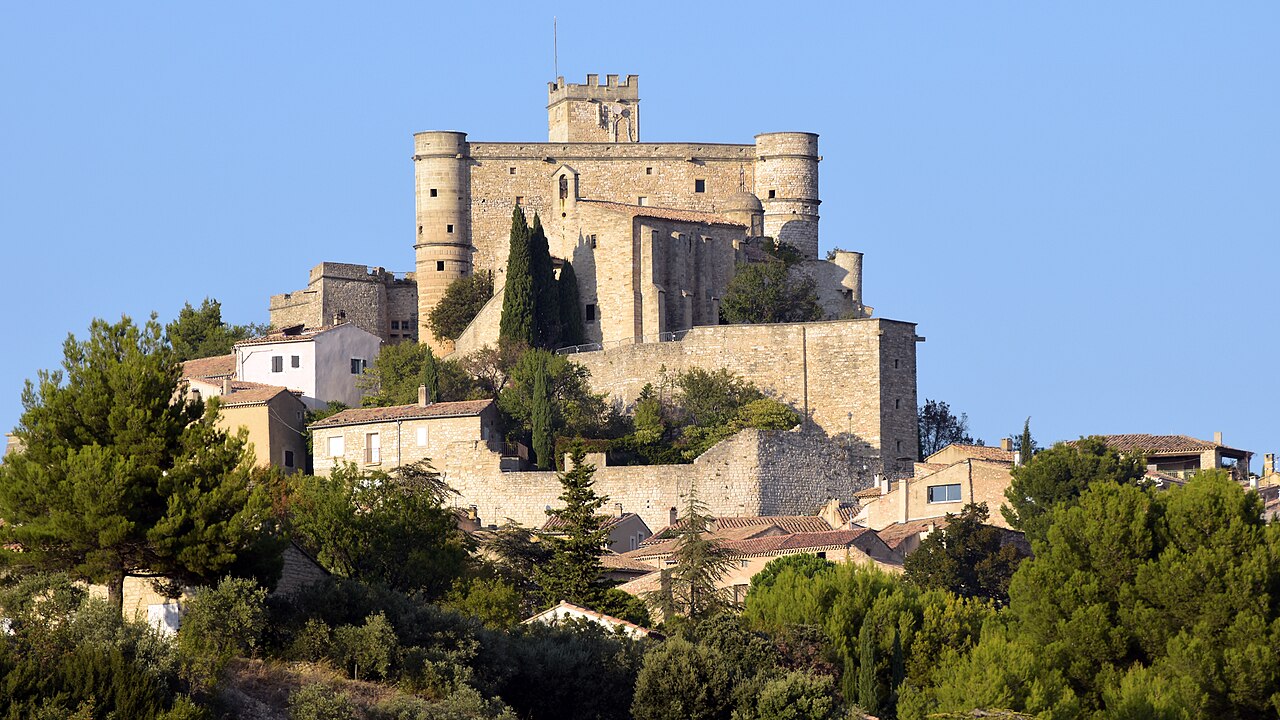
Château d’Aulan
The Château d’Aulan stands as a remarkable example of a medieval hill castle in the southeastern region of France, specifically within the municipality of Aulan. Its origins date back to the 12th century, when it was constructed atop an ancient fortified settlement known as an oppidum. This strategic location overlooking the Toulourenc valley provided a commanding view essential for both defense and communication during the turbulent Middle Ages.
Historical development and ownership
The castle initially formed part of the barony of Mévouillon, a significant feudal domain in the region. In 1240, ownership transferred when Raymond IV de Mévouillon sold the estate to Hugues du Puy-Montbrun. Subsequently, the castle passed through the hands of the Montbrun and then the Baux families, reflecting the complex feudal allegiances of the period. By 1293, the estate was incorporated into the holdings of the Dauphin of Viennois, a regional ruler whose domain encompassed parts of southeastern France.
In 1313, the Dauphin granted the estate as a fief to Rican de l’Espine, a knight of peerage status within the Dauphiné. The l’Espine family maintained control for several centuries until their lineage ended in 1640. Prior to this, in 1635, the castle passed by marriage to the Suarez family. Over the early modern period, the castle underwent various modifications that gradually diminished its military character, reflecting evolving defensive needs and technological advancements.
The French Revolution brought significant upheaval to Château d’Aulan, during which it suffered destruction, pillaging, and abandonment. After 1796, the property passed by inheritance to the Harouard de Suarez d’Aulan family. The castle endured further damage during World War I, highlighting its continued strategic importance and vulnerability through centuries.
Restoration efforts began in the early 20th century, with significant rebuilding initiated in 1933 by Charles Harouard de Suarez d’Aulan, supported by his cousin Jean Harouard de Suarez d’Aulan. These restorations were crucial in preserving the castle’s historical legacy and architectural integrity.
Architectural features and layout
The Château d’Aulan was originally designed as a fortified complex, embodying typical medieval military architecture. Its layout includes an arrangement of towers, turrets, a central courtyard, and an enclosing bailey or outer ward. This configuration was intended to control the surrounding valley and enable communication with neighboring strongholds, including another Mévouillon castle situated over a thousand meters higher on a nearby rock formation.
Constructed using local stone and traditional medieval building techniques, the castle features thick defensive walls and formidable fortifications designed to withstand sieges. Over time, as the castle's military role diminished, alterations softened its fortress-like characteristics, adapting it more towards residential and administrative functions.
Today, the façades and roofs of the château are officially recognized as historic monuments, listed since May 1950. Inside, visitors can find notable artifacts such as the wooden statue "Virgin of Pity", dating from the 15th or 16th century and likely crafted in Catalonia. This statue was acquired near Perpignan in 1933 and has been protected as a historic object since 2009.
Cultural significance and archaeological heritage
The castle holds cultural importance beyond its architectural presence. It features in the writings of prominent French literary figures such as Jean Giono and René Char. Poet René Char notably associated Château d’Aulan with the French Resistance during World War II, underscoring the site’s symbolic role in modern French history.
Within the château’s courtyard lies a remarkable Gallo-Roman funerary inscription embedded in the wall. This ancient monument links the site to an even older historical layer, connecting the medieval castle to the region’s Roman past. The inscription inspired one of Char’s poems, highlighting the continuity of human presence and cultural memory at the location.
Photographic documentation preserves views of both the exterior and interior of Château d’Aulan, illustrating its architectural evolution, phases of decay, and restoration efforts. Although precise measurements and decorative details are scarce in available sources, the remains today stand as a composite testament to centuries of construction, decline, and renewal.
Visiting château d’aulan
Visitors to Château d’Aulan can explore the historic site’s exterior fortifications and courtyard, experiencing firsthand the castle’s commanding position over the Toulourenc valley. The site’s status as a listed historic monument ensures ongoing preservation and public interest. While interior access may be limited, the castle’s rich history and cultural associations make it a compelling destination for those interested in medieval architecture and French heritage.
The castle’s elevated hilltop location offers scenic views and a tangible connection to the medieval period’s military and social dynamics. Its layered history from Roman times through the Middle Ages to modern restoration provides a unique narrative of resilience and transformation.
Frequently asked questions (FAQ)
- How do I visit Château d’Aulan?
- Château d’Aulan is accessible to visitors who can explore its exterior fortifications and courtyard. Check local tourism resources for opening times and guided tours, as interior access may be limited.
- What is the historical significance of Château d’Aulan?
- Château d’Aulan is historically significant for its origins in the 12th century and its role in regional feudal politics, as well as its connections to notable families like the Mévouillon, Montbrun, and Suarez.
- When was Château d’Aulan built?
- The castle was originally constructed in the 12th century atop an ancient oppidum, serving as a strategic hilltop stronghold in medieval France.
- Can I see any artifacts inside Château d’Aulan?
- Inside the château, visitors can find artifacts such as the 15th or 16th-century wooden statue known as the "Virgin of Pity," which is protected as a historic object.
- Why is Château d’Aulan culturally important?
- The castle is culturally important due to its appearance in the works of Jean Giono and René Char, its association with the French Resistance, and the Gallo-Roman funerary inscription linking it to ancient history.
Information
Sources & official resources
Verify the information above using these authoritative references.
Loading map...
Visitor reviews
No reviews yet. Been here? Write the first review and help other travelers!
Write the first reviewVisited this castle? Share your experience
Your review helps other travelers and adds first-hand knowledge to our encyclopedia.