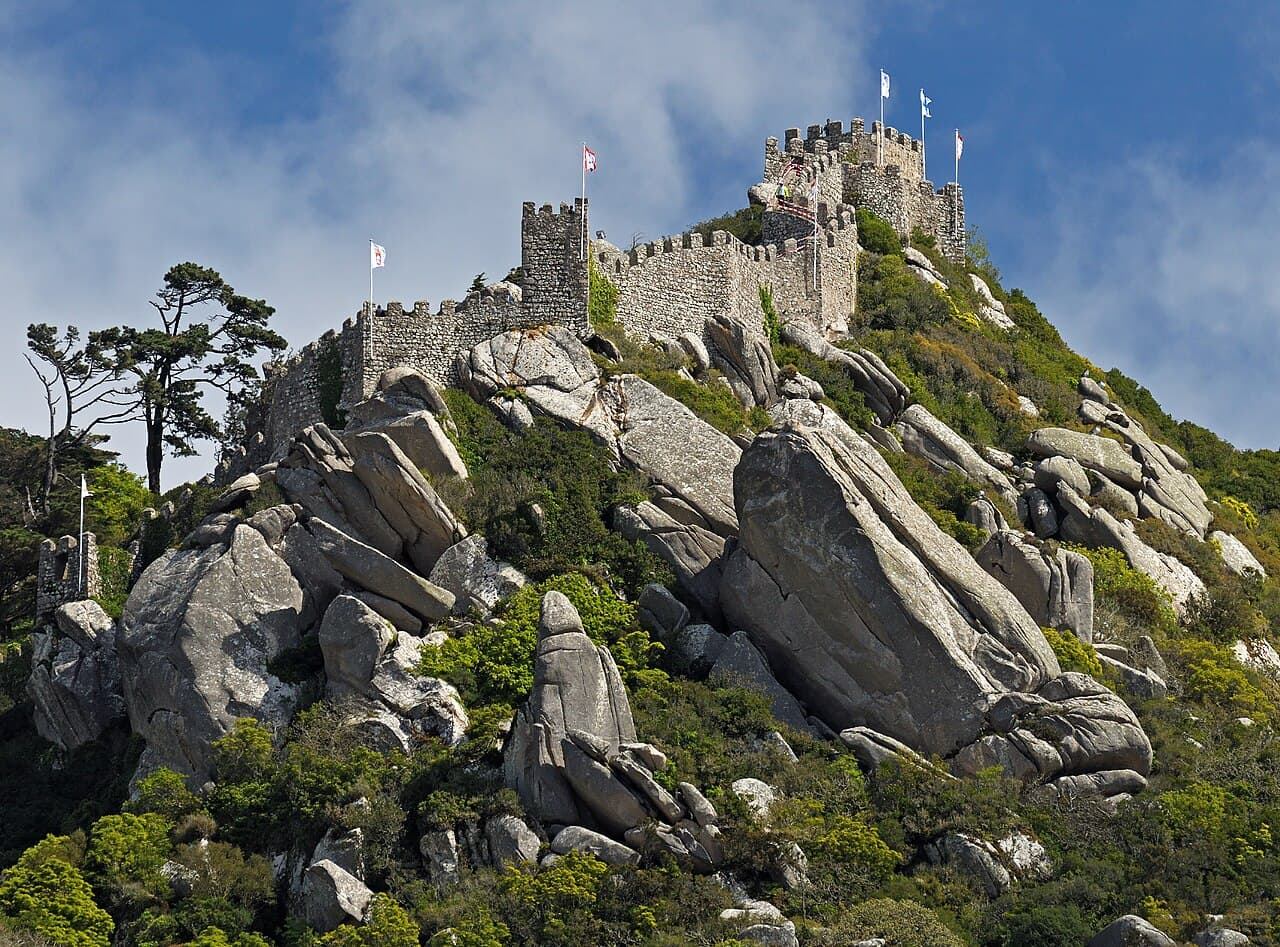
Castle of the Moors
The Castle of the Moors is a striking hilltop medieval castle situated in the civil parish of Santa Maria e São Miguel, within the municipality of Sintra, approximately 25 kilometers northwest of Lisbon, Portugal. This fortress stands prominently amidst the lush, verdant forests of the Serra de Sintra, offering commanding views over the surrounding landscape, including the Tagus River valley and the town of Sintra itself. The castle is a significant historical monument, reflecting the complex cultural and military history of the Iberian Peninsula during the early Middle Ages and the Reconquista period.
Constructed originally by the Moors in the 8th and 9th centuries, the castle was strategically positioned to guard the town of Sintra and to oversee the important routes and fertile lands of the region. The Moors, who were North African Muslim conquerors, established this fortress as part of their defensive network in the Iberian Peninsula. The castle's location was chosen for its natural defensive advantages, perched on a rocky hilltop that allowed for early warnings of approaching enemies and control over the surrounding territory.
Architectural features and fortifications
The castle's fortifications include extensive walls that stretch over the hilltop, encompassing an irregular perimeter adapted to the natural contours of the terrain. These walls are punctuated by several towers and battlements that provided vantage points for surveillance and defense. The castle's design is characterized by robust stone masonry typical of early medieval military architecture, with thick curtain walls and crenellated parapets. The remains of the main gate and several towers still stand, offering insight into the castle's defensive capabilities.
Within the castle walls, there are remnants of various structures, including a chapel built in the 12th century during the Christian period, which served as the parish seat for a time. The castle also housed residential quarters and storage facilities necessary for sustaining a garrison during sieges. The layout reflects the dual function of the castle as both a military fortress and a small fortified settlement.
Historical significance and timeline
The Castle of the Moors played a pivotal role during the Reconquista, the centuries-long series of campaigns by Christian kingdoms to reclaim territory from Muslim rule. It was captured briefly by Christian forces led by King Alfonso VI of Castile in 1093 but was retaken by the Moors the following year. The castle's most significant change of hands occurred in 1147 during the second Christian crusade, when a much larger crusading army successfully seized it following the fall of Lisbon. This event marked the castle's integration into the emerging Portuguese kingdom.
Following the Christian conquest, the castle underwent various modifications and expansions, particularly under the reigns of King Sancho I and King Ferdinand I in the 12th and 14th centuries respectively. These improvements enhanced the castle's defensive structures to adapt to evolving military technologies and threats. However, over the centuries, the castle's military importance waned as the population gradually moved to the nearby town of Sintra.
By the 15th century, the castle had largely lost its strategic value and was inhabited primarily by a small Jewish community until their expulsion under King Manuel I in the early 16th century. The castle fell into disuse and suffered significant damage from natural disasters, including a devastating fire caused by lightning in 1636 and the catastrophic 1755 Lisbon earthquake, which severely damaged the walls and the chapel.
19th-century restoration and romanticism
In the 19th century, the castle was rediscovered and romanticized by King Ferdinand II of Portugal, an avid patron of the arts and architecture. Fascinated by medieval history and aesthetics, he initiated a restoration project to preserve and enhance the ruins, transforming the site into a picturesque romantic ruin. This restoration was part of a broader movement in Sintra, including the construction of the nearby Pena Palace, which celebrated medieval and Gothic revival styles and contributed to Sintra's reputation as a cultural and architectural landmark.
King Ferdinand II's work included reinforcing the existing walls, reconstructing parts of the battlements, and landscaping the surrounding grounds to create a contemplative environment for visitors. His vision was to integrate the castle ruins into the natural beauty of the Sintra hills, making it a key attraction within the Sintra Cultural Landscape, which is now recognized as a UNESCO World Heritage Site.
Cultural and touristic importance today
Today, the Castle of the Moors is a well-preserved historical monument and a popular tourist destination. Visitors can explore the extensive ramparts, climb the towers, and enjoy panoramic views of Sintra, the Atlantic coast, and Lisbon in the distance. The castle's rugged ruins, intertwined with dense forest vegetation, create a unique atmosphere that contrasts with the more ornate palaces and estates in the area.
The castle is part of the Sintra Cultural Landscape, a protected area that includes several palaces, gardens, and natural parks. Its designation as a National Monument underscores its importance in Portuguese heritage and history. The site is accessible to the public and offers educational opportunities about medieval military architecture, the history of the Reconquista, and the cultural synthesis of Moorish and Christian influences in Portugal.
Visiting the castle
Visitors to the Castle of the Moors can walk along the preserved walls and towers, which provide excellent vantage points for photography and sightseeing. The castle's location on a hilltop requires some physical exertion to reach, but the paths are well-maintained. Informational signage throughout the site helps contextualize the historical and architectural significance of the ruins.
The castle is often combined with visits to other nearby attractions in Sintra, such as the Pena Palace and the Quinta da Regaleira, making it a key part of the region's cultural tourism circuit. Seasonal events and guided tours are sometimes offered to enrich the visitor experience.
Frequently asked questions (FAQ)
- What is the historical significance of the Castle of the Moors?
- The Castle of the Moors, built in the 8th and 9th centuries, holds a rich history as a defensive stronghold during the Moorish occupation of Portugal. It offers insight into the region's Islamic heritage and later Christian reconquest, making it a key site for understanding Sintra's historical evolution.
- When was the Castle of the Moors constructed?
- The construction of the Castle of the Moors began in the late 8th century, during the period of Moorish rule in the Iberian Peninsula. It was strategically built to protect the region and has since become a symbol of the historical conflict between the Moors and the Christians.
- Can I visit the Castle of the Moors year-round?
- Yes, the Castle of the Moors is open to visitors throughout the year, though hours may vary by season. It is advisable to check the official website for the most current opening times to plan your visit accordingly.
- What are the ticket prices for the Castle of the Moors?
- As of 2023, the ticket prices for the Castle of the Moors are approximately €8 for adults, with discounts available for children and seniors. Tickets can be purchased on-site or online, and it’s recommended to buy in advance during peak tourist seasons.
- Is it possible to reach the Castle of the Moors by public transport?
- Yes, the Castle of the Moors is accessible by public transport, including buses that connect Sintra's train station to major attractions. Additionally, visitors can enjoy a scenic walk from the town center, which takes around 30 minutes.
- What is the best time to visit the Castle of the Moors?
- The best time to visit the Castle of the Moors is during the spring and fall when the weather is mild and crowds are smaller. Early mornings or late afternoons are also ideal for avoiding peak tourist times and enjoying the breathtaking views.
- What can I see nearby the Castle of the Moors?
- Nearby attractions include the stunning Pena Palace, the quaint town of Sintra, and the lush gardens of Quinta da Regaleira. Each site offers unique experiences, making it easy to spend a full day exploring the enchanting landscape of Sintra.
- How do I get the most out of my visit to the Castle of the Moors?
- To enhance your visit, consider joining a guided tour that provides detailed insights into the castle's history and architecture. Additionally, wearing comfortable shoes is recommended, as there are steep paths and uneven terrain to navigate throughout the castle grounds.
- Is the Castle of the Moors accessible for visitors with disabilities?
- The Castle of the Moors has made efforts to improve accessibility, but due to its historical nature and terrain, some areas may be challenging for visitors with mobility issues. It is best to contact the site directly for specific information regarding accessibility options available to guests.
Photo gallery

Information
Website
Visit websiteSources & official resources
Verify the information above using these authoritative references.
Loading map...
Visitor reviews
No reviews yet. Been here? Write the first review and help other travelers!
Write the first reviewVisited this castle? Share your experience
Your review helps other travelers and adds first-hand knowledge to our encyclopedia.



