Castle Hackett — Ireland castle

Castle Hackett

Castle Hackett: medieval tower house ruins in County Galway
Tuam, Ireland
High Medieval (11th–13th c.)
Ruins

Castle Hackett is a notable example of a 13th-century medieval tower house located in the west of Ireland, specifically in County Galway. Situated at the base of Knockma Hill, approximately 10 kilometres southwest of Tuam in the parish of Caherlistrane, this castle stands near the village of Belclare in the townland known as Castlehacket (Irish: Caisleán an Haicéadaigh).

Historical context and significance

The castle was constructed during the High Medieval period, a time when tower houses were commonly built across Ireland as fortified residences for local lords and chieftains. These structures served both defensive and domestic purposes, reflecting the turbulent political landscape of medieval Ireland. Castle Hackett was likely the seat of the Hackett family, a Gaelic-Irish lineage prominent in the region.

Architectural features and layout

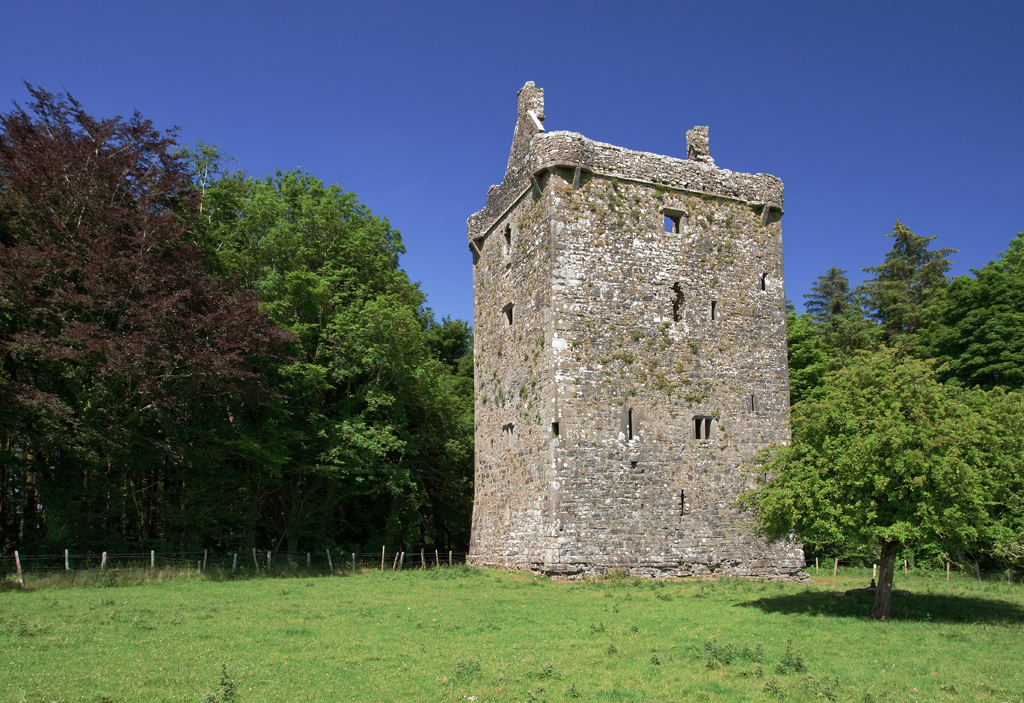
As a tower house, Castle Hackett was designed as a vertical defensive structure, typically several stories tall. The surviving ruins indicate a rectangular plan with thick stone walls, characteristic of Irish tower houses of the 13th century. The construction utilized locally sourced stone, providing robust fortification against attacks.

The castle would have originally included narrow slit windows for archers, a battlemented roofline for defense, and a strong entrance secured by a heavy wooden door and possibly a murder hole or machicolation above. Internally, the tower likely contained a great hall, private chambers, and storage areas arranged vertically.

Location and strategic importance

Positioned at the base of Knockma Hill, the castle occupied a strategic location overseeing the surrounding countryside. This vantage point allowed the occupants to monitor movements and defend against potential invaders. The proximity to Tuam, an important ecclesiastical and market town, further enhanced its significance.

Current condition and preservation

Today, Castle Hackett remains a ruin, classified as an archaeological site. The structure has suffered from centuries of weathering and neglect, with only portions of the original tower house walls still standing. Despite this, it retains enough architectural elements to provide insight into medieval Irish defensive residences.

Efforts to preserve the site have been limited, but it remains accessible to visitors interested in Ireland's medieval heritage and castle architecture. The ruins offer a tangible connection to the region's past and the lifestyle of its medieval inhabitants.

Visiting Castle Hackett

Visitors to Castle Hackett can explore the ruins and enjoy the scenic landscape of County Galway. The site is open year-round, although no formal visitor facilities are available on-site. It is advisable to wear suitable footwear and take care when navigating the uneven terrain of the ruins.

Nearby attractions

The castle's location near Knockma Hill also provides opportunities for hiking and exploring local folklore associated with the hill, including tales of the legendary Queen Maeve. The nearby town of Tuam offers additional historical sites, shops, and accommodations for visitors.

Frequently asked questions

  • What is the historical significance of Castle Hackett? Castle Hackett is a 13th-century tower house that served as a fortified residence for a local Gaelic family during the High Medieval period, reflecting the defensive architecture of the time.
  • Can visitors enter the castle? The castle is a ruin and open to the public for exploration, but there are no formal visitor facilities or guided tours, so visitors should exercise caution.
  • When was Castle Hackett built? The castle dates back to the 13th century, during the High Medieval period in Ireland.
  • Is the site accessible year-round? Yes, Castle Hackett is accessible throughout the year, though weather conditions may affect ease of access.
  • Are there other historical sites nearby? Yes, the nearby town of Tuam and Knockma Hill offer additional historical and cultural attractions for visitors.

Frequently asked questions (FAQ)

What is the historical significance of Castle Hackett?
Castle Hackett is a 13th-century tower house that served as a fortified residence for a local Gaelic family during the High Medieval period, reflecting the defensive architecture of the time.
Can visitors enter the castle?
The castle is a ruin and open to the public for exploration, but there are no formal visitor facilities or guided tours, so visitors should exercise caution.
When was Castle Hackett built?
The castle dates back to the 13th century, during the High Medieval period in Ireland.
Is the site accessible year-round?
Yes, Castle Hackett is accessible throughout the year, though weather conditions may affect ease of access.
Are there other historical sites nearby?
Yes, the nearby town of Tuam and Knockma Hill offer additional historical and cultural attractions for visitors.

Photo gallery

Castle Hackett
Click to view

Photo by Mike Searle•CC BY-SA 2.0

1 photo • Click any image to view in full screen

Information

Archaeological Site / Ruins

Loading map...

Visitor reviews

No reviews yet. Been here? Write the first review and help other travelers!

Write the first review

Visited this castle? Share your experience

Your review helps other travelers and adds first-hand knowledge to our encyclopedia.

Write a review

(5/5)

0/2000 characters

Your review will be visible after admin approval

Nearby castles

1.5 km

Castle Hackett

Knockma Hill, United Kingdom

Castle Hackett is a notable 13th-century tower house situated near Knockma Hill on the eastern shore of Lough Corrib in Ireland. This medieval stronghold was originally constructed by the Norman Hackett family, who settled in the region following the Norman invasion. The castle exemplifies the typical defensive architecture of the period, designed to serve both as a residence and a fortification. The origins and historical context of Castle Hackett The castle stands within a historically contested area that was once part of the extensive lands of the O'Flaherty clan. After the Norman invasion of Ireland in the late 12th century, the O'Flahertys were gradually displaced from their eastern territories around Lough Corrib, retreating westward into the rugged region of Connemara. This displacement allowed Norman families like the Hacketts to establish themselves in the area, constructing fortified residences such as Castle Hackett to assert their control. By the 15th century, the castle came under the ownership of the Kirwan family, one of the prominent Tribes of Galway. The Kirwans were a wealthy merchant family who played a significant role in Galway's civic and commercial life. Their acquisition of Castle Hackett marked a shift from purely military use towards a more residential and status-symbol function, reflecting the evolving nature of Irish tower houses during the late medieval period. Architectural features and design Castle Hackett is primarily a tower house, a common type of fortified residence built in Ireland between the 13th and 17th centuries. These structures typically feature a tall, narrow rectangular plan with thick stone walls, designed for defense against local conflicts and raids. The castle's construction includes stone masonry walls with narrow slit windows for archers, and a single entrance fortified with a heavy wooden door, possibly reinforced with iron. Internally, the tower would have contained several floors connected by a spiral staircase, with living quarters, storage rooms, and a great hall. Defensive features likely included battlements and machicolations, allowing defenders to protect the base of the tower from attackers. The location of Castle Hackett near Knockma Hill provided a strategic vantage point overlooking the surrounding landscape and Lough Corrib, enhancing its defensive capabilities and control over local territory. The Kirwan family and later developments After the Kirwans took residence in the 15th century, Castle Hackett remained an important family seat for several generations. However, by the 18th century, the castle was abandoned as the Kirwans constructed a more modern and comfortable residence nearby, known as Castlehacket House. This new house was a three-story building reflecting the architectural tastes of the period, moving away from fortified structures to more elegant manor houses. Unfortunately, Castlehacket House suffered damage during the Irish Civil War in 1923 when it was burned. It was subsequently rebuilt and still stands today, representing a continuity of the Kirwan family's presence in the area. Castle Hackett today and its heritage significance Currently, Castle Hackett exists as a ruined tower house, a testament to Ireland's turbulent medieval past and the complex history of Norman and Gaelic interactions. Its remains provide valuable insights into the defensive architecture and social history of the High Medieval period in this region. The castle is part of the rich cultural landscape surrounding Knockma Hill, an area steeped in legend and history. Visitors to the site can appreciate the castle's strategic location and the enduring legacy of the families who shaped its story.

High Medieval (11th–13th c.)
Details
8.2 km

Shrule Castle

Shrule, United Kingdom

Shrule Castle stands as a significant example of a medieval tower house located in County Mayo, Ireland, near the border with County Galway. Constructed around 1238 by the influential de Burgh family, this castle occupies a strategic position close to the Black River. Its location was crucial for controlling the surrounding lands during the High Medieval period. Origins and construction The castle was built as a fortified residence typical of the High Medieval era, reflecting the architectural and defensive needs of Anglo-Norman settlers in Ireland. The de Burgh family, one of the most powerful Anglo-Norman dynasties in Ireland, established Shrule Castle to secure their territorial claims along the Mayo-Galway frontier. The structure was originally a tower house, a common form of fortified dwelling in Ireland from the 13th century onwards, characterized by a tall, narrow stone tower designed for defense and habitation. Historical significance and ownership In 1308, the castle was granted to John de Burgh by his father, Richard Óg de Burgh, 2nd Earl of Ulster, cementing its importance within the de Burgh family holdings. Over the centuries, Shrule Castle was a focal point in regional conflicts, especially during the turbulent 16th century. Siege and battle of 1570 The castle was captured in 1570 by a formidable force led by Sir Edward Fitton, the President of Connaught and Vice Treasurer of Ireland. This military expedition notably included the McDonnells of Knocknacloy's gallowglass warriors, elite mercenary soldiers of Scottish origin renowned for their combat skills. In response, a coalition of local powers including Mac William Uachtar, the Lord of Thomond, the de Burghs of Mayo, and the McDonnells of Mayo attempted to retake the castle but were unsuccessful. The battle was fierce and costly; Calvagh McDonnell, chief of the McDonnells of Knocknacloy, was killed on 18 June 1570. Sir Edward Fitton himself was unhorsed and suffered severe facial wounds during the engagement. Following the siege, the castle was occupied by William Burke, who later passed it to his son John Burke in 1574. Later history and leasing By the early 17th century, the castle and its surrounding lands were leased by Richard Burke, 4th Earl of Clanricarde to Pierce Lynch of Galway in 1610. This transition reflects the changing political and social landscape of Ireland during the period, as Gaelic and Anglo-Norman noble families negotiated control over land and power. Architectural features and current condition Shrule Castle is classified as a tower house, a defensive residential structure typical of the Irish medieval landscape. Its design would have included thick stone walls, narrow windows for archers, and a vertical layout with multiple floors accessed by narrow staircases. Such castles were built both for defense and as symbols of lordly status. Today, Shrule Castle remains in a ruined state. Though much of the structure has succumbed to time and neglect, the remnants still convey the castle's original form and defensive purpose. The ruins offer valuable insights into medieval military architecture and the turbulent history of the region. Location and strategic importance Situated near the border of County Mayo and County Galway, close to the Black River, Shrule Castle's position was strategically chosen to control movement and trade routes between these territories. This location also placed it at the heart of several military conflicts during the medieval and early modern periods. Visiting Shrule Castle While the castle is in ruins, it remains an important heritage site for visitors interested in medieval Irish history and architecture. Its remote location offers a glimpse into the rugged landscape of western Ireland and the legacy of Anglo-Norman influence in the region.

High Medieval (11th–13th c.)
Details
8.4 km
Feartagar Castle — Ireland castle

Feartagar Castle

, Ireland

Feartagar Castle, also known as Jennings Castle, is a prominent 16th-century Renaissance tower house situated in County Galway, Ireland. This hill castle is recognized as a National Monument and exemplifies the architectural style and defensive features typical of the period in Ireland. Historical context and significance Constructed during the Renaissance period in the 16th century, Feartagar Castle reflects the transitional era in Irish castle building, where medieval defensive needs merged with emerging residential comforts. The castle was built at a time when tower houses were a common form of fortified dwelling for the Gaelic and Anglo-Irish gentry, combining defense with status. The castle's alternative name, Jennings Castle, likely derives from a family associated with its ownership or occupancy, which was a typical practice for naming castles in Ireland. Its designation as a National Monument underlines its cultural importance and the need for preservation of Ireland's historical heritage. Architectural features and design Feartagar Castle is a classic example of a tower house, a vertical stone structure designed for both habitation and defense. Tower houses like Feartagar typically feature thick stone walls, narrow windows or arrow slits for protection, and battlements or parapets at the roof level. Structure and layout The castle’s design includes multiple floors connected by a spiral staircase, a common feature in tower houses to maximize defensibility. The lower levels were often used for storage and as a secure refuge during attacks, while the upper floors contained living quarters and halls. Defensive elements As a hill castle, Feartagar Castle benefits from a naturally elevated position, enhancing its defensive capabilities. The thick stone walls and limited access points would have made it difficult for attackers to breach. Features such as machicolations or murder holes may have been present to defend the entrance, although specific details for Feartagar Castle require further archaeological confirmation. Current condition and preservation Feartagar Castle remains a significant historical structure and is classified as a National Monument in Ireland. While the exact condition varies, tower houses of this era often survive in a partially preserved or ruined state. Preservation efforts focus on maintaining the integrity of the stonework and preventing further deterioration. The castle is accessible to visitors interested in Irish history and architecture, providing insight into the lifestyle and defensive strategies of the Renaissance period in rural Ireland. Visiting Feartagar Castle Visitors to County Galway can explore Feartagar Castle as part of the region's rich collection of historical sites. The castle's location on a hill offers scenic views of the surrounding landscape, enhancing the experience of touring this Renaissance-era fortification. Information on visiting hours and access may be limited due to its status as a protected monument, so prospective visitors should seek local guidance or official resources before planning their trip. Feartagar Castle in the broader context of Irish tower houses Feartagar Castle is one among many tower houses built in Ireland during the 15th and 16th centuries. These structures were primarily constructed by local lords and chieftains as fortified residences that balanced defense with domestic needs. The Renaissance influence on Feartagar Castle is evident in its architectural details, which mark a departure from purely military fortresses toward more comfortable and stylistically refined homes. This evolution reflects broader social and political changes in Ireland during the period. Studying Feartagar Castle alongside other Irish tower houses provides valuable insight into the complex history of Ireland's feudal and post-medieval periods.

Renaissance (15th–17th c.)
Details