Castell de Santa Florentina
The Castell de Santa Florentina is a remarkable example of a Catalan hill castle whose history spans from Roman times through the High Medieval period and into the early 20th century modernist era. Located in the coastal town of Canet de Mar in the Catalunya region of Spain, this castle uniquely combines layers of architectural and historical significance, reflecting the evolving defensive, residential, and cultural needs of its owners across centuries.
Originally constructed on the foundations of an Ancient Roman villa and fortification, the site served as a strategic military presence along the Mediterranean coast. By the 11th century, the castle had developed into a fortified medieval residence under the stewardship of the Canet family, notably Gaudamir de Canet and Gilabert de Canet, who enhanced its defenses with towers and embrasures. This medieval phase established the castle's core defensive structures, including two surviving stone towers and a rectangular building that formed part of the fortified house.
Medieval origins and evolution
The castle's High Medieval origins are well documented, with ownership passing through prominent local families such as the Canets and later the Peguera family in the 15th century. The castle endured significant damage during the remences conflicts, a series of peasant revolts in Catalonia, resulting in a destructive fire. Following this, the castle was expanded and fortified further to repair the damage and strengthen its defenses.
In 1521, the estate was acquired by Salvador Spano, and through marital alliances, it entered the Montaner family by the late 16th century. The Montaners maintained ownership for several centuries, preserving the castle's medieval character while adapting it to changing times.
Architectural features of the medieval castle
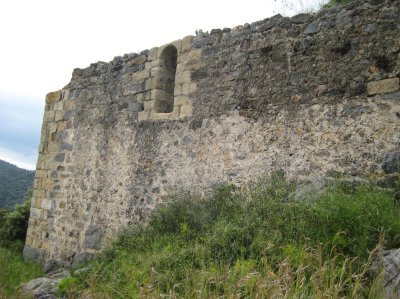
The medieval section of the castle prominently features two stone towers with embrasures—narrow slits designed for archers or defensive weaponry—demonstrating its military purpose. Adjacent to these towers is a rectangular building, which likely served as the main dwelling or a defensive enclosure within the fortified house. These structures are concentrated in the northeast sector of the site and retain their fundamental medieval construction style despite later modifications.
Modernist transformation in the early 20th century
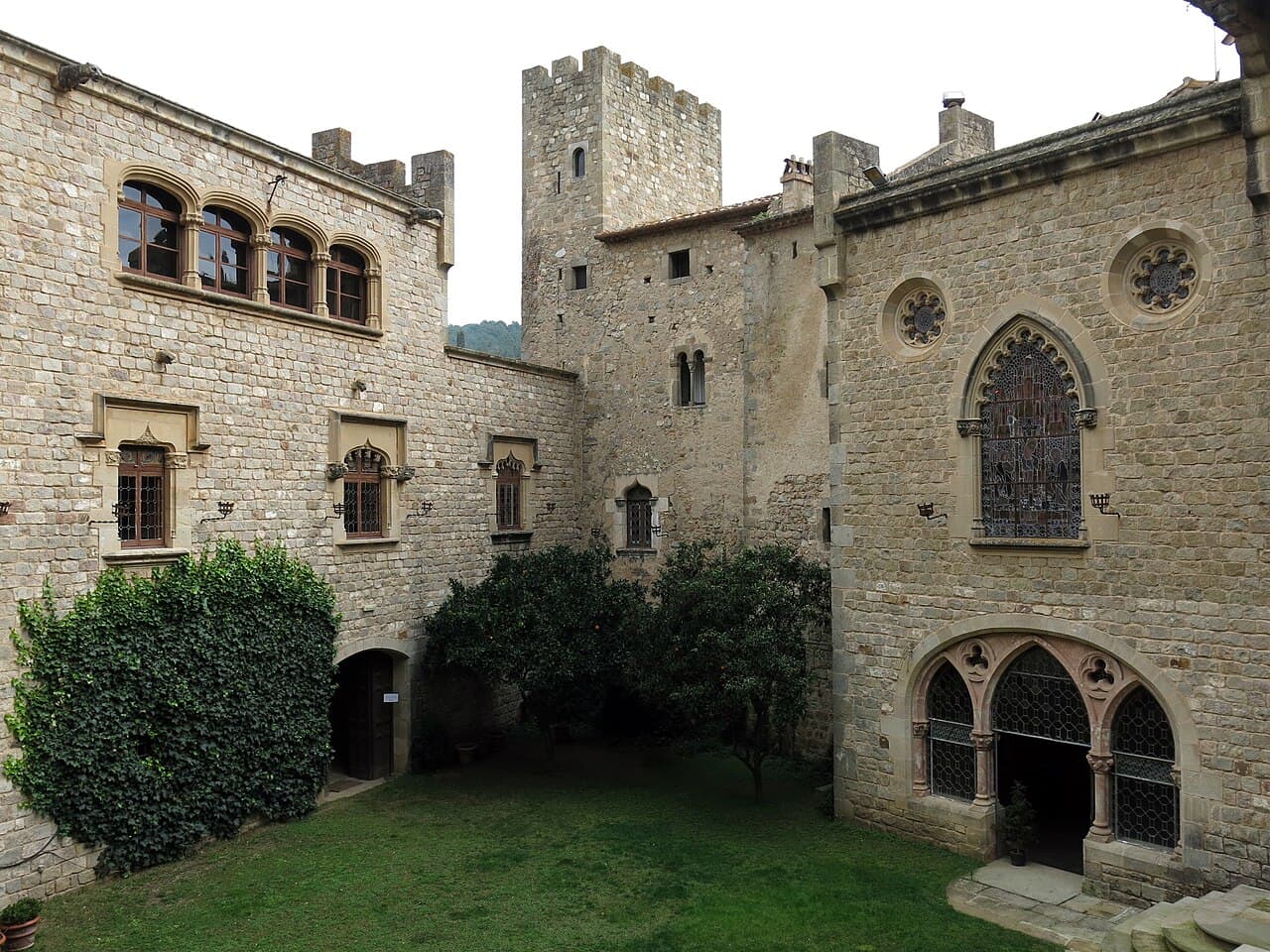
Between 1900 and 1910, the castle underwent a significant transformation under the direction of the renowned Catalan modernist architect Lluís Domènech i Montaner. Commissioned by Ramon de Montaner i Vila, the remodeling aimed to evoke a romanticized medieval past, consistent with 19th-century European trends that idealized knightly castles. Domènech i Montaner infused the castle with neo-Gothic architectural elements and incorporated salvaged historic components from other sites, such as a Gothic gallery from the sanctuary of El Tallat.
The renovation also added artistic and cultural richness, including a crypt constructed as a burial place for Florentina Malató i Suriñach, wife of Ramon Montaner, in 1900. The façade was adorned with sculptural decorations and gargoyles crafted by the sculptor Carles Flotats i Galtés, reflecting the Catalan modernism movement's artistic flair.
Interior artistic elements
The castle's interiors showcase exquisite stained glass windows, wrought ironwork, coffered ceilings, and sculptures by prominent early 20th-century Catalan artists. Notable rooms include the King's Bedroom, the circular and bright King's Bathroom located in one of the towers, and the Throne Room featuring a magnificent sculpted fireplace where scenes from the television series Game of Thrones were filmed.
A unique blend of styles is evident in the castle, where the neo-Gothic style of the main rooms contrasts with the modernist touches of the crypt, intertwining family history with architectural innovation.
Cultural significance and modern use
Today, Castell de Santa Florentina remains private property but hosts a museum accessible by appointment, exhibiting a rich collection of works by Catalan artists from the early 20th century. The castle also annually hosts a festival of classical music, enhancing its role as a cultural hub.
The castle's historical and cultural importance has been formally recognized since 1949 when it was declared a Bien Cultural d’Interès Nacional (Cultural Asset of National Interest). Its medieval towers and modernist expansions provide a tangible link to Catalonia's layered history.
In popular culture, the castle gained international attention when it was selected as a filming location for the sixth season of the acclaimed fantasy television series Game of Thrones in 2015, showcasing its dramatic architectural features to a global audience.
Visitor experience
Visitors to the castle can explore its dual heritage through guided tours that highlight both the medieval defensive structures and the modernist artistic interventions. The museum's collections, including a painting by Pau Béjar depicting Count Guifré el Pilós and the legend of the Catalan shield, connect the site to broader regional history and identity.
The castle is also available for private events and film shoots, continuing its legacy as a living cultural and historical monument.
Architectural remains and preservation
The castle's preservation is notable for maintaining its medieval defensive character alongside early 20th-century modernist additions. The medieval stone towers and rectangular building remain solidly intact, featuring original embrasures and masonry techniques from the High Medieval period. Beneath these layers, remnants of the Romanesque structure are still visible, illustrating the site's continuous occupation and adaptation.
The modernist renovations skillfully blend new architectural forms with historic stonework, creating a harmonious ensemble. The Gothic gallery transplanted from the sanctuary of El Tallat adds a distinctive medieval artistic element to the castle's expanded sections.
The castle's façade, with its sculptural details and gargoyles, alongside the interior's stained glass and wrought ironwork, exemplifies the Catalan modernism movement's integration of art and architecture.
Overall, Castell de Santa Florentina stands as a unique testament to the evolving architectural styles and historical narratives of Catalonia, from its Roman roots through medieval fortification to modernist revival and cultural prominence.
Frequently asked questions (FAQ)
- What is the historical significance of Castell de Santa Florentina?
- Castell de Santa Florentina is a prominent example of Catalan Gothic architecture and has a rich history dating back to the 11th century. It was originally built as a fortress and later transformed into a grand residence, reflecting the evolution of architectural styles in the region.
- When was Castell de Santa Florentina built?
- The castle's construction began in the 11th century, with significant modifications and expansions occurring over the centuries. Its current form showcases elements from various periods, particularly the 19th century when it was restored to enhance its Gothic features.
- Can I visit Castell de Santa Florentina?
- Yes, Castell de Santa Florentina is open to visitors, offering guided tours that provide insights into its history and architecture. It is advisable to check the official website for the latest visiting hours and any special events.
- What are the opening hours for Castell de Santa Florentina?
- The castle typically opens to visitors from Tuesday to Sunday, with specific hours varying by season. It is recommended to confirm the exact times before planning your visit, as they may change due to special events or holidays.
- Is it possible to take photographs inside Castell de Santa Florentina?
- Photography is generally allowed in designated areas of the castle, but it's best to verify the rules during your visit. Some special events or exhibitions may have restrictions, so be sure to ask your guide for clarification.
- What are the ticket prices for Castell de Santa Florentina?
- Ticket prices for Castell de Santa Florentina vary depending on age and the type of tour selected. Discounts may be available for students, seniors, and groups, so check the official site for the most current pricing information.
- When is the best time to visit Castell de Santa Florentina?
- The best time to visit is during the spring and fall when the weather is pleasant, and there are fewer crowds. Summer months can be quite busy, so planning your visit during the shoulder seasons can enhance your experience.
- Are there any nearby attractions to Castell de Santa Florentina?
- Yes, visitors can explore the charming coastal town of Canet de Mar, which offers beautiful beaches and local dining options. Additionally, the area is rich in history and culture, with several other historical sites and natural parks nearby.
- How do I access Castell de Santa Florentina using public transport?
- Castell de Santa Florentina is accessible via local trains and buses from nearby major cities like Barcelona. The closest train station is Canet de Mar, and from there, it's a short walk or taxi ride to the castle.
Photo gallery

Information
Website
Visit websiteSources & official resources
Verify the information above using these authoritative references.
Loading map...
Visitor reviews
No reviews yet. Been here? Write the first review and help other travelers!
Write the first reviewVisited this castle? Share your experience
Your review helps other travelers and adds first-hand knowledge to our encyclopedia.