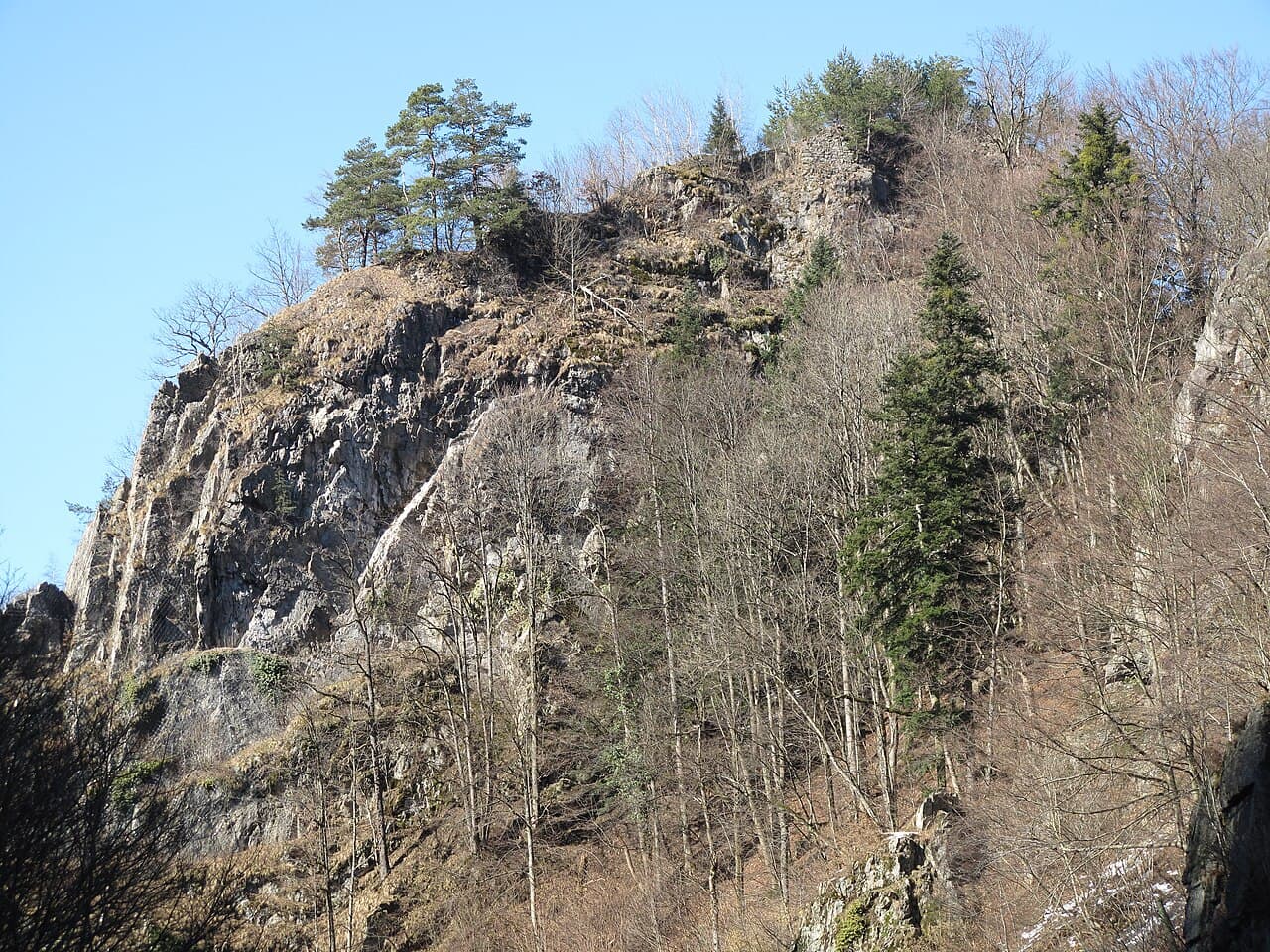
Bubenstein Castle
Bubenstein Castle, also known as Neu-Falkenstein, is an important high medieval spur castle located on the northern side of the Höllental valley near the village of Falkensteig in the municipality of Buchenbach, Baden-Württemberg, Germany. Constructed in the 13th century by Walter of Falkenstein, it served as a fortified residence for the lords of Falkenstein, who were first recorded as its occupants in 1266. The castle occupies a strategic position on a rocky spur overlooking the valley, providing commanding views and natural defenses.
Historical background and ownership
The castle was an important seat for the lords of Falkenstein during the high medieval period. By 1328, the castle had passed to the lords of Staufen, indicating a shift in regional power and ownership. The castle's history reflects the feudal dynamics of southwestern Germany during the Middle Ages, with noble families controlling key defensive positions in the Black Forest region.
Architectural features and layout
Bubenstein Castle was built as a spur castle, utilizing the natural topography of a rocky promontory to enhance its defenses. The castle's most prominent feature was its bergfried, a large tower measuring approximately 10 by 10 metres. This tower would have served as a last refuge during sieges and a lookout point over the surrounding landscape.
The castle was protected by a neck ditch carved into the rock, which was about 5 metres deep and 8 metres wide. This defensive trench separated the castle from the adjacent land, making direct assault difficult. The remaining wall fragments and the neck ditch are key elements that illustrate the castle's defensive design.
Defensive structures
As with many spur castles, Bubenstein's position on a steep rocky outcrop provided natural protection on several sides. The man-made fortifications, including the bergfried and neck ditch, complemented these natural defenses. The castle's walls, though now mostly ruined, would have enclosed a courtyard and living quarters, typical of medieval fortifications.
Later history and current condition
In the 19th century, the castle suffered significant damage when part of the castle rock was blasted to make way for a railway line, reflecting the industrial expansion of the era and the changing priorities in land use. By 1960, due to its poor state of repair, the castle was partially dismantled to prevent further collapse.
Today, Bubenstein Castle survives only as ruins, with some wall remains and the neck ditch still visible. The site is classified as an archaeological ruin, offering valuable insights into medieval castle construction and feudal history in the Black Forest region.
Location and surrounding landscape
The castle is situated approximately 500 metres west of Old Falkenstein Castle above the village of Falkensteig, within the municipality of Buchenbach. It lies at an elevation of about 617.6 metres above sea level, perched on a rocky crag that is now difficult to access. This location provided strategic control over the Höllental valley and the nearby Engenbach valley, key routes through the region.
The surrounding landscape is characterized by dense forest and steep terrain, typical of the Black Forest area. The castle's position on a spur made it a formidable defensive site in the medieval period.
Preservation and archaeological significance
Although much of the castle has been lost, the remaining structures and earthworks are important for understanding the high medieval fortification techniques used in southwestern Germany. Archaeological studies of the site contribute to knowledge about the lifestyle, military architecture, and feudal relations of the period.
Visitors today can observe the surviving walls and the neck ditch, which highlight the castle's original defensive layout. The ruin is less well preserved compared to other castles in the Breisgau region but remains a significant cultural heritage site.
Frequently asked questions (FAQ)
- How do I get to Bubenstein Castle?
- Bubenstein Castle is located near the village of Falkensteig in Buchenbach, Baden-Württemberg. It is accessible by hiking trails from nearby towns, but the terrain is steep and rocky, so sturdy footwear is recommended.
- What remains of Bubenstein Castle can I see today?
- Today, visitors can see the ruins of the castle walls, the large bergfried base, and the deep neck ditch. These features illustrate the castle's medieval defensive design despite its ruined state.
- When was Bubenstein Castle built and by whom?
- The castle was built in the 13th century by Walter of Falkenstein. It served as a residence for the lords of Falkenstein and later the lords of Staufen.
- Is Bubenstein Castle open to the public?
- As a ruin and archaeological site, Bubenstein Castle is open to the public for exploration, but there are no formal visitor facilities or guided tours on site.
- Why was part of the castle destroyed in the 19th century?
- In the 19th century, part of the castle rock was blasted to make way for a railway line, reflecting industrial development that impacted the historic site.
Photo gallery

Information
Loading map...
Visitor reviews
No reviews yet. Been here? Write the first review and help other travelers!
Write the first reviewVisited this castle? Share your experience
Your review helps other travelers and adds first-hand knowledge to our encyclopedia.



