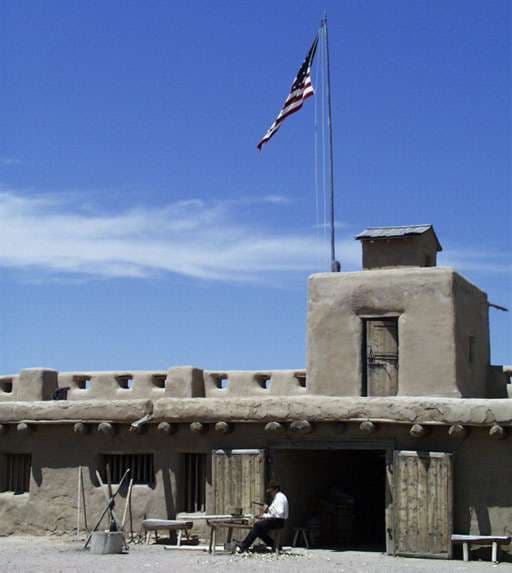
Bent's Old Fort National Historic Site
Bent's Old Fort National Historic Site stands as a significant monument to early 19th-century trade and cultural exchange on the American frontier. Located in Otero County, southeastern Colorado, this fort was originally constructed in 1833 by the partnership of Charles Bent, William Bent, and Ceran St. Vrain. Its primary function was to serve as a trading post with the Southern Cheyenne and Arapaho Plains Indians, as well as with trappers, facilitating commerce in buffalo robes and other goods. For much of its operational life, spanning approximately 16 years, Bent's Old Fort was the only major permanent white American settlement along the Santa Fe Trail between Missouri and Mexican territories.
Historical context and significance
The fort's establishment in the early 19th century came at a time of expanding American influence westward and growing economic interactions with Indigenous peoples and Mexican settlements. Bent's Old Fort was strategically positioned on the Arkansas River, allowing it to become a vital hub for trade and diplomacy. The fort's design and function reflected the needs of a frontier trading post, balancing defense with commercial activity.
William Bent, one of the key figures behind the fort, abandoned it in 1849 as trade patterns shifted and the American frontier evolved. Despite its relatively brief period of operation, the fort played a crucial role in regional commerce and intercultural relations during a transformative era in the American West.
Architectural features and layout
Bent's Old Fort was constructed primarily of adobe, a common building material in the region, which provided insulation against the harsh climate. The fort's walls were thick and robust, forming a roughly rectangular enclosure approximately 200 feet long and 125 feet wide. These walls were designed with defensive considerations, featuring bastions at the corners to allow for protective firing angles and to guard against potential attacks.
The fort included multiple functional structures within the enclosure, such as living quarters, trading rooms, storerooms, and a blacksmith shop. The layout was practical, facilitating the flow of goods and people while maintaining security. The main entrance was a large gate on the south side, which was heavily fortified.
Defensive elements
The bastioned design of the fort was a distinctive feature, providing overlapping fields of fire along the walls. This architectural choice reflected the uncertain and sometimes hostile environment of the frontier. The fort's walls were approximately 15 feet high and 3 feet thick, made from adobe bricks covered with a protective plaster. The bastions protruded from the corners, allowing defenders to cover all approaches.
Reconstruction and preservation
After being abandoned in 1849, the original fort fell into ruin over the decades. Recognizing its historical importance, the National Park Service undertook a comprehensive reconstruction of Bent's Old Fort in 1976. This reconstruction was based on archaeological evidence and historical records to ensure accuracy in replicating the fort's original appearance and layout.
Today, Bent's Old Fort is open to the public as a National Historic Site, offering visitors a tangible connection to the early trade era of the American West. The site was designated a National Historic Site on June 3, 1960, and later that year, on December 19, 1960, it was recognized as a National Historic Landmark due to its cultural and historical significance.
Visitor experience and educational value
Visitors to Bent's Old Fort can explore the reconstructed adobe walls and buildings, gaining insight into the daily life of traders, Native Americans, and settlers during the fort's operational period. The site offers interpretive programs, guided tours, and reenactments that illustrate the complex interactions between diverse cultural groups on the frontier.
The fort's location along the historic Santa Fe Trail provides additional context for understanding the economic and social dynamics of the 19th-century American West. Educational exhibits detail the importance of the fort in facilitating trade between the United States, Native American tribes, and Mexican territories.
Legacy and cultural importance
Bent's Old Fort remains a key symbol of early American frontier history. Its architecture exemplifies practical defensive design adapted to the unique conditions of the plains. The fort's history reflects broader themes of trade, cultural exchange, and the complex relationships between Indigenous peoples and expanding American settlements.
As a preserved and interpreted historic site, Bent's Old Fort continues to serve as a resource for historians, educators, and visitors interested in the formative years of the American West and the Santa Fe Trail's role in shaping regional development.
Frequently asked questions (FAQ)
- When was Bent's Old Fort built and by whom?
- Bent's Old Fort was built in 1833 by Charles Bent, William Bent, and Ceran St. Vrain as a trading post on the Santa Fe Trail.
- What is the significance of Bent's Old Fort in American history?
- The fort was the only major permanent white American settlement on the Santa Fe Trail between Missouri and Mexican territories during its operation, playing a key role in trade and cultural exchange.
- Can I visit Bent's Old Fort today?
- Yes, Bent's Old Fort was reconstructed in 1976 and is now a National Historic Site open to the public with tours and educational programs.
- What architectural features define Bent's Old Fort?
- The fort features thick adobe walls with bastions at the corners for defense and includes living quarters, trading rooms, and storerooms within a rectangular enclosure.
- Why was Bent's Old Fort abandoned?
- The fort was abandoned in 1849 due to shifting trade patterns and changes in the American frontier that reduced its strategic importance.
Photo gallery

Photo by unknown NPS photographer•Public domain
Information
Loading map...
Visitor reviews
No reviews yet. Been here? Write the first review and help other travelers!
Write the first reviewVisited this castle? Share your experience
Your review helps other travelers and adds first-hand knowledge to our encyclopedia.


