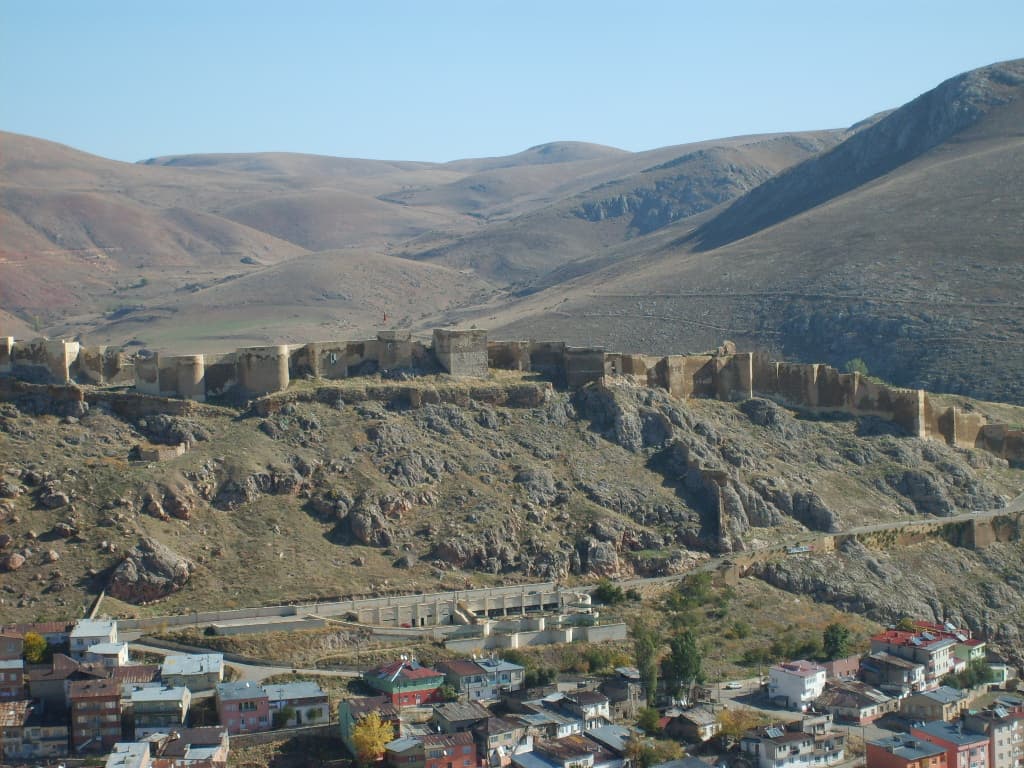
Bayburt Castle
Bayburt Castle stands as a remarkable example of a hill castle with a history that spans several millennia in northeastern Turkey. Located in the municipality of Halfikale (Kaleardı) within the city of Bayburt, this fortress commands a strategic position atop a steep rocky hill approximately 1,150 meters above sea level. Overlooking the upper basin of the Çoruh River, the castle’s location was chosen for its natural defensive advantages and its control over key transit routes between the Black Sea coast and the interior of Anatolia and beyond.
The origins of Bayburt Castle are shrouded in antiquity, with archaeological and historical evidence suggesting the site was fortified well before the Common Era. While the exact builders remain uncertain, the castle is first documented in historical records during the period of the Bagratid dynasty between 885 and 1044 AD, underscoring its long-standing strategic importance in the region.
Historical significance and ownership through the ages
Throughout its history, Bayburt Castle has been a coveted military stronghold due to its commanding position and control over surrounding lands. In late antiquity, the fortress was part of the Byzantine Empire and was notably reinforced during the reign of Emperor Justinian I in the 6th century. These fortifications were part of Justinian’s wider program to strengthen the empire’s eastern frontiers against Persian and other incursions.
Following Byzantine control, the castle came under the rule of various Armenian dynasties, reflecting the shifting political landscape of eastern Anatolia. The mid-11th century marked a significant turning point when Turkic forces captured the fortress around 1054–1055, making Bayburt one of the earliest Anatolian strongholds to fall under Turkish control. Subsequent rulers included the Great Seljuks, the Saltukids, and the Danishmendids, each contributing to the castle’s evolving defenses and administrative importance.
In the early 12th century, Sultan Tughril II and his governor in Erzurum undertook significant fortification efforts to bolster the castle’s defenses against threats from the Empire of Trebizond. Later, the fortress was incorporated into the realm of the Akkoyunlu confederation before ultimately becoming part of the Ottoman Empire in 1514 after a notable siege during the Ottoman-Safavid conflicts.
The Ottomans valued Bayburt Castle for its strategic location on the vital transit route connecting Trabzon on the Black Sea coast to the Iranian plateau. Historical records from 1520 indicate the castle was garrisoned by nearly 400 guards and stocked with extensive arms, highlighting its military significance. During the reign of Suleiman the Magnificent in 1541, the fortress underwent major restoration as part of his military campaigns in Iran, with further repairs carried out under Murad III in the late 16th century.
Travel accounts from the 17th century, including those by the famed Ottoman traveler Evliya Çelebi, describe a thriving citadel neighborhood within the castle walls. At that time, approximately 300 houses and a mosque existed inside the fortress, indicating a substantial settled population and a vibrant community life within the defensive perimeter.
The castle sustained damage during the Russo-Turkish War of 1828–1829, leading to a period of neglect. Preservation efforts resumed in the late 20th century, with archaeological excavations and restoration projects beginning anew in 2017, uncovering multiple layers of the castle’s extensive history. The site is also culturally significant, referenced in the "Kitabi Dədə Qorqud" epic and known as Çinimaçin Castle during the Ottoman period.
Architectural features and defensive design
Bayburt Castle exemplifies a sophisticated defensive layout adapted to its rugged terrain. The fortress consists of two concentric walls extending over two kilometers in length, with walls rising up to 30 meters high. A wide 200-meter space separates the inner and outer enclosures, creating a formidable defensive barrier that maximizes the natural steepness of the hill.
The outer wall is ingeniously integrated with the natural rocky outcrops, following the contours of the hill to enhance its defensive capability. Numerous bastions of varying shapes—including semicircular, quadrangular, and triangular forms—are spaced along the walls. These bastions, some supported by retaining walls, reinforce vulnerable points and corners, providing vantage points for archers and artillery.
The castle has two main gates reflecting its defensive priorities. The eastern gate, known as Demirkapı or Iron Gate, is fortified with three layers of iron, underscoring its importance as a primary access point. The western gate, called Nöbethane Kapısı or Watch Station Gate, connected the fortress to the nearby city and served as a controlled exit and entry point.
Inside the citadel, historical records and 17th-century accounts by Evliya Çelebi describe a densely built neighborhood with around 300 houses and a mosque. This indicates that the fortress was not only a military installation but also a thriving residential and religious center. Inscriptions on the walls attribute significant repairs and bastion construction to architect Ziyâeddin Lü’lü, a palace official and military commander under Sultan Tughril II during the Seljuk period.
A notable stone inscription in elegant Naskh script once adorned the city-facing walls, bearing the name of Hatice Sultan, wife of Tughril II. Unfortunately, this inscription was lost after 1936, but its existence highlights the castle’s historical connections to prominent figures of the Seljuk era.
Additional architectural elements
East of the main fortress lie the remains of a church dating from between the 14th and 18th centuries, reflecting the religious diversity and historical layers of the site. On the western side of the hill, cave structures have been identified, adding to the complexity and multifunctional nature of the castle’s features. These caves may have served as storage, shelter, or even secret passages, though their exact use remains a subject of ongoing research.
Cultural and historical legacy
Bayburt Castle is not only a military and architectural landmark but also a cultural symbol embedded in the region’s heritage. Its mention in the Kitabi Dədə Qorqud epic connects it to Turkic oral traditions and literature, enhancing its significance beyond mere fortification.
The castle’s long history of occupation by diverse powers—from Byzantine and Armenian to Seljuk, Akkoyunlu, and Ottoman—illustrates the dynamic political and cultural shifts in northeastern Anatolia. Each era left its imprint on the fortress’s structure and function, making it a palimpsest of regional history.
Today, ongoing archaeological efforts and restoration projects aim to preserve and interpret Bayburt Castle for future generations. Visitors can appreciate its impressive defensive architecture, panoramic views of the Çoruh River valley, and the layered historical narratives embodied in its walls and ruins.
Frequently asked questions (FAQ)
- How do I get to Bayburt Castle?
- Bayburt Castle is located in the city of Bayburt, Turkey, on a steep hill in the Halfikale district. It is accessible by local roads, and visitors can reach it by car or taxi from the city center. The climb to the castle involves walking uphill, so comfortable footwear is recommended.
- What is the historical significance of Bayburt Castle?
- Bayburt Castle has a rich history dating back to late antiquity and was a strategic fortress for Byzantine, Armenian, Seljuk, Akkoyunlu, and Ottoman rulers. It controlled key trade and military routes, making it a vital stronghold in northeastern Anatolia.
- Can I visit the interior of Bayburt Castle?
- Yes, visitors can explore the ruins of Bayburt Castle, including its concentric walls, bastions, and gate structures. While some areas are in ruins, parts of the castle are accessible for walking and viewing historical features.
- When is the best time to visit Bayburt Castle?
- The best time to visit Bayburt Castle is during the spring and autumn months when the weather is mild and pleasant for hiking and outdoor exploration. Summers can be hot, and winters may bring snow, making access more difficult.
- Are there any guided tours available at Bayburt Castle?
- Guided tours may be available through local tourism offices or private guides in Bayburt. These tours provide detailed historical and architectural insights about the castle and its significance in the region.
Photo gallery

Information
Loading map...
Visitor reviews
No reviews yet. Been here? Write the first review and help other travelers!
Write the first reviewVisited this castle? Share your experience
Your review helps other travelers and adds first-hand knowledge to our encyclopedia.



