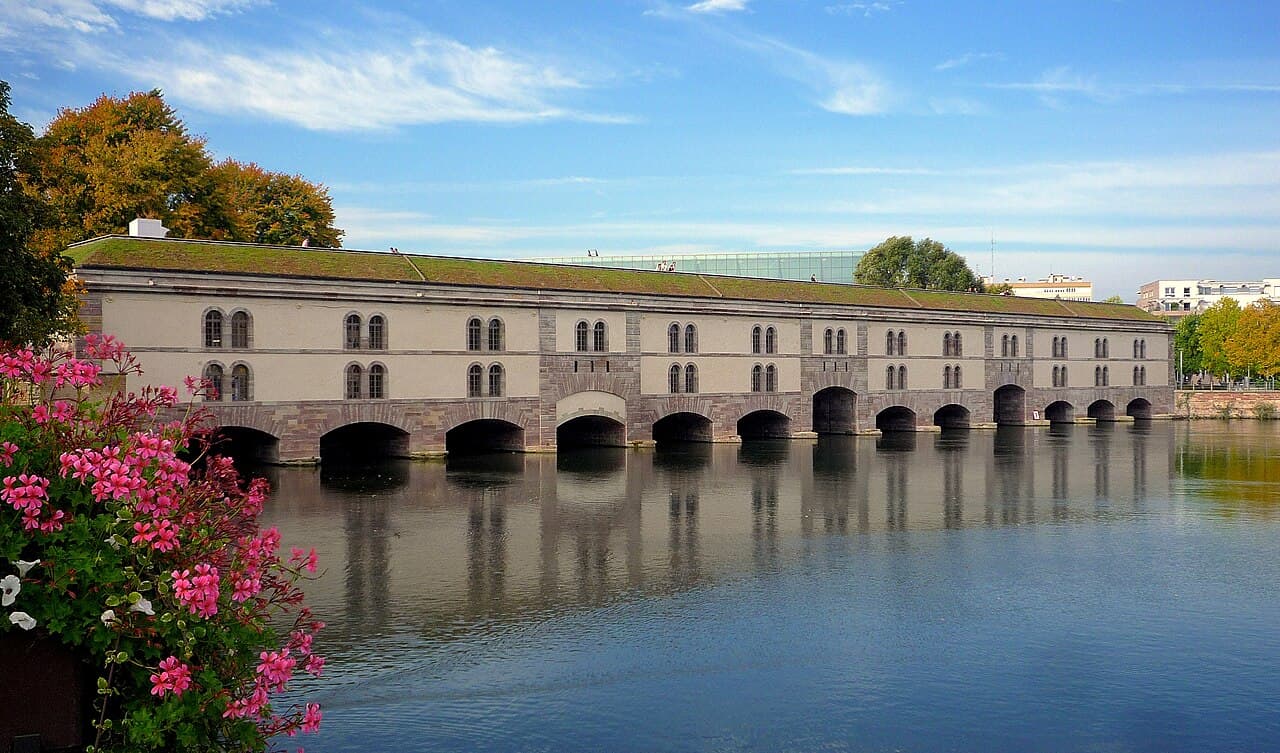
Barrage Vauban
The Barrage Vauban, also known as the Vauban Dam, is a remarkable example of 17th-century military engineering located on the River Ill in Strasbourg, France. Constructed between 1686 and 1690, this structure was designed by the famed military engineer Sébastien Le Prestre de Vauban and built by French engineer Jacques Tarade using distinctive pink Vosges sandstone. Originally called the Grande Écluse or Great Lock, the barrage was not intended as a navigation lock in the modern sense but rather as a defensive hydraulic structure integrated into the city's fortifications.
The primary military purpose of the barrage was to control the flow of the River Ill, allowing the deliberate flooding of the southern lands around Strasbourg in the event of an enemy attack. This flooding created a formidable barrier by turning the surrounding terrain into an impassable marshland. This defensive tactic was notably employed during the Franco-Prussian War of 1870, when Strasbourg was besieged by Prussian forces. The deliberate raising of the river flooded the northern part of the Neudorf suburb, demonstrating the effectiveness of Vauban's innovative defensive strategy.
Architectural design and features
The barrage stretches approximately 120 metres (390 feet) in length and comprises 13 arches constructed from the regionally sourced pink sandstone, giving it a distinctive appearance that harmonizes with the local architectural vernacular. The structure functions as a bridge and includes a weir system to regulate water levels. Three of its arches are raised to allow navigation, with drawbridges spanning these openings to maintain the defensive integrity when required.
Within the barrage is an enclosed corridor that connects the two banks of the river. This corridor not only facilitated troop and equipment movement during military operations but now serves as a lapidarium, housing an impressive collection of ancient plaster casts and replicas of sculptures, including statues and gargoyles from the nearby Strasbourg Cathedral and the Palais Rohan. This cultural aspect adds a unique dimension to the structure, blending military architecture with artistic heritage.
The roof of the barrage was reconstructed in 1965-66 to create a panoramic terrace, offering visitors sweeping views of the Ponts Couverts and the historic Petite France quarter. This terrace has become a popular vantage point for both tourists and locals, enhancing the site's appeal beyond its original military function.
Historical context and military significance
The 17th century was a period of intense military innovation in Europe, and Vauban was a leading figure in fortification design. The Barrage Vauban is an example of his approach to integrated defense systems that combined natural and man-made elements. The ability to flood surrounding areas was a strategic advantage that complemented the city's walls and bastions, making Strasbourg a difficult target for invading armies.
During the Franco-Prussian War, the barrage's flood defense was activated, showcasing its practical value in modern warfare. This event underlined the continued relevance of Vauban's designs well into the 19th century, long after their initial construction. The flooding not only impeded enemy movement but also protected the city from direct assault.
Cultural and urban significance today
Today, the Barrage Vauban stands as a Monument historique, having been officially classified since 1971. It is a key element of Strasbourg's rich architectural landscape and a testament to the city's military and cultural history. Its location near important institutions such as the Strasbourg Museum of Modern and Contemporary Art and the Commanderie Saint-Jean, home to the prestigious École Nationale d'Administration, situates it at the heart of the city's cultural district.
At the southern end of the barrage lies the Hôtel du Département, the administrative headquarters of the Bas-Rhin department, linking the historic structure with contemporary civic life. The barrage's accessibility, with free admission and daily opening hours from 09:00 to 19:30, makes it a popular destination for visitors interested in history, architecture, and panoramic city views.
Visitor experience and amenities
Visitors to the Barrage Vauban can explore the enclosed corridor and its lapidarium, gaining insight into the artistic heritage of Strasbourg through its collection of plaster casts. The rooftop terrace provides an exceptional viewpoint to observe the Ponts Couverts, a series of historic covered bridges, and the picturesque Petite France quarter with its timber-framed houses and canals.
The structure's integration into the urban fabric allows easy access from nearby cultural institutions and public transport. The combination of military history, architectural interest, and cultural exhibitions makes the Barrage Vauban a multifaceted site appealing to a wide range of visitors.
Frequently asked questions (FAQ)
- What is the primary historical purpose of the Barrage Vauban?
- The Barrage Vauban was designed as a defensive hydraulic structure to flood the surrounding lands and protect Strasbourg from enemy attacks.
- When was the Barrage Vauban constructed?
- It was built between 1686 and 1690 during the late 17th century under the direction of Jacques Tarade following Vauban's plans.
- Can visitors access the rooftop terrace?
- Yes, the rooftop terrace is open daily and offers panoramic views of Strasbourg, including the Ponts Couverts and Petite France quarter.
- Is there an admission fee to visit the Barrage Vauban?
- Admission to the Barrage Vauban and its terrace is free of charge.
- What cultural features are displayed inside the barrage?
- The enclosed corridor houses a lapidarium with plaster casts and copies of statues and gargoyles from Strasbourg Cathedral and the Palais Rohan.
Photo gallery

Information
Opening hours
09:00-19:30, daily
Ticket prices
Free
Architect
Jacques Tarade
Loading map...
Visitor reviews
No reviews yet. Been here? Write the first review and help other travelers!
Write the first reviewVisited this castle? Share your experience
Your review helps other travelers and adds first-hand knowledge to our encyclopedia.



