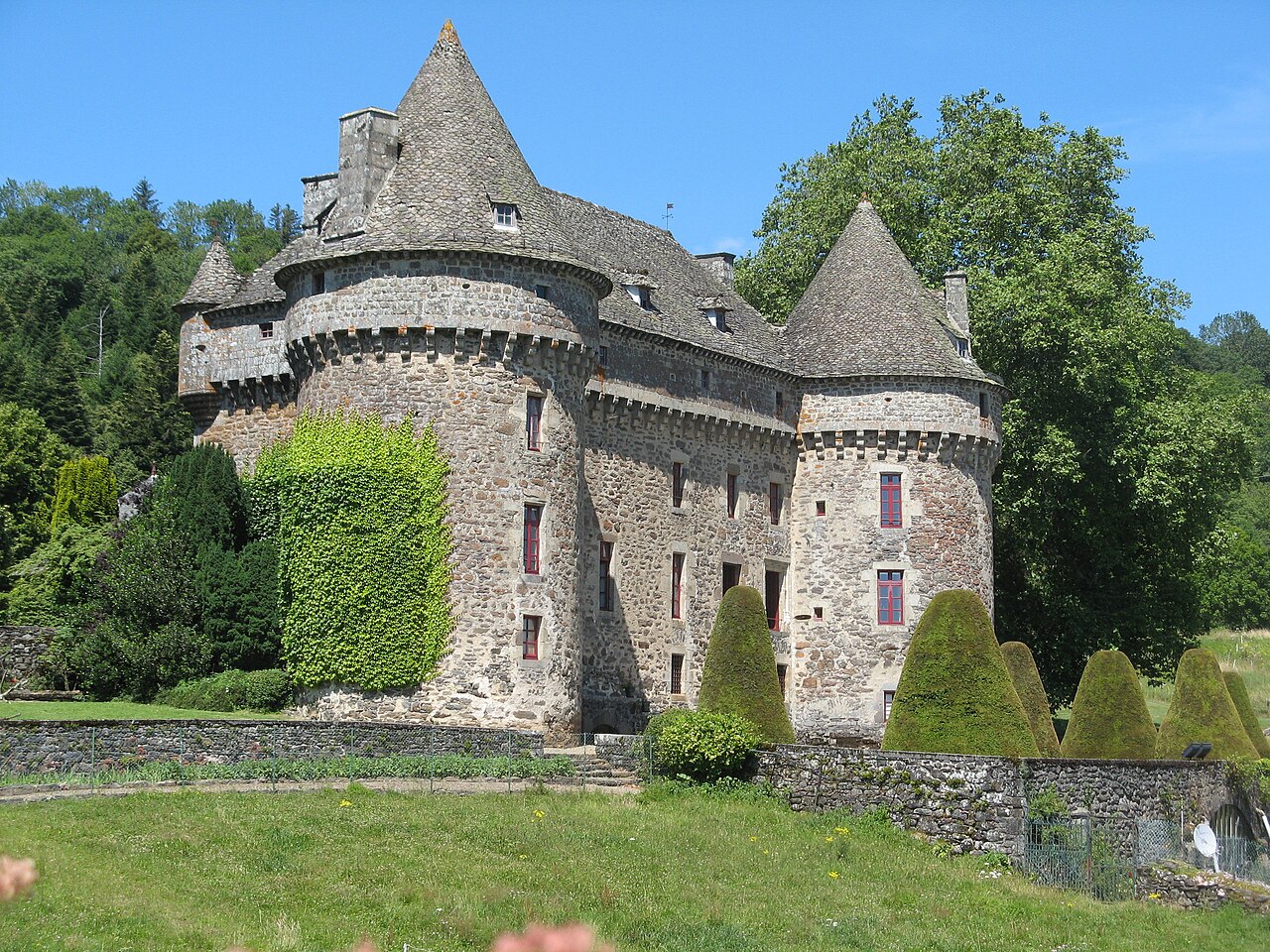
Apchon Castle
Apchon Castle, or Château d'Apchon, is a medieval fortress located next to the village of Apchon in the Cantal department of France. Positioned on a prominent basaltic outcrop overlooking the village, the castle's strategic location provided commanding views of the surrounding Auvergne countryside. This site has a long history of fortification, with legends attributing its first construction to a Roman officer during Julius Caesar's campaigns, although the earliest documented mention dates to 998 AD.
Early history and origins
The first known owner was Amblard I d'Apchon, who held the castle in the late 10th century, making Apchon one of the oldest castles in the Auvergne region. Initially, the fortification was likely a wooden structure typical of early medieval defensive sites. During the 11th century, the Apchon family rebuilt the castle in stone, transforming it into a more durable and imposing medieval fortress. This stone reconstruction marked the transition from timber to masonry, a common evolution in castle architecture reflecting advancements in military technology and the need for stronger defenses.
Architectural development and features
The castle is built on a natural volcanic outcrop, which itself serves as a formidable defensive feature. The stone fortress included an inner castle surrounded by seven towers, which were added or rebuilt between 1408 and 1422. These towers provided multiple vantage points for surveillance and defense. The curtain walls connecting the towers formed a strong perimeter, while the elevated position on the basalt outcrop enhanced its defensive capabilities.
The castle's layout and construction reflect typical high medieval military architecture, with thick walls, battlements, and narrow windows designed for archers. The towers likely included arrow slits and machicolations to defend against attackers. The use of local basalt stone gave the castle a distinctive dark appearance and contributed to its durability.
Role during the hundred years' war
During the 14th century, Apchon Castle gained significant military importance due to its location near the border with the Limousin region, which fell under English control during the Hundred Years' War. As a frontier fortress, it was repeatedly besieged by English forces but successfully resisted capture. Its resilience made it a key stronghold in the region.
Guillaume VI d'Apchon used the castle as a base for the reconquest of Limousin, demonstrating its strategic value. The castle's fortifications were strengthened during this period, including the reconstruction of the inner castle and towers, which enhanced its defensive capabilities against siege warfare.
Decline and current state
Apchon Castle remained inhabited until at least 1747 but was reported as uninhabitable by 1760. After this period, it was likely abandoned and fell into ruin. In the 19th century, the castle was gradually dismantled as local inhabitants used its stones for construction, a common fate for many medieval ruins.
Today, Apchon Castle stands as a partially preserved ruin accessible to the public. Visitors can explore the remains of the towers and walls while enjoying panoramic views of the surrounding Auvergne landscape. Despite its ruined state, the castle retains significant historical and architectural interest as a representative example of a high medieval stone fortress in central France.
Cultural and heritage significance
As one of the oldest castles in the Auvergne, Apchon Castle is an important monument illustrating the evolution of medieval fortifications from wooden motte-and-bailey designs to stone castles. Its role in the Hundred Years' War and its endurance against English sieges highlight its military and historical importance.
The castle's location and ruins contribute to the cultural landscape of the Cantal department, attracting visitors interested in medieval history, architecture, and scenic views. Preservation efforts focus on maintaining the site as a heritage landmark and promoting public access.
Visiting apchon castle
Apchon Castle is freely accessible to visitors year-round. The site offers a unique opportunity to explore medieval ruins in a natural setting. While facilities may be limited due to its ruinous condition, the castle's elevated position provides excellent views and a tangible connection to the region's medieval past.
Frequently asked questions (FAQ)
- How do I get to Apchon Castle?
- Apchon Castle is located next to the village of Apchon in the Cantal department of France, near the D49 road. Visitors can reach it by car or local transport to Apchon village, then walk a short distance to the basaltic outcrop where the castle stands.
- What is the historical significance of Apchon Castle?
- Apchon Castle is one of the oldest castles in the Auvergne region, dating back to the 11th century. It played a key role during the Hundred Years' War as a frontier fortress resisting English sieges and served as a base for the reconquest of the Limousin region.
- Can I visit Apchon Castle year-round?
- Yes, Apchon Castle is freely accessible throughout the year. Visitors should be prepared for uneven terrain and limited facilities due to its ruinous condition.
- What architectural features can I see at Apchon Castle?
- Visitors can explore the remains of the castle's seven towers, curtain walls, and the basaltic outcrop foundation. The castle exhibits typical Gothic military architecture, including thick stone walls and defensive towers.
- Is Apchon Castle suitable for families and children?
- While the castle ruins are open to all visitors, the uneven ground and lack of safety barriers may require supervision for children. Families should exercise caution when exploring the site.
Information
Address
Next to the D49-road, Apchon, Cantal, France
Loading map...
Visitor reviews
No reviews yet. Been here? Write the first review and help other travelers!
Write the first reviewVisited this castle? Share your experience
Your review helps other travelers and adds first-hand knowledge to our encyclopedia.