Ankara Castle
Ankara Castle, located in the Altındağ district of Ankara, Turkey, stands as a monumental testament to the region's rich and layered history. Its origins trace back to early civilizations, with archaeological evidence suggesting the initial foundations may have been laid by the Phrygians in the 8th century BCE. Over millennia, this strategic hilltop fortress evolved through the hands of Celts, Romans, Byzantines, Seljuks, and Ottomans, each leaving a distinct imprint on its architecture and function.
Ancient foundations and early history
The site of Ankara Castle was initially part of a Celtic settlement known as the Galatian city following the Phrygian period. Around 278 BCE, the Galatians fortified the area, establishing Ankara as a significant regional center. The Romans later recognized its strategic importance, undertaking major reconstruction efforts under Emperor Caracalla in 217 CE. Despite these enhancements, the castle suffered damages during the Roman-Persian conflicts between 222 and 260 CE, reflecting the turbulent military history of the region.
Byzantine reconstruction and medieval transformations
The fortress as it largely appears today was primarily constructed in the 7th century CE, following the Persian conquest and near destruction of Ankara around 622 CE. Some architectural elements date from the reign of Byzantine Emperor Constantine II in 668 CE. The castle served as a vital strategic administrative and transportation center for the Byzantines until the late 8th century.
In 797 CE, the castle fell to Arab forces under Harun al-Rashid, marking a significant shift in regional power. Later, the Paulicians, a Christian sect, occupied the fortress in 871 CE. The Seljuk Turks seized control around 1073 CE, introducing Islamic architectural influences, including the construction of a mosque at the inner entrance in 1197 CE by Sultan Alaeddin.
The castle briefly experienced Crusader control in 1101 CE before ultimately becoming part of the expanding Ottoman Empire in 1356 CE. Throughout these periods, Ankara Castle remained a focal point of military and political significance.
Architectural features and defensive structures
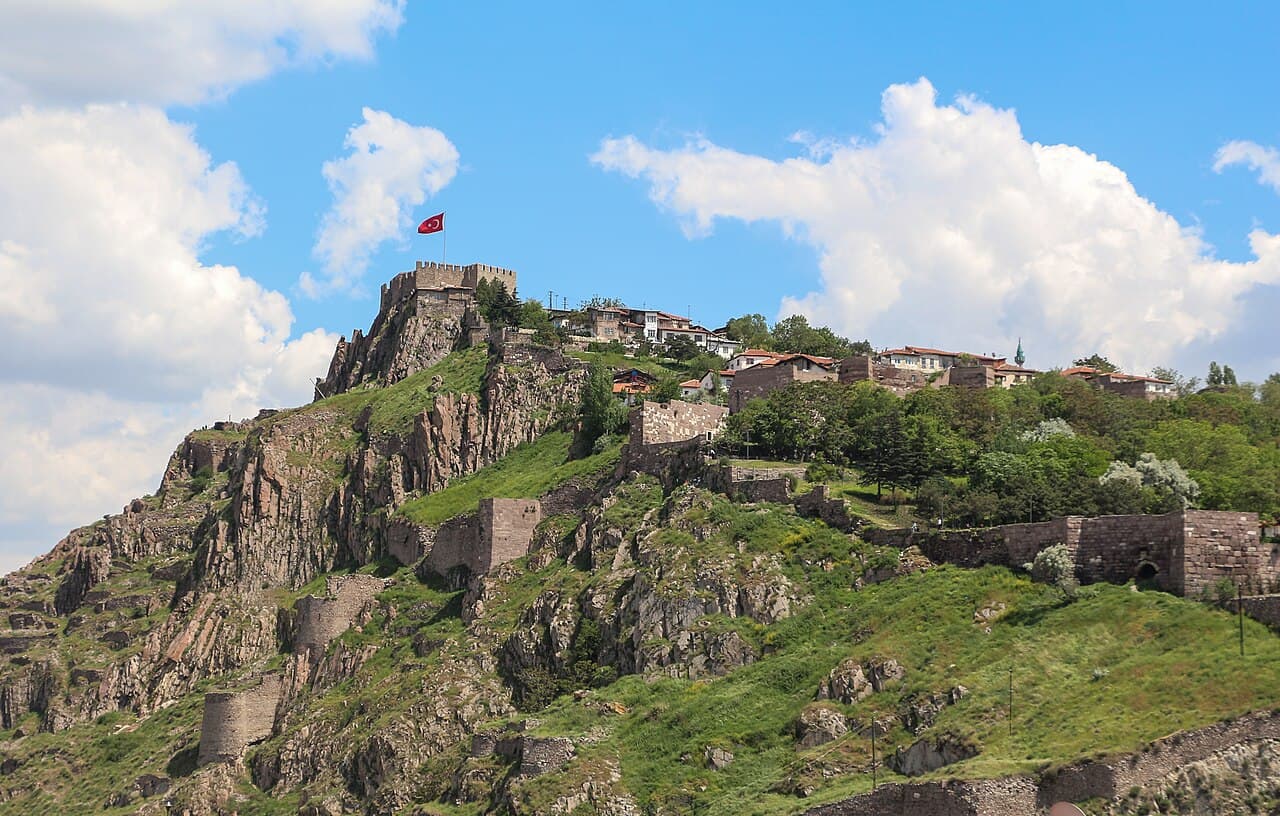
Ankara Castle is a classic example of a hill castle, strategically positioned to dominate the surrounding landscape. It comprises two concentric defensive walls enclosing the historic city core. The outer wall stretches approximately 350 meters north to south and 180 meters east to west, featuring around twenty towers spaced roughly every 40 meters. This design provided comprehensive surveillance and defense capabilities.
The inner wall encloses about 43,000 square meters and is fortified with 42 pentagonal towers, predominantly along the east, west, and south walls. These towers are closely spaced every 15 to 20 meters, including five prominent corner towers. The walls vary in height from 14 to 16 meters, constructed robustly to withstand prolonged sieges. The layout follows the natural hill contours, with the south and west walls intersecting at right angles and the east wall curving along the hillside.
The castle's highest point is the Akkale (Alitaşı) tower, a four-story structure at the southeast corner of the inner fortification. This tower, built primarily from local Ankara stone and reused Roman materials such as marble blocks and column capitals, stands as a dominant architectural feature. The use of spolia not only reflects practical reuse but also symbolizes continuity across eras.
Building materials vary, with foundations and lower walls made of durable marble and basalt, while upper sections incorporate brickwork, some of which shows signs of wear. The castle's interior housed a vibrant community, with approximately 600 residences constructed from wood, adobe, and brick, rising two to three stories. These dwellings clustered around small squares that functioned as bazaars—historically known as Atpazarı, Samanpazarı, and Koyunpazarı—which supported the economic and social life within the fortress.
Gateways, inscriptions, and cultural significance
Two main gateways provide access to the inner castle: an outer gate and the fortress gate. These entrances bear inscriptions from different historical periods, including one from the Ilkhanate period and another attributed to the Seljuk era. These inscriptions offer valuable insights into the castle's multifaceted history and the diverse powers that controlled it.
Throughout its history, Ankara Castle has endured natural disasters, notably an earthquake in 1688 that caused structural damage. Restoration efforts were made in 1832 by Kavalalı İbrahim Pasha. In the 20th century, the castle was occupied by Allied forces after World War I until it was incorporated into the Republic of Turkey in 1920. During the early republican period, the castle housed Turkey's first museum, the Eti Museum, established in 1921 under the support of Mustafa Kemal Atatürk and located in the castle's highest tower until 1948.
Historical layers and archaeological importance
Ankara Castle represents a complex architectural and historical palimpsest, showcasing centuries of Anatolian history. Its walls and towers embody the military, cultural, and political shifts from ancient Phrygian and Galatian roots through Roman, Byzantine, Seljuk, and Ottoman periods. The extensive reuse of Roman materials within the castle's fabric highlights both practical construction methods and symbolic links to the past.
Today, the castle stands as a ruined but evocative monument, offering valuable insights into early medieval fortification techniques and urban life within a fortified hilltop city. Its preservation and archaeological study continue to enrich our understanding of Anatolia's diverse historical heritage.
Frequently asked questions (FAQ)
- What is the historical significance of Ankara Castle?
- Ankara Castle, dating back to Roman times, has served as a vital fortress throughout various empires, including the Byzantines and Ottomans. It offers insights into the military architecture and strategic importance of Ankara in ancient and medieval times.
- When was Ankara Castle built?
- The exact date of construction is unclear, but the castle has origins that trace back to the Roman period, with significant expansions and renovations occurring during the Byzantine and Ottoman eras. Its current structure reflects the architectural styles of these different periods.
- What are the opening hours for Ankara Castle?
- Ankara Castle is open to visitors daily from 9:00 AM to 7:00 PM. However, it's advisable to check for any seasonal changes in hours before your visit, as they may vary.
- Can I enter Ankara Castle for free?
- There is no entrance fee to access the castle grounds, making it an affordable attraction for visitors. However, certain areas and museums within the castle may charge a small fee.
- Is it possible to explore the castle's interior?
- Yes, visitors can explore both the exterior and some interior areas of Ankara Castle. The castle features various towers and buildings that provide a glimpse into its historical significance.
- When is the best time to visit Ankara Castle?
- The best time to visit Ankara Castle is during the spring (April to June) and fall (September to November) when the weather is mild and pleasant. This allows for a comfortable exploration of the castle and its surroundings.
- What nearby attractions can I visit after Ankara Castle?
- After visiting Ankara Castle, you can explore the Museum of Anatolian Civilizations, which showcases artifacts from various historical periods. Additionally, the historic Hamamönü district nearby offers charming streets and traditional Ottoman architecture.
- How do I get to Ankara Castle?
- Ankara Castle is easily accessible by public transport, with several bus routes and metro lines servicing the area. Alternatively, taxis and rideshare options are available for a more direct route to the castle.
- What is the architectural style of Ankara Castle?
- Ankara Castle features a mix of architectural styles, including Roman, Byzantine, and Ottoman influences. This blend reflects the various cultures that have occupied the castle throughout its long history.
Photo gallery

Information
Loading map...
Visitor reviews
No reviews yet. Been here? Write the first review and help other travelers!
Write the first reviewVisited this castle? Share your experience
Your review helps other travelers and adds first-hand knowledge to our encyclopedia.