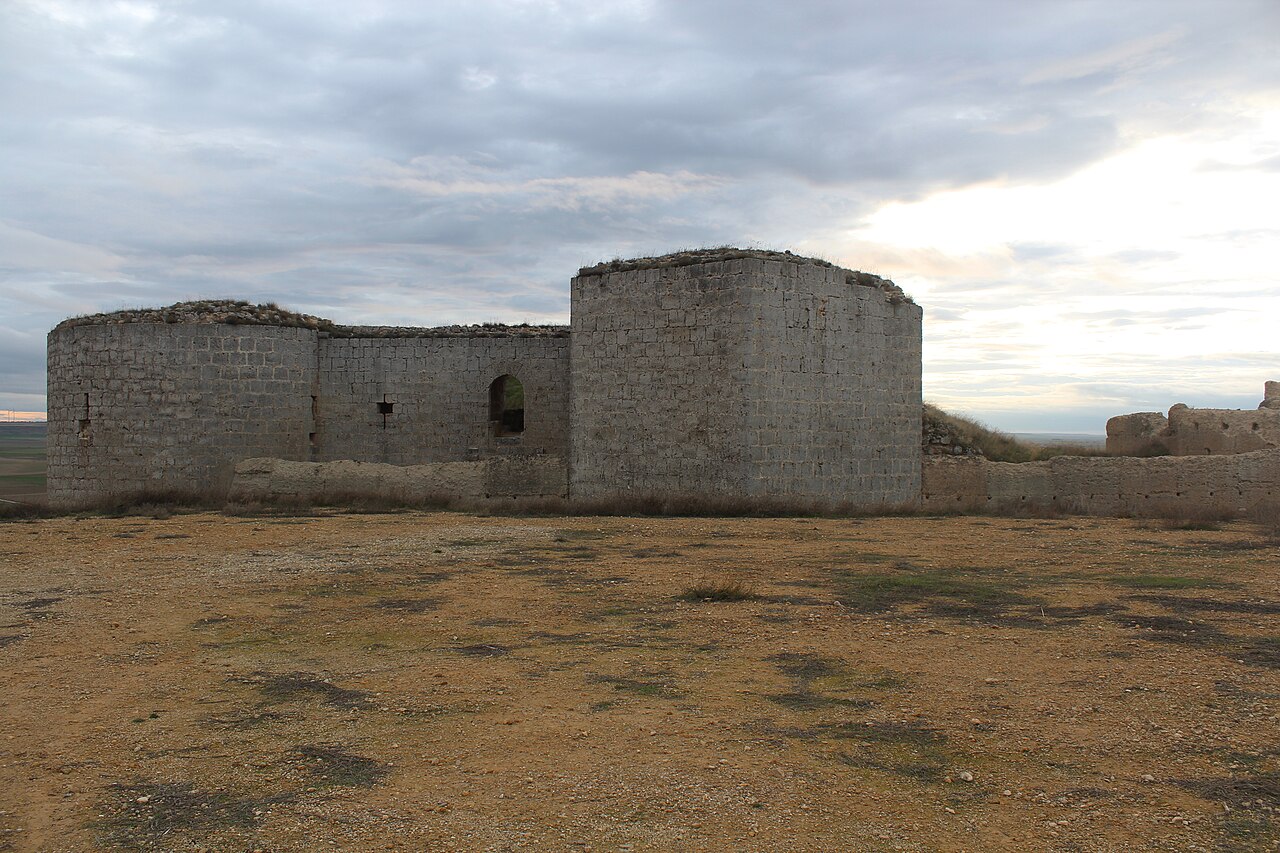
Ampudia Castle
Ampudia Castle stands as one of the most remarkable examples of late medieval Gothic architecture in the province of Palencia, Spain. Constructed primarily in the 15th century, this hill castle has preserved its imposing structure and historical significance through centuries of political upheaval, noble ownership, and careful restoration. Its strategic position and architectural features reflect the defensive needs and aristocratic prestige of the Castilian nobility during the late Middle Ages.
The castle's origins trace back to the 13th century, but it was extensively rebuilt and expanded in the 15th century under the direction of García López de Ayala, lord of Ayala and Salvatierra. This reconstruction gave the castle its characteristic square plan with a central Gothic courtyard surrounded by arcaded galleries and flanked by four large corner towers. The southwest tower, known as the torre del Homenaje, serves as the castle's keep and symbolizes feudal authority. The entire complex is encircled by a moat and a barbican fortified with cylindrical towers, enhancing its defensive capabilities.
Architectural features and layout
Ampudia Castle exhibits a trapezoidal footprint, a distinctive feature among Castilian castles of its time. The central courtyard, or Patio de Armas, is a key architectural highlight, enclosed on three sides by elegant porticoed galleries with three levels of flattened escarzano arches. The upper gallery is narrower, creating a striking visual rhythm and emphasizing the Gothic style's verticality and lightness.
The castle's defensive elements include four corner towers, three of which remain intact while the fourth collapsed due to foundation issues caused by adjacent cellars. The moat surrounding the castle, crossed by a historic drawbridge, and the barbican wall with its cylindrical towers and gatehouse, complete with ornamental escaraguaitas, demonstrate the castle's military design adapted to late medieval warfare.
Interior spaces and collections
The interior of Ampudia Castle has been converted into a museum housing the Eugenio Fontaneda Collection, named after the biscuit manufacturer who purchased and restored the castle in the 1960s. The collection is displayed across six thematic rooms, including archaeology, sacred art, toys, weapons, musical instruments, pharmacy, and ethnography and popular arts. Among the archaeological artifacts are Bronze Age weapons, Roman funerary stelae, and milestones, illustrating the region's long history.
The sacred art room contains sculptures from the 13th to 15th centuries, liturgical furniture, and paintings spanning the 15th to 18th centuries. The ethnography and popular arts section showcases traditional crafts and cultural objects, enriching visitors' understanding of local heritage. The castle's galleries also display noble coats of arms, architectural fragments, and baptismal fonts, further highlighting its aristocratic legacy.
Historical significance and ownership
Ampudia Castle has been a focal point of regional power struggles and noble lineage. It passed through the hands of several prominent families, including Juan Alfonso de Alburquerque, Sancho de Rojas, Pedro García Herrera (Marshal of Castile), and later the Dukes of Lerma and the House of Alba. The castle's history is intertwined with key historical events such as the 1521 Comunidades revolt, when it was seized by Castilian rebels led by Bishop Antonio de Acuña and subsequently retaken by royal forces under the Duke of Lerma.
In 1528, the castle served as a detention site for the sons of French King François I after the Battle of Pavia, underscoring its strategic importance. During the early 17th century, under the ownership of Francisco Gómez de Sandoval y Rojas, Duke of Lerma and favorite of King Felipe III, the castle became an occasional seat of the Spanish court, marking its period of greatest splendor.
Following this golden era, the castle experienced a long period of decline and abandonment until the mid-20th century restoration efforts by Eugenio Fontaneda Pérez, who preserved its historical fabric and transformed it into a cultural landmark.
Restoration and current use
The restoration led by Eugenio Fontaneda Pérez in the 1960s was pivotal in rescuing Ampudia Castle from ruin. His meticulous work not only stabilized the structure but also reinstated many of its original architectural features, allowing the castle to regain its former grandeur. Today, the castle remains a well-preserved monument and a private property, with guided tours available for visitors to explore the ground floor and museum rooms.
While the upper levels and the keep are not open to the public, the accessible areas provide a rich experience of medieval architecture and Spanish noble history. The castle's designation as a National Historic-Artistic Monument since 1931 affirms its cultural and historical value.
Visitor information and cultural importance
Ampudia Castle is a significant heritage site that attracts visitors interested in medieval architecture, Spanish history, and museum collections. Its combination of military design and aristocratic residence offers insight into the lifestyle and defense strategies of Castilian nobility in the late Middle Ages.
The castle's museum collections, especially the Eugenio Fontaneda Collection, provide a comprehensive overview of the region's archaeological and artistic heritage. Visitors can appreciate artifacts spanning from prehistoric times through the Renaissance, enhancing the educational value of the visit.
Its location in the town of Ampudia makes it accessible for cultural tourism within the province of Palencia, contributing to local identity and historical awareness. The castle's preservation and continued use as a museum underscore the importance of safeguarding Spain's medieval architectural legacy for future generations.
Frequently asked questions (FAQ)
- How do I visit Ampudia Castle?
- Ampudia Castle is privately owned but offers guided tours of the ground floor and museum rooms. Visitors should check local tourism websites for updated opening hours and tour availability.
- What is the historical significance of Ampudia Castle?
- Ampudia Castle played a key role during the 1521 Comunidades revolt and served as a detention site for French royal hostages after the Battle of Pavia. It was an occasional seat of the Spanish court under the Duke of Lerma.
- What architectural style is Ampudia Castle built in?
- Ampudia Castle is a prime example of late medieval Gothic architecture, featuring a trapezoidal layout, a central Gothic courtyard with arcaded galleries, and fortified corner towers.
- Are there museum collections inside Ampudia Castle?
- Yes, the castle houses the Eugenio Fontaneda Collection, which includes archaeological artifacts, sacred art, toys, weapons, musical instruments, pharmacy items, and ethnographic objects.
- Is Ampudia Castle accessible for visitors with mobility issues?
- Due to its medieval structure, some areas of Ampudia Castle may be challenging for visitors with mobility issues. The ground floor and museum rooms are more accessible, but visitors should inquire in advance about accommodations.
- When was Ampudia Castle declared a national monument?
- Ampudia Castle was declared a National Historic-Artistic Monument on July 3, 1931, recognizing its cultural and architectural importance.
Information
Sources & official resources
Verify the information above using these authoritative references.
Loading map...
Visitor reviews
No reviews yet. Been here? Write the first review and help other travelers!
Write the first reviewVisited this castle? Share your experience
Your review helps other travelers and adds first-hand knowledge to our encyclopedia.