
Vítkův kámen
Vítkův kámen castle stands as a remarkable medieval hilltop fortress in the Czech Republic, notable for its commanding position and rich history. Located near the municipality of Přední Výtoň, this castle ruin crowns a rocky hill at an elevation of 1,035 meters, making it the highest castle site in the country. Its strategic location offered sweeping views of the Bohemian and Alpine landscapes, underscoring its military and administrative importance over several centuries.
The castle's origins trace back to around 1250, when Vítek I of Krumlov, a prominent member of the Vítkovci noble family, established the stronghold. This family wielded significant influence in the region during the High Medieval period. Positioned on a steep rocky hill, the fortress was designed primarily for border defense and to serve as the administrative center of the family's estates. Although the first reliable written record dates from 1347, earlier sources suggest the site was in existence before 1277, highlighting its longstanding medieval presence.
Historical development and ownership transitions
Throughout its history, Vítkův kámen experienced several changes in ownership and underwent various phases of expansion and fortification. In 1302, control of the castle passed to the powerful Rožmberk family, one of Bohemia's most influential noble lineages. The Rožmberks maintained possession for over three centuries, with a brief interruption during the Hussite Wars. In 1427, amid the religious conflicts of the time, the castle was sold to Reinprecht of Walsee but was returned to the Rožmberks by 1464.
During the Rožmberk stewardship, Vítkův kámen was significantly expanded and fortified. The castle's defenses were enhanced with the construction of a substantial stone curtain wall enclosing a trapezoidal courtyard and the addition of five bastions in the 16th century. These bastions were designed specifically to accommodate handheld firearms, reflecting the evolution of military technology and siege warfare tactics of the period.
Notably, in 1394, the castle briefly held King Václav IV prisoner, underscoring its political and military significance. By the late 14th century, the estate controlled by the castle included fifteen villages and a glassworks, illustrating its economic importance.
In 1602, Peter Vok of Rožmberk sold Vítkův kámen to Emperor Rudolf II of the Habsburg dynasty. The castle's strategic position made it a focal point during the Bohemian Revolt of 1618, when insurgent forces besieged it. The garrison was reinforced to two hundred soldiers to withstand the threat. Subsequently, ownership transferred to the Eggenberg family, and the castle served as an imperial military post throughout the Thirty Years’ War, reflecting its ongoing military relevance.
After the mid-18th century, Vítkův kámen fell into decline following a damaging fire and a lack of maintenance. However, in 1869, the Schwarzenberg family undertook partial restoration efforts, including converting the main tower into a lookout point, preserving part of the structure for posterity.
During the Cold War, the castle's elevated location was repurposed by Czechoslovak state air defense forces as an observation post, maintaining a military presence until around 1990. Ownership then passed to the local municipality, and from 1998, a civic group led renovations that included installing a wooden staircase to the tower's viewing platform, enhancing visitor access and appreciation of the panoramic vistas.
Architectural features and layout
The residential tower and courtyard
The core of Vítkův kámen’s remains centers on a residential tower, or donjon, originally measuring approximately 14 by 17.5 meters and rising to four stories. Constructed with thick stone walls, the tower's ground floor featured narrow slit windows to provide light while maintaining defensive strength. The upper floors served residential and operational purposes, with larger window openings and access to latrines, indicating a balance of comfort and functionality.
The first floor likely contained several rooms separated by wooden partitions beneath a large hall, while the upper stories were used for defense and daily operations. Access to the tower was via a bridge connecting from an adjacent rocky outcrop, spanning a defensive gap into a trapezoidal courtyard enclosed by a substantial stone curtain wall.
Within the courtyard stood various castle buildings, including a vaulted structure along the northeastern wall divided into three rooms at ground level with a platform above. This platform was probably intended for mounting small artillery pieces, reflecting the castle's defensive adaptations over time.
Fortifications and bastions
In response to evolving military threats, the castle's defenses were upgraded in the 16th century with an outer wall featuring five bastions. These bastions were specifically designed for handheld firearms, differing from earlier fortifications that relied on earthen ramparts. The bastions incorporated multiple vertically stacked firing positions across three levels, continuous shooting galleries, and loopholes to allow defenders to cover all approaches effectively.
A moat or ditch once fronted the principal entrance, though the original gatehouse, believed to have been tower-like, no longer survives. Defensive structures also included a large semicircular wall closing off the southern bastion’s inner side, creating a rondel—a rounded fortification occupying the rocky outcrop at the castle’s entrance. A similar rounded structure may have existed near the gatehouse area, enhancing the castle's layered defenses.
Later modifications and adaptations
Before the outbreak of the Thirty Years’ War, the tower was heightened by an additional floor, and minor alterations were made to doors and windows, possibly to improve both comfort and defense. The addition of gables to the tower’s roof likely dates to this period, adding architectural character while enhancing weather protection.
Today, the most prominent remains are the ruined tower and scattered fragments of outer walls and supporting buildings. The tower has been adapted with a wooden stairway of sixty-one steps leading visitors to a viewing platform that offers panoramic views of the surrounding landscape.
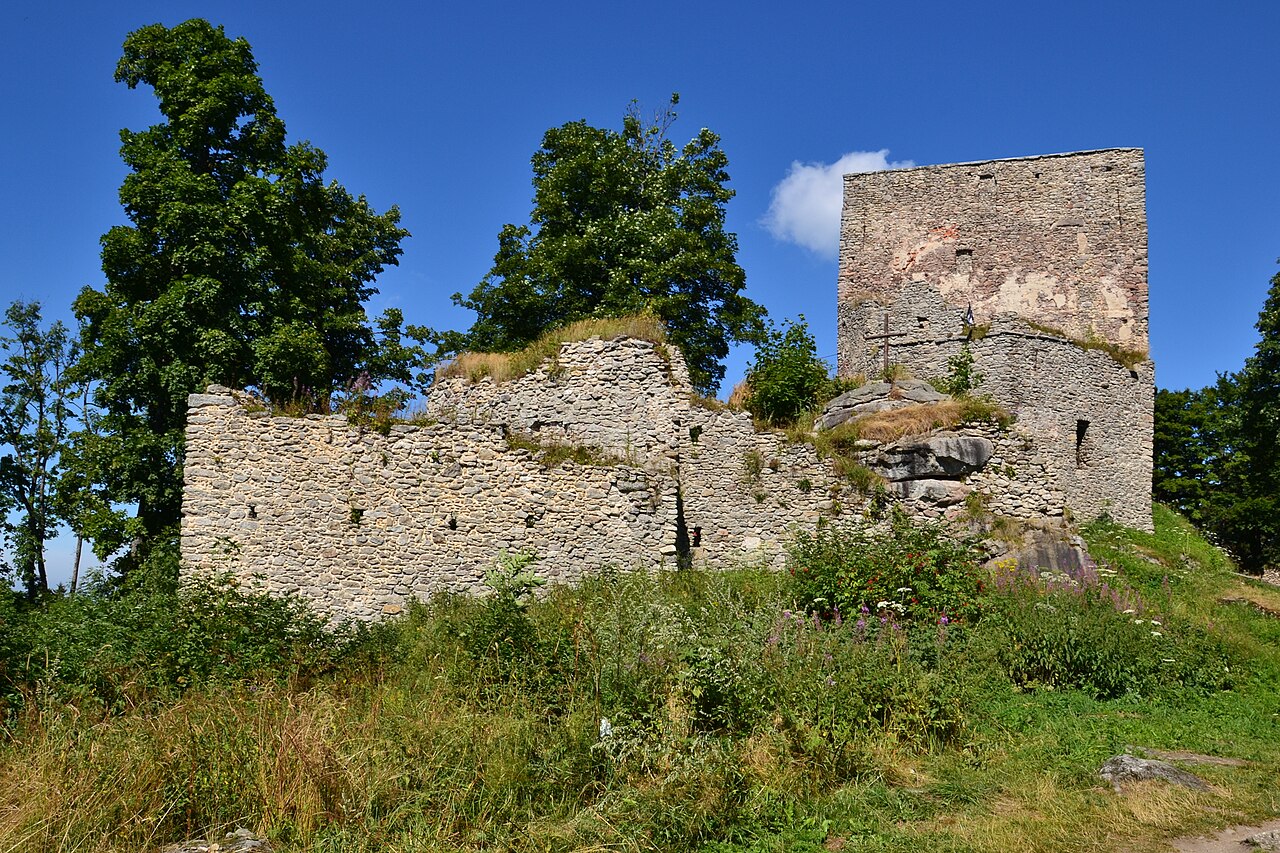
Photo by Petr Kinšt • CC BY-SA 4.0
Cultural significance and modern preservation
Vítkův kámen holds a notable place in Czech cultural history, inspiring literary works such as Adalbert Stifter’s historical novel "Witiko" and Adolf Heyduk’s tragedy "Under Vítkův kámen." These works reflect the castle’s enduring presence in the regional imagination and its symbolic importance.
A statue commemorating Vítek I was erected near the ruins in 2017, although it was removed in 2023. The castle’s commanding views and historical depth continue to attract visitors and researchers interested in medieval architecture and Bohemian history.
Managed by a local civic group, ongoing preservation efforts focus on maintaining the site’s accessibility and structural integrity while highlighting its historical and architectural significance. The castle’s status as the highest hilltop fortress in Czechia emphasizes its unique role in the medieval defense network and its value as a cultural heritage landmark.
Frequently asked questions (FAQ)
- How do I get to Vítkův kámen castle?
- Vítkův kámen castle is located near Přední Výtoň in South Bohemia. Visitors can reach the site by car or hiking trails leading up to the hilltop, with signage directing to the ruins.
- What is the best time to visit Vítkův kámen?
- The best time to visit Vítkův kámen is during late spring through early autumn when weather conditions are favorable for hiking and the panoramic views are clear.
- Is Vítkův kámen accessible for visitors with limited mobility?
- Due to its hilltop location and rugged terrain, access to Vítkův kámen involves steep paths and stairs, which may be challenging for visitors with limited mobility.
- What architectural features are notable at Vítkův kámen?
- Notable features include the ruined residential tower or donjon, the trapezoidal courtyard enclosed by stone curtain walls, and the 16th-century bastions designed for handheld firearms.
- Can I climb the tower at Vítkův kámen?
- Yes, the tower has a wooden staircase with sixty-one steps leading to a viewing platform, offering panoramic views of the surrounding Bohemian and Alpine landscapes.
- When was Vítkův kámen built?
- Vítkův kámen was constructed around 1250 by Vítek I of Krumlov, a member of the Vítkovci noble family.
- Are there any nearby attractions to visit along with Vítkův kámen?
- Nearby attractions include the picturesque town of Český Krumlov, known for its historic center and castle, as well as the natural beauty of the Šumava National Park.
Photo gallery

Information
Loading map...
Visitor reviews
No reviews yet. Be the first to share your experience!