
Vinné Castle Ruins
Vinné Castle is a striking example of a Gothic hill castle ruin located near the village of Vinné in eastern Slovakia. Constructed in the second half of the 13th century, it was strategically built to protect a vital trade route leading to Poland. The castle’s placement on a volcanic andesite hill in the foothills of the Vihorlat Mountains afforded it a commanding view of the surrounding landscape, making it a formidable defensive stronghold during the High Medieval period.
From its inception, Vinné Castle was closely tied to the noble families of the Michalovce region and integrated into their landed estates. Its earliest known written record dates back to 1312, during a time of regional unrest, when the castle was attacked by the Omodejovci family amid their rebellion against King Charles Robert of Hungary. This early conflict underscores the castle’s importance in local power struggles and its role as a military and administrative center.
Historical significance and turbulent past
Throughout its history, Vinné Castle witnessed numerous conflicts and sieges that shaped its development and eventual decline. In 1466, the fortress suffered severe damage during the war between King Matthias Corvinus of Hungary and Polish King Casimir IV. This conflict was part of broader regional power struggles in Central Europe during the late Middle Ages.
Following this, the castle was repaired and fortified in the early 16th century, reflecting the ongoing military importance of the site. However, in 1594, it again endured significant damage when besieged by the imperial army, an event that further weakened its defensive capabilities. The noble Sztáray family, who held the castle at the time, undertook restoration efforts, but by the mid-17th century, they abandoned the fortress in favor of more comfortable manor houses in the nearby village. The castle’s remote and difficult-to-access location likely contributed to this decision.
The final blow to Vinné Castle came in the early 18th century during the 1711 uprising against Habsburg rule. The Hungarian Diet ordered the deliberate demolition of the castle to prevent its future use as a rebel stronghold. Since then, the castle has remained a ruin, a silent witness to centuries of Central European history.
Architectural features and layout
Vinné Castle was constructed following an irregular, roughly triangular plan that closely conformed to the shape of the volcanic hill on which it stands. This adaptation to the natural terrain is typical of hill castles built for defensive advantage.
The castle was originally enclosed by robust curtain walls that protected a central courtyard. Early construction included a defensive tower and a three-room palace accessible from the courtyard, forming the core of the fortress. By the early 14th century, the complex had expanded to include two towers, a main palace, an older gate, and a chapel dedicated to Saint Margaret. Residential buildings for inhabitants were also added, reflecting the castle’s role as both a military and domestic site.
The main tower and defensive structures
A 1449 description notes that the principal tower rose to four floors and included vaulted cellars beneath. This tower contained a dungeon, a common feature in medieval fortifications used for imprisonment and storage. The tower’s stone ashlar masonry, with finely cut blocks fitted closely together, exemplifies the skilled craftsmanship of the period. Original window and door openings survive along with fragments of old plaster, offering insight into the castle’s construction techniques.
The eastern entrance was guarded by a prism-shaped defensive tower, now preserved as ruins through which visitors pass. This tower was a critical element of the castle’s defenses, controlling access to the interior.
Residential and economic buildings
Within the castle, residential buildings with vaulted ceilings from the Renaissance period demonstrate continued occupation and adaptation beyond the Gothic era. The palace features traces of fireplaces and architectural niches, while vaulted cellar spaces below were likely used for storage.
Along the outer curtain wall, remnants of economic buildings such as kitchens and workshops once stood. A preserved garderobe, a medieval latrine projecting from the wall, remains as a testament to the castle’s domestic infrastructure. Surrounding the castle are earthworks including ramparts and ditches, which enhanced the fortress’s defensive capabilities. Some of these earthworks have been cleared of overgrowth in recent conservation efforts.
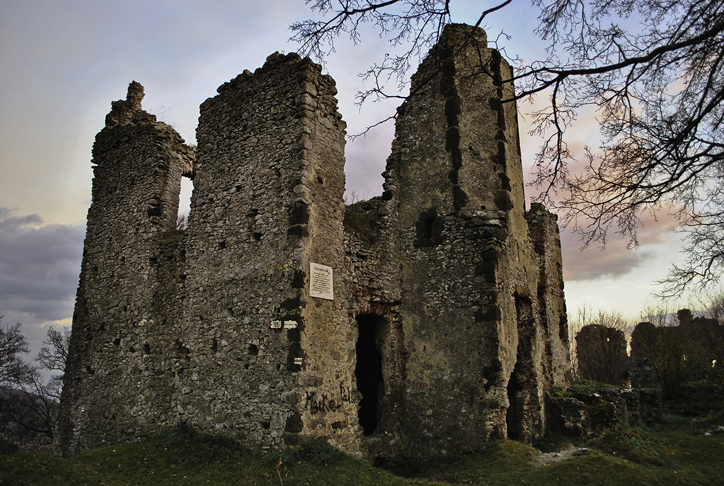
Photo by Patrik.cimprich • CC BY-SA 3.0
Archaeological discoveries and preservation efforts
Excavations conducted in the 19th century unearthed a rich collection of artifacts, shedding light on the castle’s long history. Nearly two thousand copper coins were found, alongside Renaissance-era stove tiles, fragments of decorative facade elements, metal keys, arrowheads, and ceramic objects. These finds highlight the castle’s role as a vibrant medieval center and provide valuable information about the daily life and material culture of its inhabitants.
In the 20th century, efforts to preserve the ruins began in earnest. The site was declared a cultural monument in 1963, recognizing its historical and architectural significance. To protect the unique flora and fauna of the hill, the surrounding area was designated a nature reserve in 1984. Since 2011, local organizations have actively worked to conserve and partially restore the castle remains, including the installation of a temporary technical roof to shield the palace structures from weathering during restoration.
Visiting the ruins today
Today, Vinné Castle ruins attract visitors interested in medieval history, architecture, and nature. The site offers a tangible connection to the turbulent history of the region and showcases the architectural ingenuity of medieval builders who adapted their designs to challenging terrain. Visitors can explore the surviving curtain walls, towers, vaulted cellars, and remnants of residential buildings while enjoying panoramic views from the volcanic hilltop.
The castle’s location within a nature reserve adds an ecological dimension to the visit, with opportunities to observe distinctive plants and wildlife native to the Vihorlat Mountains foothills. Conservation efforts continue to preserve this important cultural landmark for future generations, ensuring that Vinné Castle remains a significant monument in Slovakia’s medieval heritage.
Frequently asked questions (FAQ)
- What are the opening hours for Vinné Castle Ruins?
- Vinné Castle Ruins are typically open to visitors from April to October, with hours varying by month. It is advisable to check the official website or local tourist information for specific opening times, as they may change due to holidays or events.
- How do I get to Vinné Castle Ruins?
- Vinné Castle Ruins are located near the village of Vinné in Slovakia. Visitors can reach the site by car, and there is parking available nearby. Public transportation options may include local buses, but it's best to check current schedules for the most accurate information.
- What is the historical significance of Vinné Castle Ruins?
- Vinné Castle Ruins date back to the 13th century and served as an important defensive structure in the region. The castle played a key role in local history, protecting the area from invasions and serving as a residence for nobility.
- Can I explore the ruins on my own?
- Yes, visitors are generally allowed to explore the ruins of Vinné Castle on their own. However, guided tours may be available for those interested in learning more about the site's history and architecture.
- Is it possible to access the castle with a wheelchair?
- Unfortunately, Vinné Castle Ruins may pose challenges for wheelchair accessibility due to uneven terrain and steps. It is recommended to contact local authorities or visitor services for detailed information on accessibility options before planning your visit.
- When is the best time to visit Vinné Castle Ruins?
- The best time to visit Vinné Castle Ruins is during the late spring and early autumn months when the weather is mild and the surrounding landscape is at its most vibrant. Visiting during these times can enhance your experience of the natural beauty and historical significance of the site.
- What are the ticket prices for visiting Vinné Castle Ruins?
- Ticket prices for Vinné Castle Ruins are generally quite affordable, with discounts often available for students and seniors. It's best to check the official website for the latest pricing information and any special deals that may be offered during the season.
- Are there any nearby attractions to visit after Vinné Castle Ruins?
- Yes, there are several nearby attractions worth exploring, such as the picturesque village of Vinné and the stunning Zemplínska Šírava lake. Additionally, hiking opportunities and other historical sites can be found in the surrounding area, making it a great destination for a full day of exploration.
Photo gallery

Information
Website
Visit websiteLoading map...
Visitor reviews
No reviews yet. Be the first to share your experience!