
Valdštejn Castle
Valdštejn Castle, also known as Waldstein Castle, is a remarkable early Gothic fortress situated near Turnov in the Czech Republic. Built in the second half of the 13th century, this hill castle occupies a strategic position atop three sandstone cliffs, offering commanding views over the surrounding Bohemian landscape. Its foundation between 1260 and 1280 marks it as a significant medieval stronghold established by the noble Waldstein family, descendants of the influential Markvartic lineage. Over centuries, the castle witnessed pivotal historical events, transformations, and a unique evolution from a military fortress to a Baroque pilgrimage site.
Founding and medieval significance
The origins of Valdštejn Castle trace back to the late High Medieval period, when Jaroslav of Hruštice or his son Zdeněk likely initiated its construction. The castle's name derives from the Germanized form of the family name Waldstein, reflecting the cultural intermingling in Bohemia during the Middle Ages. For roughly a century, the castle served as the ancestral seat of the Waldstein family, who played prominent roles in the political and military affairs of the region. Notable figures include Zdeněk, a courtier to King John of Bohemia, Hynek, who participated in a military expedition to Lithuania in 1336, and Jan, a financier who supported the future King Charles IV.
Ownership transitions and military role
By the late 14th century, around 1380, the castle came under the ownership of the Vartenberk family, also descendants of the Markvartic line. During the Hussite Wars in the early 15th century, Valdštejn Castle became a focal point of military activity. It was seized in 1424 by the renowned Hussite leader Jan Žižka, who entrusted it to an ally based at nearby Valečov. The castle also functioned as a prison, notably holding Prince Sigismund Korybutovič for a year starting in 1427. Subsequently, it served as a refuge for Hussite supporters and later fell into the hands of robber knights until royal forces expelled them.
Decline and ruin after the 16th century fire
Around 1550, a catastrophic fire devastated Valdštejn Castle, leaving it largely in ruins by 1582. Despite the estate's reacquisition in 1620 by Albrecht von Wallenstein, a prominent figure of the Thirty Years' War and a member of the Waldstein family, no efforts were made to restore the fortress. Consequently, the castle remained abandoned and fell into further decay over the following centuries.
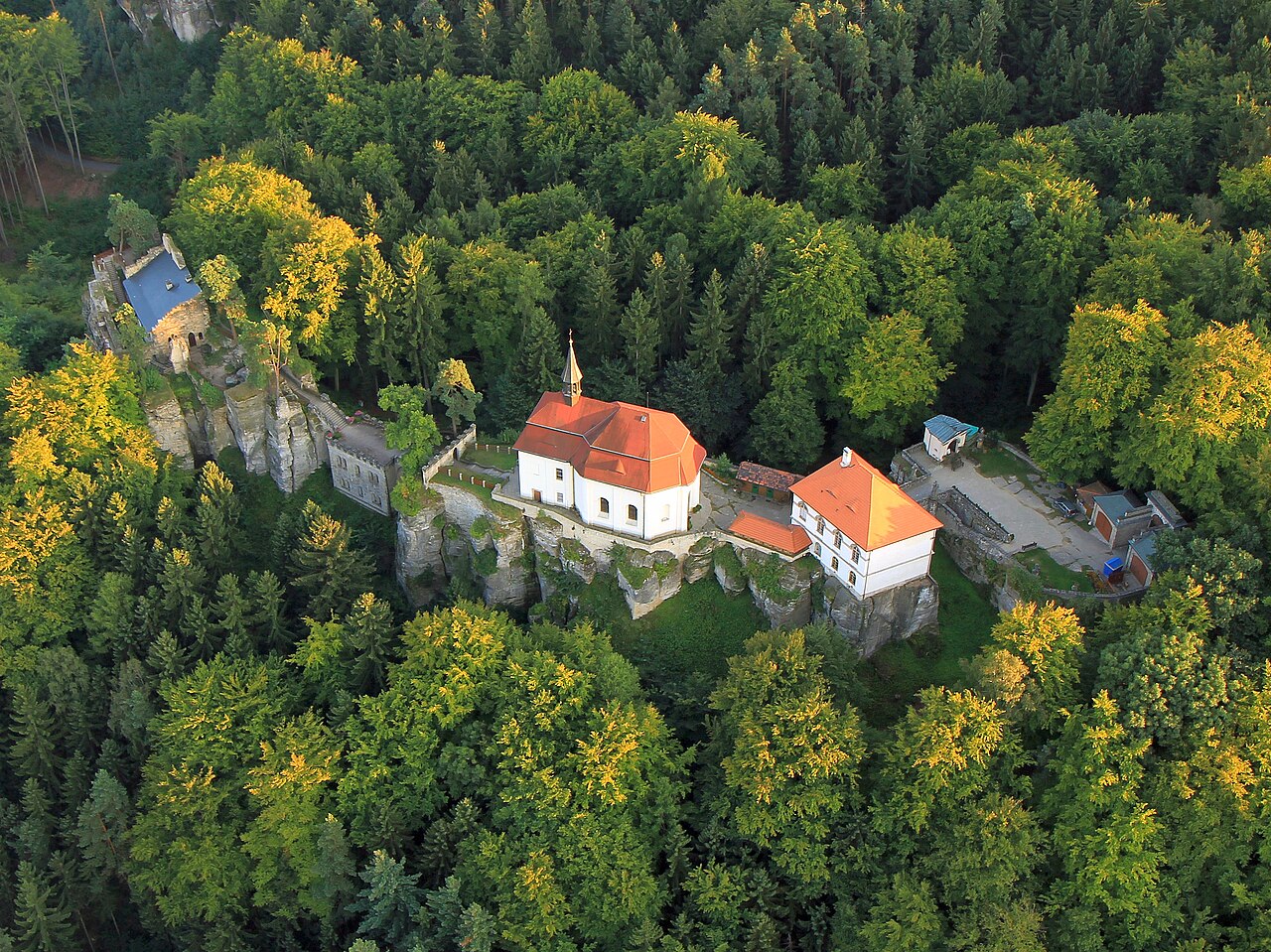
Photo by Zdeněk Fiedler • CC BY-SA 3.0
Baroque pilgrimage transformation
In the late 17th century, the castle's ruins gained new spiritual significance. Starting in 1694, Václav Karel Holan Rovenský, a Baroque composer and former organist from Prague, lived as a hermit within the ruins. His presence attracted pilgrims, transforming the site into a religious destination. In 1722, the Waldstein family constructed a pilgrimage church dedicated to St. John of Nepomuk on the castle's first courtyard, marking a shift from military to religious use.
Baroque chapels and statuary
The Baroque period saw the addition of several religious structures and artistic elements. Two stone bridges adorned with sandstone statues of Bohemian saints connected key parts of the site. A chapel dedicated to St. John the Baptist was erected in 1817, further enriching the sacred atmosphere. The original Baroque statues, crafted by the Jelínek brothers between 1725 and 1735, are preserved inside the chapel, with faithful copies displayed outdoors to maintain historical authenticity.
19th-century neo-gothic restoration and architectural layering
Between 1824 and 1843, the Aehrenthal family undertook a significant restoration project in the neo-Gothic style, characteristic of 19th-century historicism. This effort integrated the medieval ruins with newly built structures, blending Gothic revival elements with the existing Baroque chapels. A stone entrance gate featuring statues was constructed in 1836, enhancing the castle's monumental presence. The restoration included a main residential building designed in a classical style and preserved palace remnants, creating a complex architectural narrative that reflects centuries of evolving tastes and functions.
Architectural features and natural setting
Valdštejn Castle is uniquely situated on three sandstone rock formations connected by wooden bridges. This layout maximizes natural defenses by utilizing the vertical cliffs and a deep ditch carved into the terrain. The castle's original Gothic features included a donjon, serving as the strongest defensive tower, and a wooden watchtower for surveillance. Vaulted cellars carved into the living rock beneath the fortress provided secure storage and shelter.
The castle ruins are surrounded by a wooded area on three sides and stand approximately 389 meters above sea level, with a dramatic vertical drop of about 90 meters. Its proximity to the Hruboskalsko nature reserve makes it accessible via hiking trails from Turnov, linking historical exploration with natural beauty.
Cultural heritage and current status
Since 1945, the ruins of Valdštejn Castle have been owned by the town of Turnov. Today, they represent an important cultural and historical landmark in the region, attracting visitors interested in medieval architecture, Baroque religious art, and Bohemian history. The site offers a rich tapestry of architectural styles, from Gothic fortifications to Baroque chapels and 19th-century neo-Gothic restorations, embodying the layered history of Central Europe.
Visitors can explore the castle's remains, including the donjon, vaulted cellars, chapels, and statues, while enjoying panoramic views of the surrounding landscape. The castle's transformation from a medieval fortress to a spiritual pilgrimage site and later a historic monument reflects broader historical currents in Czechia and the Bohemian region.
Frequently asked questions (FAQ)
- How do I get to Valdštejn Castle from Turnov?
- Valdštejn Castle is accessible by several hiking trails starting from Turnov, offering scenic routes through the surrounding forests and natural reserves. The hike is moderately challenging and well-marked, making it a popular day trip for visitors.
- What is the historical significance of Valdštejn Castle?
- Valdštejn Castle was a key medieval fortress established by the Waldstein family in the 13th century and played an important role during the Hussite Wars. Its later transformation into a Baroque pilgrimage site adds to its cultural and historical importance.
- Can I visit the interior of Valdštejn Castle?
- The castle is mostly in ruins, but visitors can explore the remains of the donjon, vaulted cellars, and Baroque chapels. There are no fully restored interiors, but the site offers informative signage and panoramic views.
- When is the best time to visit Valdštejn Castle?
- The best time to visit is during late spring to early autumn when the weather is favorable for hiking and outdoor exploration. The surrounding nature reserve is especially beautiful during these months.
- Is there an entrance fee to Valdštejn Castle?
- No, visiting Valdštejn Castle is free of charge. The site is open year-round and accessible to the public without an entrance fee.
Photo gallery

Information
Opening hours
Open year-round, accessible via hiking trails
Ticket prices
Free
Current owner
Town of Turnov
Website
Visit websiteLoading map...
Visitor reviews
No reviews yet. Be the first to share your experience!