
Turégano Castle
The Castle of Turégano is a remarkable 15th-century hill castle located in the town of Turégano, north of Segovia, Spain. This fortress is notable for its unique integration with the adjacent Church of San Miguel, combining military and religious architecture in a single complex. The castle stands on a commanding rocky promontory overlooking the town, a strategic location that has been fortified since ancient times, reflecting a long history of occupation and adaptation.
The origins and early history of Turégano Castle
The site of Turégano Castle has a layered past beginning with a Celtiberian settlement, which laid the groundwork for subsequent fortifications. During the early medieval period, the location was occupied by an Arab fortress, remnants of which survive in the form of northern towers and sections of rammed earth walls. These elements demonstrate early defensive techniques using compacted soil, a method characteristic of Arab military architecture in the Iberian Peninsula.
In the late 12th century, Bishop Pedro de Agén initiated the construction of the Romanesque Church of San Miguel within the fortified enclosure. This church features three naves, with the two lateral naves dating from the 12th century and a central nave distinguished by a pointed barrel vault, an architectural feature that anticipates the Gothic style. The interior is divided into four bays by transverse arches supported on engaged columns, whose capitals are decorated with both figurative carvings and vegetal motifs, illustrating the artistic richness of medieval religious architecture. Access to the church is provided by entrances on the south and west façades.
Architectural evolution and expansion in the late medieval period
In 1471, Bishop Arias Dávila commissioned a major expansion of the fortress, transforming it into a fortress-palace that enveloped the pre-existing church. This construction phase reflects the late medieval period's architectural and military innovations. The fortress was designed not only for defense but also as a residence for ecclesiastical authority, blending martial and administrative functions.
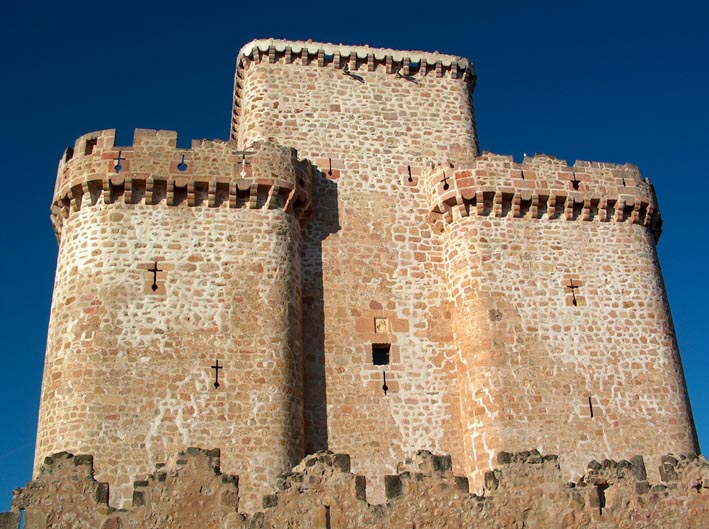
The 16th century brought further modifications to adapt the castle to the changing nature of warfare, particularly the increasing use of firearms. The walls were reinforced, and cylindrical towers were added to improve defensive capabilities and provide better angles of fire. These adaptations illustrate the transition from medieval fortifications designed for protection against siege engines to those capable of withstanding gunpowder weapons.
The castle’s role in political and military history
Turégano Castle's strategic importance extended beyond its architectural significance. In 1585, it served as the prison for Antonio Pérez, the disgraced secretary to King Philip II. Pérez's imprisonment here highlights the castle's role in the political intrigues of the Spanish monarchy. An attempted rescue led by supporters from the nearby village of Muñoveros was ultimately unsuccessful, underscoring the castle’s secure and formidable design.
Throughout its history, the castle also functioned as a symbol of ecclesiastical power in the region, with the bishops of Segovia using it as a stronghold and administrative center. Its commanding position and robust construction made it a key asset in local conflicts and governance.
Architectural features and artistic elements
The castle complex is a blend of military and religious architecture, with the Church of San Miguel at its core. The church’s Romanesque style is evident in its robust masonry, semicircular arches, and the detailed capitals of its engaged columns. The pointed barrel vault of the central nave marks a stylistic transition toward early Gothic architecture, adding architectural interest and structural innovation.
The fortress walls, constructed primarily of stone, enclose the church and include several defensive towers. The cylindrical towers added in the 16th century reflect the adaptation to firearms, offering improved defensive coverage. The walls themselves were thickened and reinforced to withstand cannon fire and other artillery.
One of the most distinctive features is the Baroque bell gable added in 1703 to the southern façade of the church. This element introduces an 18th-century artistic style atop the medieval structure, illustrating the castle’s continued evolution and the layering of architectural periods.
Preservation and current status
Declared a National Monument in 1931, Turégano Castle is recognized for its cultural and historical significance. The site preserves a remarkable combination of architectural features spanning from its Celtiberian origins through medieval and early modern periods. Its condition is generally well preserved, with ongoing efforts to maintain the structure.
Since 1994, the Diocese of Segovia has allowed the local town council to use the castle, excluding the church building, under a renewable agreement. This arrangement has helped ensure the castle’s preservation and accessibility for public appreciation and cultural activities.
Visiting Turégano Castle
Visitors to Turégano can explore the striking integration of the fortress and church, appreciating the blend of military and religious architecture. The castle's elevated position offers panoramic views of the surrounding landscape and the town below. The site provides insight into the evolution of fortification techniques and ecclesiastical architecture from the 12th to the 18th centuries.
The castle and church remain important landmarks in the region, attracting those interested in medieval history, architecture, and Spanish heritage. The combination of Romanesque, late medieval, and Baroque elements makes Turégano Castle a unique destination for cultural tourism.
Frequently asked questions (FAQ)
- How do I get to Turégano Castle?
- Turégano Castle is located in the town of Turégano, north of Segovia, Spain. It is accessible by road, with parking available nearby. Visitors can reach the castle by car or local bus services from Segovia.
- What are the opening hours of Turégano Castle?
- The castle is generally open to visitors during daylight hours, but specific opening times may vary. It is advisable to check with the local tourism office or the town council for the most current visiting hours.
- Is there an entrance fee to visit Turégano Castle?
- Entrance fees may apply depending on the events or exhibitions held at the castle. Visitors should verify ticket prices in advance through official sources or local tourist information centers.
- What architectural styles are visible at Turégano Castle?
- Turégano Castle showcases a blend of <strong>Romanesque</strong> and <strong>late medieval</strong> military architecture, with later <strong>Baroque</strong> additions such as the bell gable on the church’s southern façade.
- Can I visit the Church of San Miguel inside the castle?
- The Church of San Miguel is an integral part of the castle complex and can be visited. It features Romanesque architecture with early Gothic elements, including a pointed barrel vault and decorated capitals.
- Why is Turégano Castle historically significant?
- The castle is significant for its fusion of military and religious architecture, its role in imprisoning Antonio Pérez in 1585, and its representation of evolving fortification techniques from the Arab period through the 16th century.

Information
Website
Visit websiteLoading map...
Visitor reviews
No reviews yet. Be the first to share your experience!