
Turňa Castle
Turňa Castle stands as a significant medieval fortress perched on a rocky hill above the village of Turňa nad Bodvou in present-day Slovakia. This hill castle was strategically constructed by the medieval Kingdom of Hungary, overseeing the surrounding Turňa county near the historical border with Hungary. Its commanding position on a karst hill composed of limestone and travertine gave it a natural defensive advantage, making it a critical stronghold throughout centuries of regional conflict.
The castle's origins date back to the aftermath of the devastating Mongol invasion of 1241. According to tradition, the Slovak nobleman Ján Turňanský (Tornay), a vassal rewarded for his defense efforts, founded the initial fortification in the first half of the 13th century. The earliest structure centered on a stone donjon tower, a polygonal or rectangular main tower that served as the core defensive element. This tower was originally accessed via a door on the first floor and was encircled by its own fortified walls, representing the castle's earliest phase.
Medieval expansion and ownership changes
The first written record of Turňa Castle appears in 1357, marking a period of significant expansion. During this time, a Gothic-style palace was constructed north of the tower, likely connected to it, creating a cohesive residential and defensive complex. Later, a younger palace was added on the eastern side of the courtyard, with surviving walls featuring window openings that hint at the castle's evolving residential needs.
Throughout the 14th and early 15th centuries, the castle passed through several noble families following the extinction of the original Turňanský line in 1406. It was owned by István Berencsi, who adopted the Tornay name, then by Štefan Šafár of Branč in 1409, and by Imre Bebek by 1440. Imre Bebek, a Hungarian noble who died at the Battle of Kosovo in 1448, witnessed the castle enduring a siege by Hussite forces under Jan Iskra in the same year. The siege was lifted three years later when the Hungarian military leader János Hunyadi compelled Iskra to pledge loyalty to the Hungarian crown, securing the castle’s allegiance.
Renaissance reconstruction and military significance
In 1476, Imre Zapolya, a magnate of Croatian descent, acquired the castle, with his family holding it until 1531. The 16th century brought significant military challenges due to the advancing Ottoman Empire. Between 1540 and 1550, Turňa Castle underwent extensive reconstruction and strengthening, incorporating Renaissance military architectural elements to withstand artillery warfare.
This phase introduced artillery bastions at the castle's southwestern corner and additional bastions on the south and east sides. A large bastion defended the approach from the northwest near the main entrance, which was protected by thick walls approximately three meters wide. Adjacent to the entrance stood a rounded defensive structure called a rondella, designed to control artillery fire over the western approach. Narrow wall corridors along the southern and eastern sides featured several rondellas equipped for cannon defense, providing comprehensive coverage against attackers advancing up the steep hillside.
Among the surviving defensive features is a distinctive pistol loophole shaped in a "trouser" form, allowing defenders to fire small firearms while remaining protected. The castle's fortifications reflect the transition from medieval to early modern military architecture, adapting to the increasing use of gunpowder weapons.
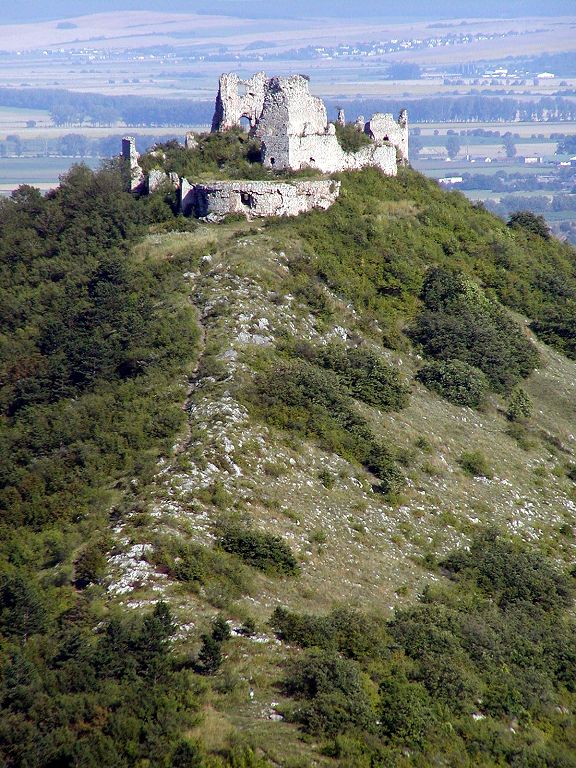
Photo by Martin Hlauka (Pescan) 09:24, 31 July 2005 (UTC) • Attribution
Conflicts and decline in the 17th century
The 17th century was a turbulent era for Turňa Castle, marked by ongoing conflicts involving Transylvanian princes and Ottoman raids. The fortress was occupied by Gábor Bethlen in 1612 and suffered attacks in 1652 and 1675. The Kuruc uprisings led by Imre Tököly further destabilized the region. In 1685, the castle was captured by imperial general Schultz, who ordered its demolition to prevent future military use by Kuruc rebels. Since then, Turňa Castle has remained in ruins.
Architectural remains and archaeological efforts
Today, the ruins of Turňa Castle reveal its complex architectural evolution. The irregular layout follows the natural contours of the karst hill. The oldest donjon tower and its surrounding walls form the core, while the Gothic palace and later Renaissance bastions illustrate the castle’s adaptation through centuries.
The ruins include substantial multi-story palace walls along the eastern courtyard boundary, the tower’s former upper access door, and window openings. Near the inner gate, remnants of economic buildings and storage spaces indicate the castle's functional aspects beyond defense.
The original access road, carved into the limestone bedrock with visible wheel ruts, remains traceable, highlighting the historical routes to the fortress. Dense vegetation now covers much of the site, but ongoing archaeological excavations and conservation efforts by the volunteer organization CASTELLUM TORNENSIS since the 1970s have helped reveal and preserve the castle’s layout and fortifications.
Cultural and historical significance
Turňa Castle stands as a testament to the region’s medieval and early modern history, reflecting the architectural and military developments from the 13th to the 17th centuries. Its strategic location and enduring ruins offer valuable insights into the defensive strategies employed against Mongol invasions, Hussite sieges, and Ottoman advances. The castle’s layered history of noble ownership, military conflict, and architectural adaptation make it a significant cultural heritage site in Slovakia.
Frequently asked questions (FAQ)
- How do I get to Turňa Castle?
- Turňa Castle is located above the village of Turňa nad Bodvou in the Košice Region of Slovakia. Visitors typically reach the site by hiking up the hill from the village, as the castle is situated on a rocky karst hill.
- What is the historical significance of Turňa Castle?
- Turňa Castle played a crucial role in regional defense from the 13th to the 17th centuries, witnessing sieges during the Hussite wars and Ottoman incursions. It reflects medieval and Renaissance military architecture adapted to evolving warfare.
- Can I explore the ruins of Turňa Castle?
- Yes, visitors can explore the ruins, although dense vegetation covers much of the site. Conservation efforts have made key parts accessible, revealing the tower, palace walls, and bastions. Proper footwear and caution are advised due to uneven terrain.
- When was Turňa Castle built?
- Turňa Castle was originally constructed in the 13th century, following the Mongol invasion of 1241, starting with a stone donjon tower as the core defensive structure.
- Is Turňa Castle open year-round?
- Visiting hours for Turňa Castle are not strictly regulated as it is a ruin on a hill. Visitors are advised to check local tourism information for seasonal accessibility and weather conditions before planning a visit.
Photo gallery

Photo by Martin Hlauka (Pescan) 09:24, 31 July 2005 (UTC)•Attribution
Information
Current owner
Private owner
Loading map...
Visitor reviews
No reviews yet. Be the first to share your experience!