
Torre del Tostón
Torre del Tostón stands as a remarkable example of 18th-century coastal defense architecture on the island of Fuerteventura in the Canary Islands, Spain. Constructed between 1740 and 1743, this military watchtower was a strategic response to the increasing threat of pirate raids that plagued the northern coast of the island. Its establishment reflects the broader Spanish efforts to fortify their Atlantic territories during a period of intense maritime conflict and piracy.
Historical context and construction
The tower was commissioned following a significant pirate attack by British forces in 1740, which exposed the vulnerabilities of Fuerteventura's northern coastline. In reaction to this threat, Andrés Bonito y Pignatelli, the Spanish General Captain of the Canary Islands, ordered the construction of two key defensive towers. These fortifications aimed to protect vital harbors from incursions by Berber, French, and British pirates. The design and construction were overseen by Claudio de L’Isle, a military engineer tasked with ensuring the towers' effectiveness and durability.
Contrary to earlier beliefs, Torre del Tostón was not built on the ruins of a 15th-century fortress known as Rico Roque. This misconception was clarified through historical research that located the original Rico Roque fortress nearly five kilometers away on Fuerteventura’s east coast near Pozo Negro. This distinction underscores the tower's unique place in the island's defensive network rather than a continuation of earlier fortifications.
Architectural features and design
Strategically positioned on a cliff southeast of El Cotillo, the tower is constructed primarily from dark volcanic stones sourced locally near the adjacent church. Its truncated conical form features a circular base with a diameter of 14.5 meters tapering to 12.5 meters at the top, with walls over 1.5 meters thick. This robust construction was designed to withstand attacks and provide a formidable defensive presence.
The tower comprises two main floors and a rooftop platform. The lower floor housed a powder magazine and an adjacent storage room, essential for maintaining the tower's armaments and supplies. The upper floor served as living quarters for a garrison of up to twelve soldiers, accessible via a landward entrance reached by a stone staircase and a wooden drawbridge suspended by iron chains. A defensive loophole above the entrance allowed defenders to repel attackers effectively.
Inside, staircases lead to the lower floor and the rooftop platform. The rooftop was equipped with three iron cannons positioned to defend the harbor and coastline. Additionally, a cistern built into the rooftop collected rainwater, providing a vital resource for the stationed garrison during sieges or prolonged watch periods.
Although initial plans included a surrounding defensive moat, this feature was never realized. Nearby, two 19th-century lime kilns have been restored, offering insight into the site's industrial activities beyond its military function. The presence of the skeletal remains of a Cuvier’s beaked whale stranded in 2004 near the tower adds a unique natural history element to the location.
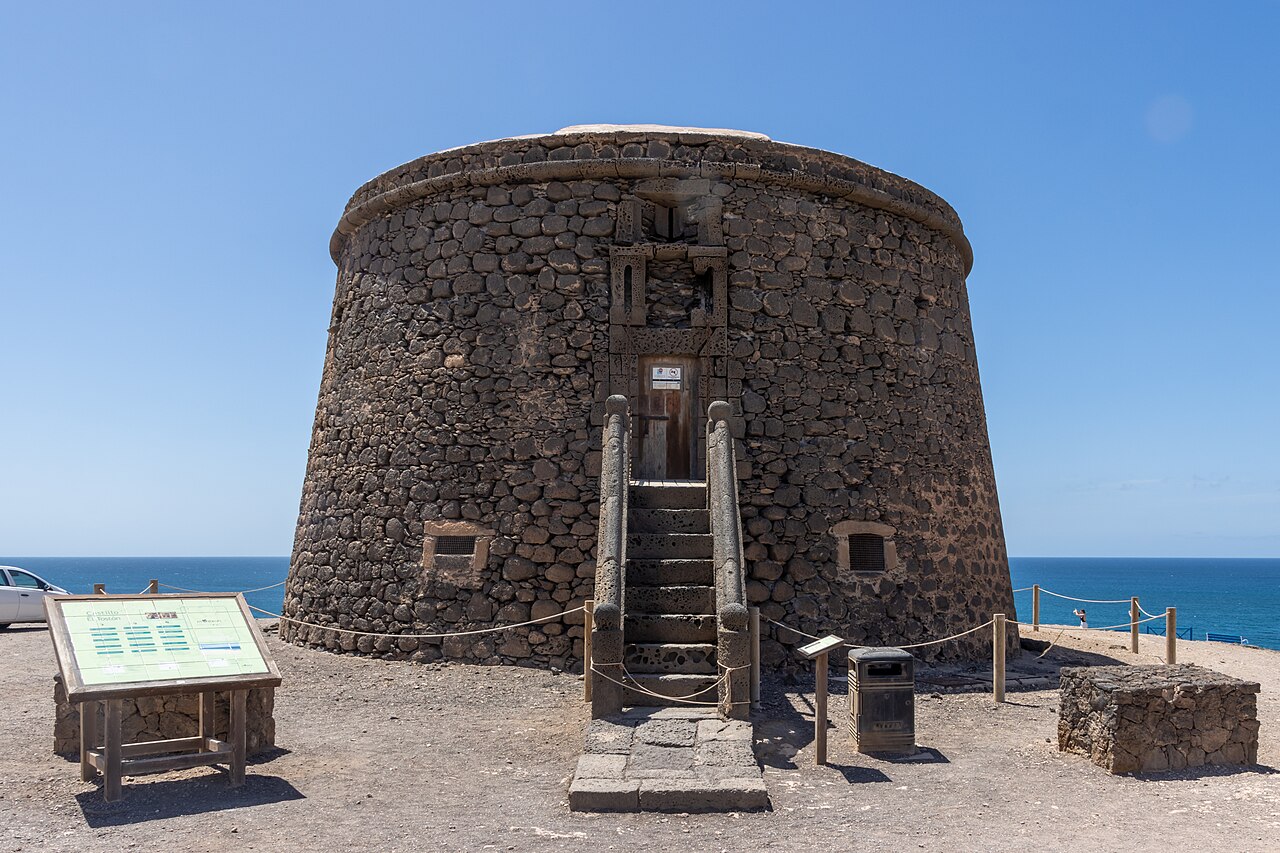
Photo by Photograph by Mike Peel (www.mikepeel.net). • CC BY-SA 4.0
Influence and legacy
Torre del Tostón served as an influential model for subsequent coastal defenses in the region. Its architectural design inspired similar towers constructed in Menorca during the late 18th century, such as the Torre d’Alcalfar and Torre de Son Ganxo. The tower's robust and functional design also prefigured the British Martello towers built in the late 1700s and early 1800s, which became a widespread coastal defense feature in the British Empire.
Since 1949, Torre del Tostón has been protected under Spain's Bien de Interés Cultural designation, recognizing its cultural and historical significance. It remains one of the best-preserved examples of 18th-century military architecture in the Canarian archipelago, offering valuable insights into the island's defensive strategies and colonial history.
Visitor experience and preservation
Today, Torre del Tostón stands prominently as a cultural heritage site, attracting visitors interested in military history, architecture, and the natural beauty of Fuerteventura's coastline. Its well-preserved structure allows visitors to explore the defensive features, including the powder magazine, living quarters, and rooftop artillery platform. The surrounding landscape offers scenic views of the Atlantic Ocean and the harbor it once protected.
The tower's preservation efforts have maintained its original materials and form, highlighting the use of local volcanic stone and traditional construction techniques. The nearby restored lime kilns add depth to the historical narrative, illustrating the site's multifaceted past. Interpretive signage and guided tours provide educational context, enhancing the visitor experience.
Frequently asked questions (FAQ)
- When was Torre del Tostón built and for what purpose?
- Torre del Tostón was built between 1740 and 1743 to defend the northern coast of Fuerteventura against pirate attacks, especially after a British raid in 1740 exposed vulnerabilities.
- What are the key architectural features of Torre del Tostón?
- The tower features a truncated conical shape with thick volcanic stone walls, two main floors including a powder magazine and living quarters, and a rooftop platform equipped with three iron cannons.
- Is Torre del Tostón open to visitors?
- Yes, Torre del Tostón is open to visitors as a protected cultural heritage site, allowing exploration of its defensive structures and enjoying scenic views of the surrounding coastline.
- What is the historical significance of Torre del Tostón?
- Torre del Tostón is a well-preserved example of 18th-century coastal defense architecture that influenced similar towers in the Canary Islands and beyond, including British Martello towers.
- Where is Torre del Tostón located?
- Torre del Tostón is located on a cliff southeast of El Cotillo in the municipality of La Oliva on the island of Fuerteventura, Canary Islands, Spain.
Photo gallery

Information
Architect
Claudio de L’Isle
Current owner
State museum
Loading map...
Visitor reviews
No reviews yet. Be the first to share your experience!