
São João Baptista d’Ajudá
São João Baptista d’Ajudá, also known as Fort St. John the Baptist of Ouidah, is a historically significant bastioned fortress located in Ouidah, Benin. Constructed in the early 18th century, specifically in 1721, it was the last of three European forts established in the region to participate in the transatlantic slave trade along the infamous Slave Coast. The fort's strategic position on the West African coast made it a key point for Portuguese commercial and military interests during the Renaissance period of European colonial expansion.
Architectural features and design
The fort is a compact bastioned fortress characterized by its star-shaped design, typical of military architecture developed in the Renaissance to withstand artillery attacks. Its thick stone walls and angular bastions allowed defenders to cover all approaches with overlapping fields of fire. The fortress includes a main gate, courtyard, and various internal chambers that served as living quarters, storage, and defensive positions.
The small size of the fort reflects its specialized function as a trading post and military outpost rather than a large-scale defensive stronghold. Despite its modest dimensions, the fort's design embodies the principles of early modern European military engineering, emphasizing both defense and control of the surrounding area.
Historical context and significance
São João Baptista d’Ajudá was built during a period when European powers were intensifying their presence along the African coast to control trade routes and resources. The fort was part of Portugal's efforts to maintain a foothold in West Africa amidst competition from other colonial powers such as France, Britain, and the Netherlands.
Its primary role was to facilitate and protect Portuguese involvement in the transatlantic slave trade. Ouidah was a major slave trading port, and the fort functioned as a hub for the collection and shipment of enslaved Africans to the Americas.
Following the early 19th-century abolition of the slave trade by many European nations, the fort's commercial importance declined, leading to periods of abandonment. However, it was reoccupied in 1865 to reaffirm Portuguese sovereignty in the area.
Colonial tensions and sovereignty disputes
In the late 19th century, the region was colonized by the French as part of their expansion into Dahomey. Despite being surrounded by French territory, Portugal insisted on retaining control of the fort, leading to an unusual enclave situation. This persistence was notable given the fort's diminished strategic value by that time.
The fort was garrisoned by troops from Portuguese São Tomé and Príncipe until 1911. After military presence ceased, it was inhabited only by the residente (governor) and his family, maintaining a symbolic Portuguese presence.
Portuguese sovereignty over the fort continued until August 1961, when the newly independent Republic of Dahomey (now Benin) seized the enclave, ending centuries of Portuguese colonial presence in the area.
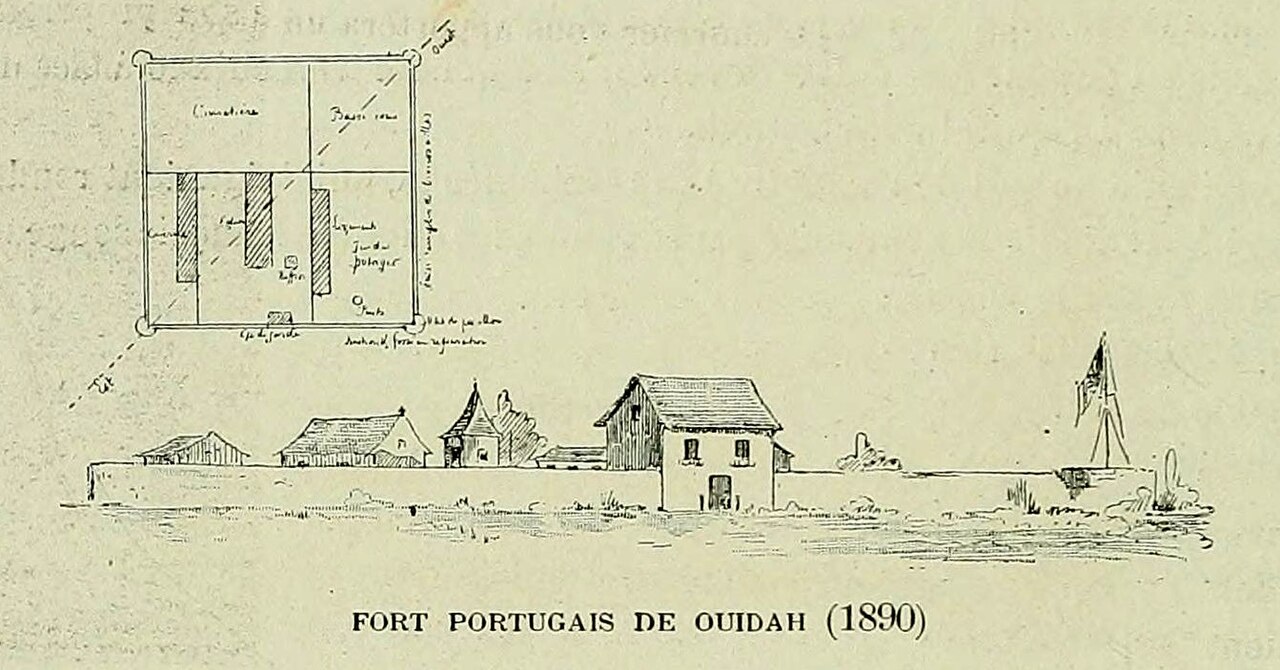
Photo by French naval officer, 1890 • Public domain
Cultural legacy and modern status
Today, the restored São João Baptista d’Ajudá stands as a cultural and historical monument within the Ouidah Museum of History. It offers visitors insight into the complex history of European colonialism, the transatlantic slave trade, and the geopolitical struggles of West Africa.
The fort's unique status as one of the smallest colonial enclaves ever recorded, highlighted in the 1958 Guinness World Records, adds to its intrigue. Its preservation allows for educational exploration of the architectural and historical narratives tied to Portuguese colonial ambitions and African history.
Visitor experience and significance
Visitors to the fort can explore its bastioned walls, courtyard, and interior rooms, gaining a tangible sense of the fort's defensive capabilities and living conditions during its operational period. The museum context enriches the experience by providing artifacts and exhibits related to the fort's role in the slave trade and colonial history.
The fort's location in Ouidah, a town with deep historical connections to the slave trade and African heritage, makes it a significant destination for those interested in understanding the darker chapters of global history and the enduring impact of European colonization in Africa.
Frequently asked questions (FAQ)
- What is the historical significance of São João Baptista d’Ajudá?
- São João Baptista d’Ajudá was a key Portuguese fort on the Slave Coast, facilitating the transatlantic slave trade and representing European colonial ambitions in West Africa during the Renaissance period.
- Can I visit São João Baptista d’Ajudá today?
- Yes, the fort is restored and open to visitors as part of the Ouidah Museum of History, offering insights into its architecture and history.
- When was the fort built?
- The fort was constructed in 1721 during the early 18th century as a Portuguese trading and military outpost.
- Why was the fort surrounded by French territory?
- After the French colonized Dahomey in the late 19th century, Portugal insisted on maintaining control over the fort, creating a small Portuguese enclave entirely surrounded by French land.
- What architectural style is São João Baptista d’Ajudá?
- The fort exemplifies Renaissance military architecture with its bastioned design, star-shaped layout, and thick defensive walls.
Photo gallery

Photo by French naval officer, 1890•Public domain
Information
Current owner
Ouidah Museum of History
Loading map...
Visitor reviews
No reviews yet. Be the first to share your experience!