Ryga
Riga Castle (Rīgas pils) stands prominently on the banks of the River Daugava in the heart of Riga, Latvia. Founded in 1330 by the Livonian Order, this historic fortress has played a pivotal role in the political and military history of the Baltic region for nearly seven centuries. Today, it serves as the official residence of the President of Latvia and houses several important museums, making it a symbol of Latvian statehood and cultural heritage.
The castle's origins trace back to a period of intense conflict between the citizens of Riga and the Livonian Order. In 1297, Riga's burghers rebelled against the Order's control, seizing and destroying the original fortress within the city walls. Following a decisive siege in 1330, the Order established a new stronghold on the northwestern edge of Riga, outside the medieval city walls, on the site of the former Convent of the Saint Spirit. This move marked the beginning of the castle's long history as a military and administrative center.
Medieval foundations and early conflicts
The initial construction phase, led by Master Eberhard von Monheim and master builder Dietrich Kreyge, lasted until around 1354. The castle was built as a convent-type fortress with a quadrangular layout surrounding an internal courtyard. It featured four corner towers and thick defensive walls, typical of high medieval military architecture. The fortress housed all the essential facilities required by the Livonian Order, including residential quarters, a chapel, and administrative rooms.
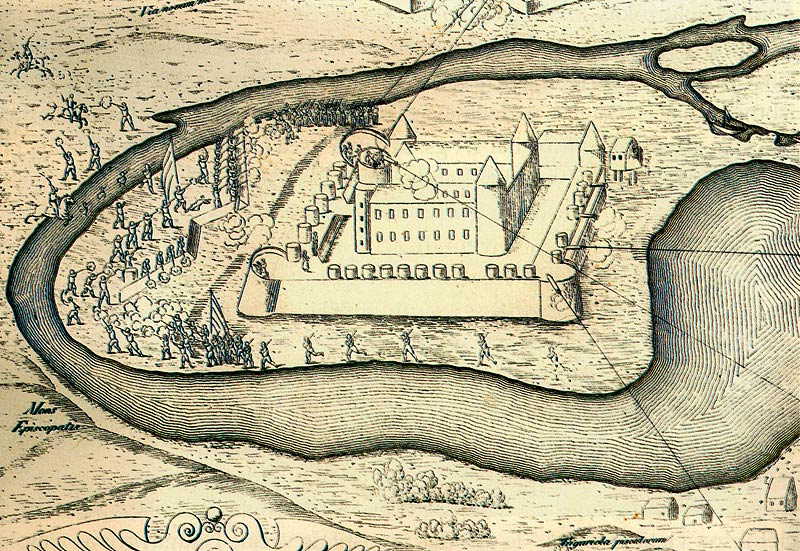
Throughout the 14th and early 15th centuries, Riga Castle served as the residence of the Master of the Livonian Order. However, persistent tensions with the city’s inhabitants led to several violent confrontations. In 1484, after a prolonged siege, Riga’s citizens captured and demolished the castle, leaving only parts of the cellar and ground floor intact. This destruction was a significant setback for the Order, which lost its stronghold in the city.
Reconstruction and architectural evolution (1497–1515)
Under pressure from Master Wolter von Plettenberg, the citizens of Riga were compelled to rebuild the castle starting in 1497. The reconstruction, completed in 1515, produced a more compact and fortified structure with a nearly square plan measuring approximately 53 by 57 meters. The castle retained the four-winged layout around an inner courtyard, which featured a central well.
The rebuilt fortress incorporated advancements in military architecture, including round towers at the southeast and northwest corners designed for artillery defense, and square towers housing staircases at the other corners. The walls, up to three meters thick, were constructed from sandstone blocks bonded with lime mortar, with bricks used to level surfaces. The castle's interior was organized with storage and workshops on the ground floor, representative chambers on the first floor, and defensive spaces including an armory in the attic.
Interior layout and defensive features
The northern wing contained the commander’s chambers and dormitory, the eastern wing housed the chapter house, the southern wing included a chapel and refectory, and the western wing likely contained the brothers’ sleeping quarters. A stone cloister on the courtyard side provided access between rooms. The main gate was located in the northern wing, controlling entry to the fortress.
Political changes and subsequent modifications
Following the secularization of the Livonian Order in 1561, Riga Castle became the residence of Gotthard Kettler, the first Duke of Courland and Semigallia, who declared himself a Protestant prince and a vassal of the Polish–Lithuanian Commonwealth. The castle then served as the seat of Polish governors and was fortified with earthworks, though no major structural changes were made during this period.
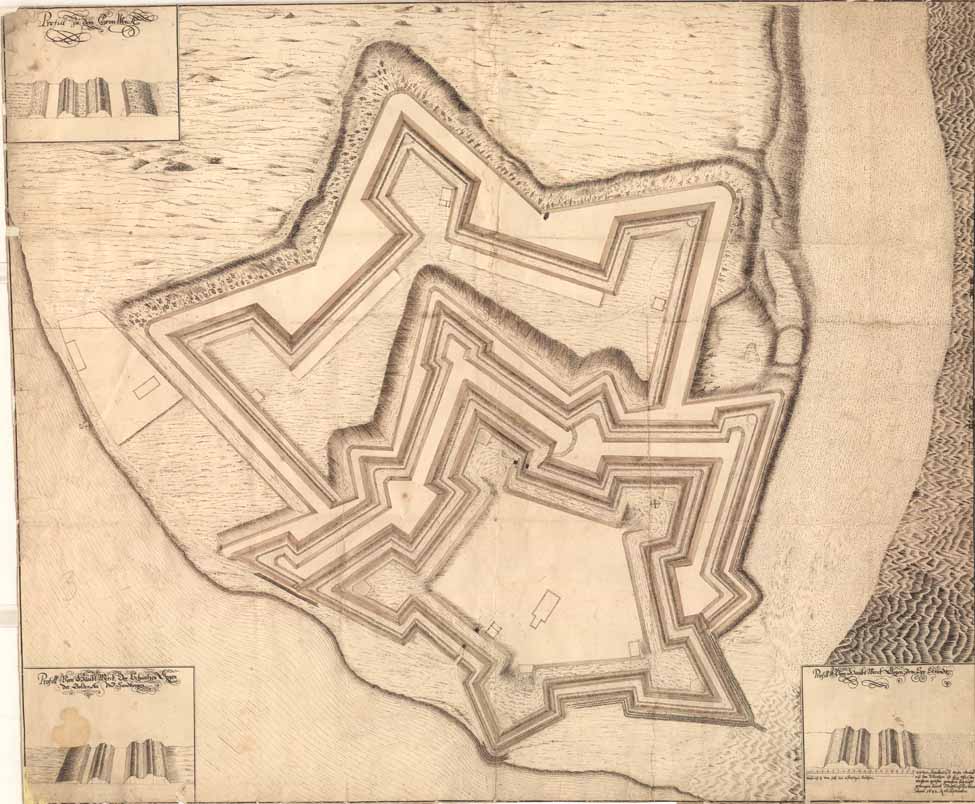
In 1621, after a lengthy siege, Swedish forces captured Riga and the castle became the residence of Swedish governors. The Swedes expanded the castle in 1642, adding an irregular quadrangle with early Baroque features, earthworks, and bastions. They also built an eastern wing and stables in 1682. The castle's military importance declined as the nearby Daugavgrīva fortress assumed greater defensive responsibilities.
Russian rule and 18th–19th century renovations
After Russian conquest in 1710, the castle became the administrative center for the Governorate of Livonia. The 18th and 19th centuries saw extensive renovations that transformed the castle from a medieval fortress into a government building. The old Swedish arsenal was demolished and replaced with a classical-style administrative building between 1783 and 1787, connecting the main castle with the forecastle.
Throughout the 19th century, the castle was remodeled several times, including the addition of the Imperial Hall and a grand granite staircase designed by architect Harald Julius Bosse. These changes reflected the castle’s evolving role as a seat of civil administration rather than a military fortress.
20th century to present: presidential residence and restoration
With the establishment of the independent Latvian state in 1919, Riga Castle was designated the official residence of the President of Latvia in 1922. Architect Eižens Laube carried out interior redesigns and added the Three Stars Tower in 1938, a distinctive feature symbolizing Latvian national identity.
During the Soviet era, the castle housed the Council of People’s Commissars of the Latvian SSR and later served as a Pioneer Palace. Several museums occupied the southern part of the castle. In 2013, a devastating fire destroyed large portions of the roof and upper floors, including valuable museum collections. Restoration efforts have been ongoing to preserve the castle’s historical and architectural legacy.
Architectural highlights and surviving features
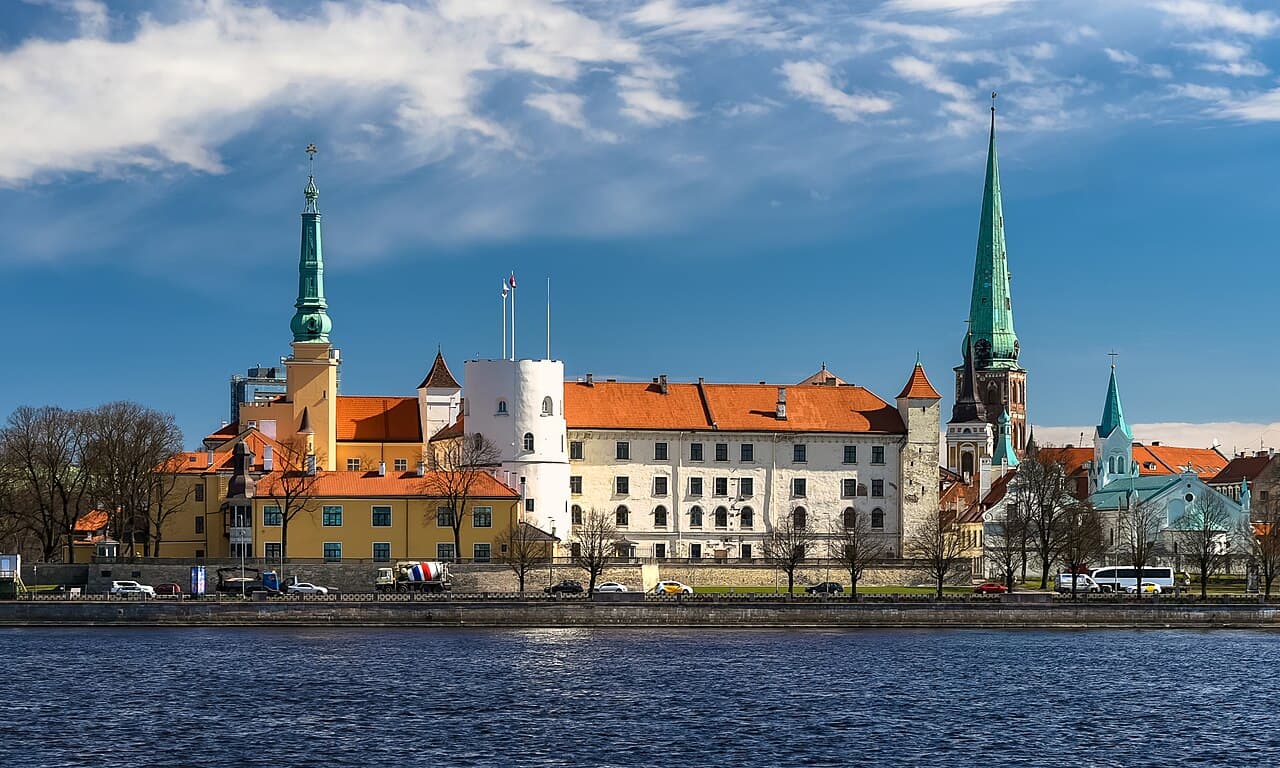
The castle complex today includes six towers representing various historical periods: the medieval Holy Spirit Tower and Lead Tower, the smaller Pepper and Northern towers, the 17th-century oriel tower of the forecastle, and the 20th-century Three Stars Tower. The castle walls retain original medieval limestone and dolomite masonry, while interior rooms such as the White Hall, Ambassador Accreditation Hall, and Coat of Arms Hall showcase a blend of Gothic, Renaissance, Baroque, and neoclassical styles.
Underground passages and tunnels remain beneath the castle grounds, offering insights into its defensive and administrative functions over the centuries. The castle is best viewed from the opposite bank of the Daugava River, where its imposing silhouette reflects Riga’s rich history.
Cultural significance and visitor experience
Riga Castle is not only a monument to medieval military architecture but also a living symbol of Latvia’s turbulent history and enduring sovereignty. Its walls have witnessed the rise and fall of empires, religious upheavals, and the birth of a modern nation. Although the castle is primarily a government residence and not fully open to the public, its museums and occasional public events allow visitors to engage with Latvia’s heritage.
For visitors, the castle offers a unique opportunity to explore architectural layers spanning from the high medieval period through Baroque and neoclassical renovations to modern national symbolism. Its location on the Daugava River provides scenic views and a connection to Riga’s historic urban landscape.
Riga Castle remains a testament to the resilience and cultural richness of Latvia, standing as a proud guardian of the city’s past and a vibrant participant in its present.
Frequently asked questions (FAQ)
- How do I get to Ryga Castle?
- Ryga Castle is located in the heart of Riga, Latvia, making it easily accessible by public transport and walking. You can take trams or buses that stop near the castle, or enjoy a pleasant stroll through the historic streets of the city.
- What is the historical significance of Ryga Castle?
- Ryga Castle, built in the early 14th century, has served as a royal residence and a military fortress throughout its history. It is an important symbol of Latvia's heritage, representing the country's medieval past and its evolution over the centuries.
- When was Ryga Castle constructed?
- Construction of Ryga Castle began in 1330 and was completed in 1340. The castle has undergone numerous renovations and expansions, reflecting various architectural styles that have influenced its design over the years.
- Can I take guided tours of Ryga Castle?
- Yes, guided tours of Ryga Castle are available and offer a deeper insight into its history and architecture. It is recommended to check the castle's official website for tour schedules and availability.
- Why is the architecture of Ryga Castle unique?
- The architecture of Ryga Castle is a blend of Gothic and Renaissance styles, showcasing the castle's evolution through different periods. Its impressive towers and fortified walls contribute to its distinctive silhouette against the Riga skyline.
- Is it possible to visit Ryga Castle year-round?
- Yes, Ryga Castle is open to visitors year-round, although specific areas may be closed for maintenance during certain months. It is advisable to check the opening hours before planning your visit to ensure access to all attractions.
- What are the ticket prices for visiting Ryga Castle?
- Ticket prices for Ryga Castle may vary depending on the type of tour and the areas you wish to visit. Generally, admission is affordable, making it accessible for both locals and tourists alike.
- What is the best time to visit Ryga Castle?
- The best time to visit Ryga Castle is during the spring and summer months when the weather is pleasant and the gardens are in full bloom. However, if you prefer fewer crowds, consider visiting during the shoulder seasons of late spring or early autumn.
- Are there any nearby attractions to Ryga Castle?
- Yes, there are several attractions near Ryga Castle, including the Latvian National Museum of Art and the picturesque Old Town of Riga. Exploring these nearby sites can enhance your visit and provide a richer experience of the city’s culture.
Photo gallery

Information
Website
Visit websiteSources & official resources
Verify the information above using these authoritative references.
Loading map...
Visitor reviews
No reviews yet. Been here? Write the first review and help other travelers!
Write the first reviewVisited this castle? Share your experience
Your review helps other travelers and adds first-hand knowledge to our encyclopedia.