
Dún Dúchathair
Dún Dúchathair, also known as Dúchathair or anglicized as Doocaher, is a prominent ancient stone fortification situated on the dramatic cliffs of Cill Éinne (Killeany) on Inishmore, the largest of the Aran Islands in County Galway, Ireland. The name translates to "black fort," reflecting the dark, weathered stone used in its construction, which has withstood the harsh Atlantic elements for centuries. This bastioned fortress is notable for its imposing defensive walls and strategic cliffside location, offering commanding views over the surrounding sea.
The fort's position on a rocky promontory, now jutting into the Atlantic due to extensive coastal erosion, highlights its original purpose as a stronghold designed to maximize natural defenses. The surviving outer walls of Dún Dúchathair reach approximately 6 metres in height and are about 5 metres thick, constructed from large, roughly hewn limestone blocks typical of the region. These massive walls form a roughly circular enclosure that would have provided formidable protection against invaders.
Architectural features and fortification elements
Inside the fort's enclosure lie the ruins of several clocháns, traditional beehive huts built with dry stone masonry without mortar. These small, corbelled stone structures are characteristic of early Irish dwellings and monastic cells, suggesting that the site may have had a dual purpose as both a defensive fortification and a settlement or refuge. However, there is no evidence of a reliable water source within the fort, which implies that inhabitants would have needed to rely on rainwater collection or external supplies during occupation.
One of the most intriguing defensive features at Dún Dúchathair is the presence of a cheval de frise near the entrance. This consists of an array of sharp stone spikes or upright slabs arranged to deter or injure attackers attempting to breach the gate, a sophisticated defensive tactic rarely found in Irish coastal forts. The entrance itself would have been heavily fortified, likely with thick wooden gates reinforced with iron, though no such gates survive today.
Historical context and age
The precise age of Dún Dúchathair remains uncertain, as no definitive archaeological dating has yet been published. However, the architectural style and construction techniques suggest it was built during the early medieval period, possibly between the 8th and 12th centuries. This timeframe corresponds with a period of frequent coastal raids and Viking incursions in Ireland, which prompted the construction of many similar coastal and island fortifications.
The fort's location on the Aran Islands, a region rich in prehistoric and early medieval archaeological sites, further supports this dating. The combination of defensive walls, beehive huts, and the cheval de frise indicates a community prepared for sustained defense and habitation in a challenging maritime environment.
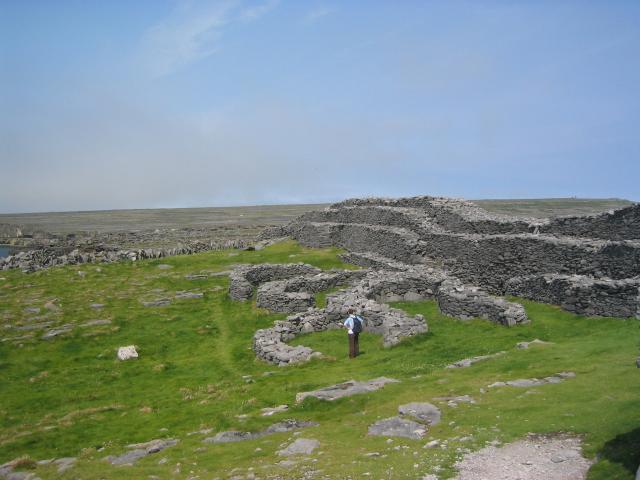
Photo by Tom Pullman • CC BY-SA 2.0
Geographical and cultural significance
Dún Dúchathair is situated on the western edge of Inishmore, where the rugged cliffs meet the Atlantic Ocean. This location not only provided natural defense but also allowed control over maritime routes and early warning of incoming threats. The fort is part of a wider network of prehistoric and early medieval sites on the Aran Islands, which together illustrate the strategic importance of these islands in Ireland's history.
The fort is a key cultural landmark for the local community and visitors, offering insight into the defensive architecture and living conditions of early Irish coastal settlements. Its dramatic setting and well-preserved stonework make it a significant attraction for those interested in Irish heritage and ancient fortifications.
Preservation and current condition
Today, Dún Dúchathair stands as a well-preserved bastioned fortress despite centuries of exposure to harsh weather and coastal erosion. The thick stone walls remain largely intact, though some sections have suffered damage from the sea and wind. The interior clochán ruins provide valuable archaeological evidence of habitation, although no roof structures survive.
Access to the site is on foot via paths on Inishmore, and visitors can explore the fort's perimeter and interior remains. Interpretation panels and guided tours help contextualize the site's historical and architectural importance.
Architectural comparison and influence
Dún Dúchathair shares characteristics with other Irish coastal stone forts, such as Dún Aonghasa, also on Inishmore, but is distinguished by its extensive bastioned walls and the unique cheval de frise defense. The use of dry stone masonry and corbelled huts reflects a continuity of ancient building traditions in the region.
The fort's design demonstrates an adaptation to the rugged coastal environment, combining natural rock formations with man-made defenses to create a formidable stronghold. This blend of natural and constructed elements is typical of Irish promontory forts and highlights the ingenuity of early medieval builders.
Photo gallery

Information
Loading map...
Visitor reviews
No reviews yet. Be the first to share your experience!