
Dún Ailinne
Dún Ailinne is a significant ancient ceremonial site located on the hill of Cnoc Ailinne (Knockaulin) in County Kildare, Ireland. This site, also known by its anglicized name Dun Aulin, occupies a large circular enclosure covering approximately 13 hectares on the hilltop, which rises to 183 metres (600 feet) above sea level. Although no visible structures remain on the surface, detailed archaeological excavations have revealed the presence of circular timber structures or rings of upright timbers dating back to the Irish Iron Age (circa 400 BCE – 400 CE). These findings indicate that Dún Ailinne was a place of considerable importance during this period.
Historical significance and royal connections
Dún Ailinne holds a prominent place in early Gaelic Ireland's mythology and historical tradition. It was regarded as one of the great royal sites where the Kings of Leinster were inaugurated, positioning it alongside other major royal sites such as Tara (for the Kings of Meath), Navan Fort (for the Kings of Ulster), and Rathcroghan (for the Kings of Connacht). These royal associations are documented in early medieval texts, though these were composed long after the site's primary period of use. Consequently, the precise relationship between Dún Ailinne and early medieval kingship remains a subject of scholarly debate.
Archaeological features and excavations
The site is characterized by a large circular earthwork enclosure that once surrounded the hilltop. Archaeological investigations have uncovered evidence of multiple phases of construction and use, including timber structures arranged in concentric circles. These timber rings likely served ceremonial or ritual purposes, possibly related to kingship rites or seasonal festivals. The presence of postholes and other features suggests a complex layout that evolved over several centuries during the Iron Age.
Despite the lack of standing structures today, the archaeological record at Dún Ailinne provides valuable insight into prehistoric ceremonial practices in Ireland. The site exemplifies the use of timber architecture in ritual contexts, contrasting with the stone-built monuments more commonly associated with later periods.
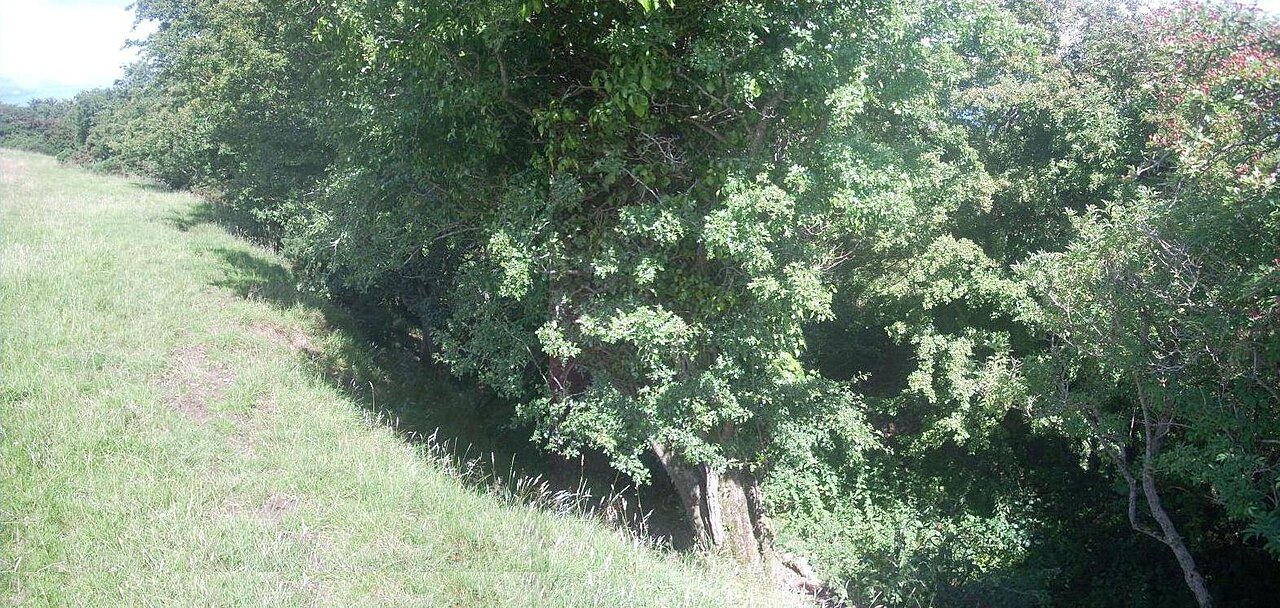
Photo by Frankysandwich • CC BY-SA 3.0
Location and accessibility
Dún Ailinne is situated southwest of Kilcullen, near the R418 road leading to Athy. The hill's elevation affords visibility across the surrounding landscape, making it a prominent landmark. However, the site itself lies on private property and is not accessible to the public. Visitors interested in viewing the location can do so from the nearby Old Kilcullen churchyard, which features a historic round tower and offers free public access with clear views of the hilltop enclosure.
It is important to distinguish Dún Ailinne from the nearby Hill of Allen (Cnoc Alúine), located to the northwest, as the two are separate sites with distinct historical and archaeological identities.
Cultural heritage and preservation status
Today, Dún Ailinne is classified as an archaeological ruin, with its physical remains largely subsumed by the landscape. The site has been the focus of various archaeological studies aimed at understanding Ireland's prehistoric ceremonial traditions and royal inauguration practices. Its preservation as a protected archaeological site ensures that this important piece of Irish heritage remains recognized, even though it is not developed as a tourist destination.
The absence of visible ruins underscores the challenges of preserving timber-based prehistoric monuments, which often leave minimal traces above ground. Nonetheless, Dún Ailinne's significance lies in its role as a key site for understanding the social and political structures of Iron Age Ireland.
Frequently asked questions (FAQ)
- What is dún ailinne and why is it important?
- Dún Ailinne is an ancient ceremonial site in County Kildare, Ireland, linked to the kingship and inauguration of Leinster's early rulers. It is important for understanding Ireland's Iron Age and early medieval history.
- Can I visit dún ailinne?
- Dún Ailinne is on private land and is not open to the public. However, visitors can view the site from the nearby Old Kilcullen churchyard, which is freely accessible and offers good views of the hill.
- When was dún ailinne constructed?
- Archaeological evidence dates Dún Ailinne's timber structures to the Irish Iron Age, approximately 400 BCE to 400 CE.
- What kind of structures were found at dún ailinne?
- Excavations revealed circular timber rings and earthwork enclosures indicating ceremonial use, but no standing stone structures remain today.
- Is dún ailinne related to other royal sites in Ireland?
- Yes, it is considered one of the four great royal sites of early Gaelic Ireland, alongside Tara, Navan Fort, and Rathcroghan, associated with regional kingship.
Photo gallery

Information
Loading map...
Visitor reviews
No reviews yet. Be the first to share your experience!