
Casbah of Béjaïa
The Casbah of Béjaïa stands as a monumental example of a fortified citadel with a rich history spanning nearly a millennium in Algeria. Constructed originally in the 11th century by the Zirid dynasty, this hill castle occupies a strategic elevated position overlooking the city of Béjaïa and the Mediterranean Sea. Its location on sloping terrain with a height difference of 22 meters provided a natural defensive advantage, making it a formidable stronghold throughout the medieval and early modern periods.
The Casbah’s layered architectural heritage reflects the diverse cultural and political influences that shaped the region over centuries. From its initial Berber foundations through the expansions by the Hammadid and Almohad dynasties, to the modifications under the Hafsid rulers, and later the Spanish and Ottoman occupations, the fortress embodies a complex synthesis of styles and functions. Its role extended beyond military defense to include administrative governance and religious significance, making it a vital center in North African history.
Historical development and dynastic influences
The Casbah’s origins date back to the Zirid dynasty in the 11th century, a period marked by the rise of Berber dynasties in North Africa. The early construction phase was significantly influenced by the Hammadid dynasty, who undertook major building projects around 1065. These efforts established the foundational structures and fortifications that would be enhanced in subsequent centuries.
In the mid-12th century, the Almohad dynasty under Sultan Abd al-Mu’min ibn Ali expanded the fortress around 1154, reinforcing its defensive capabilities in response to shifting political and military challenges. This period saw the Casbah transformed into both a military bastion and a residence for rulers, as well as a hub for managing the city and its important port.
The 13th century brought further fortifications and adaptations by the Hafsid dynasty, who modified the Casbah to meet evolving strategic needs. These enhancements reflected changes in military technology and regional threats, ensuring the fortress remained a key defensive site.
Spanish and ottoman periods
The 16th century marked a turbulent era for the Casbah, beginning with the Spanish occupation. The Spaniards reinforced the fortress defenses, including the construction of a large fort with a vaulted chamber likely used as a powder magazine for storing gunpowder. This addition demonstrates the adaptation of the Casbah to the advent of gunpowder weaponry and the changing nature of siege warfare.
Shortly after, the Ottoman Empire conquered the region and undertook further modifications to the fortress. Ottoman architectural influences are evident in the remodeling of certain structures, including a distinctive square-shaped building with a central patio surrounded by galleries. This building reflects the layering of styles as the fortress evolved under different rulers.
During the French colonial period beginning in 1830, the Casbah underwent additional alterations to accommodate the needs of the occupying forces. These changes, while functional, preserved much of the fortress’s historical fabric.
Architectural features and layout
The Casbah covers approximately two hectares, forming a roughly rectangular complex on sloping ground. Its elevated position offers commanding views over Béjaïa and the adjacent sea, underscoring its strategic importance. The fortress incorporates a variety of architectural elements from different periods, creating a rich tapestry of styles.
Defensive structures
Key defensive features include robust masonry walls, multiple defensive towers, and fortified gates designed to withstand sieges. The 16th-century Spanish fortification is particularly notable for its preserved form and the vaulted chamber used as a powder magazine, highlighting advances in military architecture related to gunpowder storage and safety.
Religious and residential buildings
Within the Casbah lies an ancient Berber-style mosque, likely dating from the Almohad period. Originally serving as the governor’s prayer space, this mosque gained prominence in the 14th century as a teaching site where the renowned historian Ibn Khaldun studied. Known as Jamaa El-Kebir during the Algerian Regency, it remained the main mosque of the fortress, maintaining continuous religious use over centuries.
The square-shaped building attributed to the Spanish era and remodeled by Ottoman and French authorities features a central courtyard surrounded by galleries. This architectural form illustrates the fusion of Mediterranean and Islamic influences and the adaptation of the fortress for residential and administrative functions.
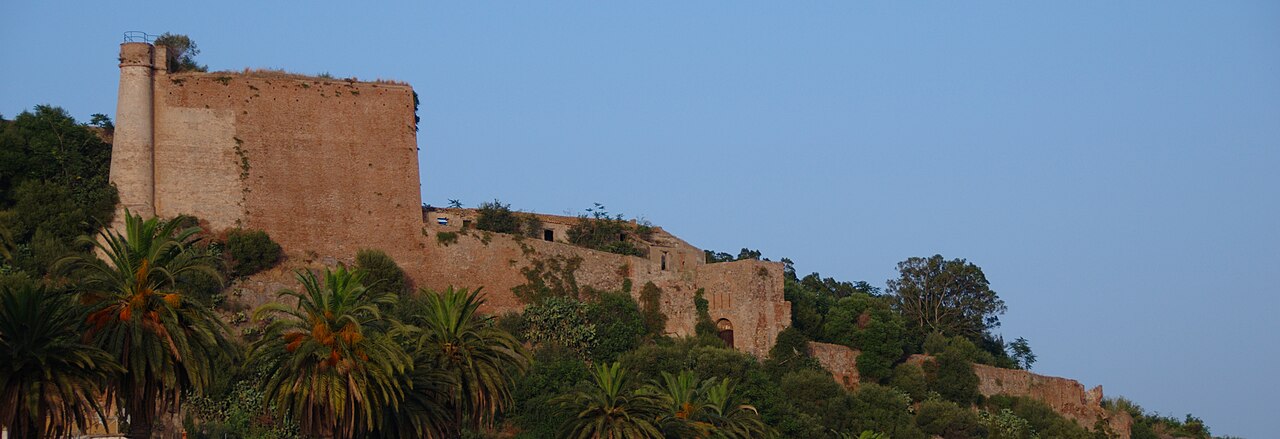
Photo by Zil • CC BY-SA 3.0
Cultural significance and notable figures
The Casbah of Béjaïa was not only a military and administrative center but also a vibrant intellectual and cultural hub. It hosted several prominent historical figures, including the historian Ibn Khaldun, mystic philosopher Ibn Arabi, mathematician Leonardo Fibonacci, scholar Raymond Lulle, and poet Ibn Hamdis. Their presence underscores the fortress’s role as a place of learning, religious contemplation, and scholarly exchange.
This cultural heritage adds depth to the Casbah’s historical importance, linking it to broader Mediterranean and Islamic intellectual traditions.
Modern restoration and preservation efforts
Following Algerian independence in 1962, the Casbah experienced a period of neglect that led to deterioration. However, recent restoration campaigns culminating in a major project completed in 2024 have aimed to preserve and rehabilitate the site. These efforts have focused on reinforcing the fortress walls, repairing defensive towers, and refurbishing interior areas while maintaining historical authenticity.
Original materials and traditional construction techniques were employed to ensure the preservation of the Casbah’s architectural integrity. Archaeological discoveries, such as Almohad coins found on-site, highlight the deep historical roots and continuous occupation of the fortress through various ruling powers.
Today, the Casbah of Béjaïa stands as a significant heritage site, attracting visitors interested in its rich history, architectural diversity, and cultural legacy. Plans to redevelop some of the 19th-century buildings into a cultural center aim to enhance its role as a living monument and community resource.
Frequently asked questions (FAQ)
- How do I get to the Casbah of Béjaïa?
- The Casbah of Béjaïa is located in the city of Béjaïa, Algeria, and can be accessed by car, public transportation, or on foot from nearby hotels. The nearest airport is Béjaïa – Soummam Airport, which is approximately 20 kilometers away. Once in Béjaïa, local taxis and buses can take you to the castle.
- What is the historical significance of the Casbah of Béjaïa?
- The Casbah of Béjaïa dates back to the 15th century and played a vital role in the region's maritime trade and culture. It served as a fortress and a center of power for various dynasties, including the Hafsids and the Ottomans. Today, it stands as a symbol of Algeria's rich history and architectural heritage.
- When was the Casbah of Béjaïa built?
- The construction of the Casbah of Béjaïa began in the early 15th century, with significant expansions and renovations occurring over the following decades. It was designed to protect the city from invasions and served as a strategic lookout point along the Mediterranean coast. Its historical layers reflect the various cultures that have influenced the region.
- Can I visit the Casbah of Béjaïa year-round?
- Yes, the Casbah of Béjaïa is open to visitors throughout the year, though it's advisable to check local schedules for any seasonal changes in visiting hours. The site can be particularly busy during the summer months, so plan your visit accordingly. Guided tours are often available to enhance your experience.
- Why is the architecture of the Casbah of Béjaïa unique?
- The architecture of the Casbah of Béjaïa showcases a blend of Berber, Arab, and Ottoman influences, making it a unique example of historical design in Algeria. The layout includes winding alleys, traditional houses, and impressive defensive structures that reflect the region's strategic importance. Its well-preserved elements provide insight into the architectural styles of the era.
- Is it possible to explore nearby attractions after visiting the Casbah?
- Absolutely! After exploring the Casbah of Béjaïa, visitors can enjoy nearby attractions such as the picturesque beaches of Béjaïa, the historic ruins of the ancient city of Ksar el Kebir, and the beautiful Yemma Gouraya National Park. These sites offer a mix of natural beauty and historical significance, making for a well-rounded visit.
- What are the opening hours for the Casbah of Béjaïa?
- The Casbah of Béjaïa typically opens at 9 AM and closes at 6 PM, but these hours may vary depending on the season or special events. It's recommended to check in advance for any changes to the schedule. Visiting early in the day can also help you avoid crowds and fully appreciate the site.
- What are the ticket prices for visiting the Casbah of Béjaïa?
- Entry to the Casbah of Béjaïa is generally affordable, with ticket prices around 200 Algerian Dinars for adults. There may be discounts available for students and children, so it's wise to inquire at the ticket counter. This low-cost entry makes it accessible for all visitors interested in exploring the historical site.

Information
Loading map...
Visitor reviews
No reviews yet. Be the first to share your experience!