Calshot Castle
Calshot Castle stands as a remarkable example of a Tudor artillery fort constructed during the reign of King Henry VIII. Built between 1539 and 1540 on the strategic Calshot Spit, where Southampton Water meets the Solent, the castle was part of the King's Device programme—a nationwide initiative to bolster England's coastal defenses against threats from France and the Holy Roman Empire. Its location was critical for controlling naval access to the important port of Southampton, a hub for both commercial and military maritime traffic.
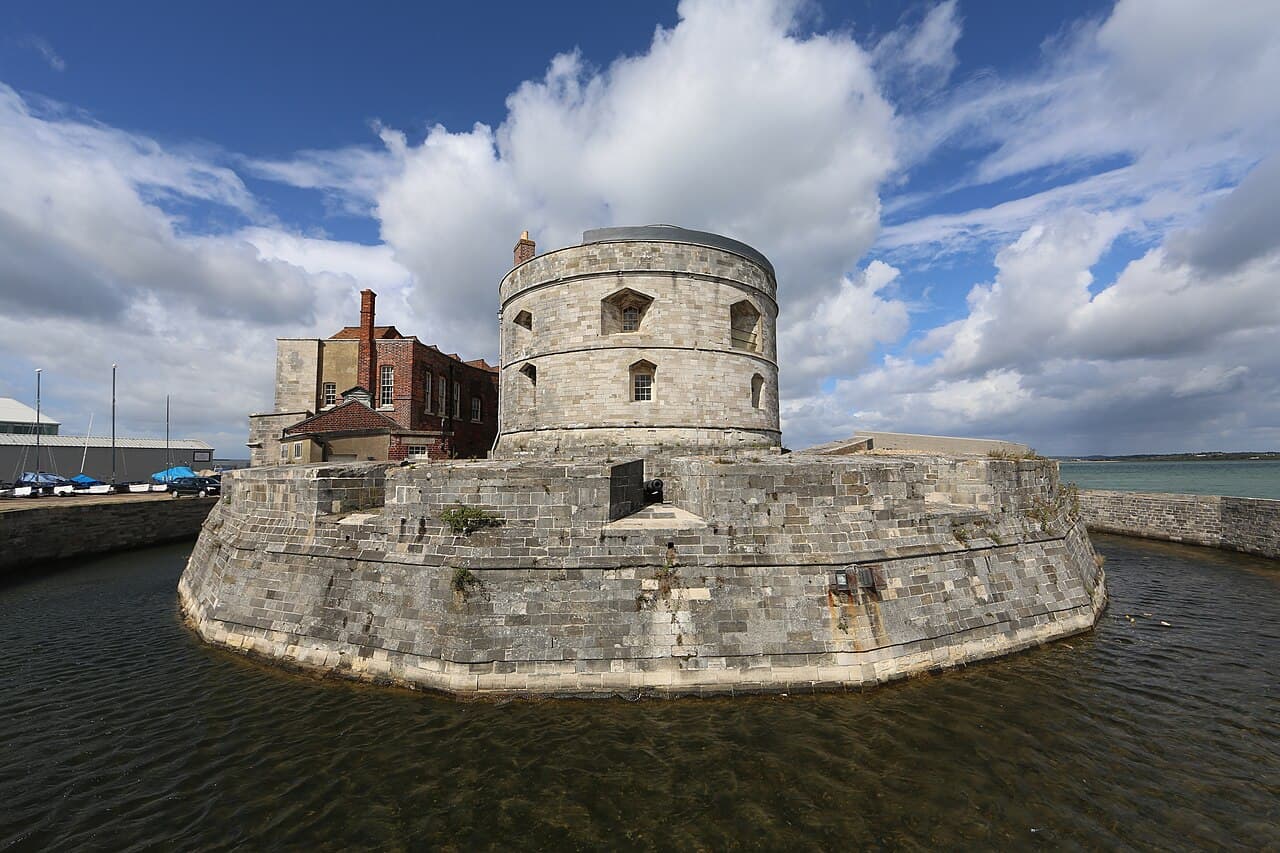
The castle's design reflects the evolving military architecture of the Renaissance period, with a focus on artillery defense. It features a circular stone keep or donjon at its center, surrounded by a curtain wall and a moat. The keep rises approximately sixteen meters, beginning with an octagonal lower floor and culminating in a circular upper structure. Originally, the roof was flat with crenellations for artillery placements, though these were removed during 18th-century modifications.
Historical context and construction
The construction of Calshot Castle was overseen by prominent Tudor officials William FitzWilliam and William Paulet. The fort was rapidly erected, likely reusing stone from nearby dissolved monastic sites such as Beaulieu Abbey and Netley Abbey. This reuse of materials was common in the period following the Dissolution of the Monasteries, allowing for efficient construction without sacrificing structural quality.
As one of four key forts protecting Southampton Water—the others being East Cowes Castle, West Cowes Castle, and Hurst Castle—Calshot played a vital role in the defense network securing southern England. Initially, the castle was garrisoned by sixteen men and armed with up to thirty-six artillery pieces, reflecting the increasing importance of gunpowder weaponry in coastal defense.
Military use and modifications through the centuries
English Civil War and 18th-century modernization
During the English Civil War in the mid-17th century, Calshot Castle remained intact and was held by Parliamentary forces. Its strategic position guarding Southampton Water ensured it continued to be of military importance, though the garrison was reduced during this period.
In the 1770s, the castle underwent significant modernization to adapt to changing military technologies. These alterations included lowering the height of the curtain walls, constructing a new parapet around the keep, modifying gun embrasures for improved artillery deployment, and expanding the gatehouse. These changes enhanced the fort's defensive capabilities while reflecting contemporary military architectural trends.
19th-century roles and coastal defense enhancements
By the early 19th century, Calshot Castle served as an ammunition storage site for the Sea Fencibles, a naval militia tasked with coastal defense. Later in the century, its function shifted to that of a coastguard station, focusing on suppressing smuggling activities along the English coast.
The 1880s brought renewed concerns over invasion threats, leading to the War Office regaining control of the castle in 1894. A defensive boom—a physical barrier stretched across Southampton Water—was established and operated from Calshot. Additionally, a larger gun battery was constructed nearby in 1895, marking the castle's integration into the broader Victorian coastal defense system.
20th-century military transformation and aviation history
World War I and naval air station
During World War I, Calshot Castle's traditional artillery was removed as the site transitioned to support a Royal Naval Air Station. The castle became a base for seaplane operations, launching patrols to counter the threat posed by German submarines in the Solent and English Channel. This marked a significant shift from static coastal defense to dynamic aerial maritime surveillance.
Interwar period and Schneider Trophy races
Between the wars, the castle and its airfield became known as RAF Calshot, hosting various training units such as the School for Naval Co-operation and Aerial Navigation and the Seaplane Training Squadron. The site gained international fame through its association with the Schneider Trophy seaplane air races, which pushed the boundaries of aviation technology and speed during the 1920s and 1930s.
World War II defenses and postwar period
In World War II, Calshot Castle was rearmed with rapid-firing guns and equipped with searchlights to defend against potential German air and sea attacks. Despite these preparations, the castle did not sustain damage during the conflict. After the war, it continued to serve as an airbase until 1961, when advances in aviation technology rendered seaplane operations obsolete.
Following its military use, the castle briefly functioned as a coastguard station before being transferred to English Heritage in 1983. Restoration efforts have focused on preserving the castle's early 20th-century military appearance, highlighting its multifaceted history.
Architectural features and current condition
Structural design and materials
Calshot Castle is constructed primarily of Portland stone ashlar, renowned for its durability and fine finish. The fortification is circular with three main levels, centered around the keep, which served as the primary artillery platform. The keep's ground floor contains eight recessed ammunition storage areas, reflecting careful consideration of safety and logistics in Tudor military design.
The surrounding curtain wall encloses a courtyard and features fifteen gun embrasures that allowed artillery to cover all approaches. The wall's height was reduced during the 1770s modernization, and a concrete block added in 1896 houses searchlights used in later defensive operations.
Moat and access
Encircling the castle is a sixteen-sided moat approximately 8.8 meters wide, originally filled with water to impede attackers. In the 20th century, parts of the moat were filled with concrete to create parking areas for aircraft when the site functioned as an airbase. Access to the castle is via a bridge leading to an 18th-century gatehouse, which was expanded in 1896 with brick buildings to provide additional accommodation for the garrison.
Interior and artillery placements
The keep's upper floors have been restored to represent early 20th-century military barracks. The second floor's ceiling is reinforced with steel beams and concrete to support artillery mounted on the roof. The roof still contains mounts for 12-pounder guns and retains original fittings, with one 12-pounder gun on display that once belonged to the Royal Navy.
Originally, the roof was crenellated to allow firing from protected positions, but these features were removed during the 1770s renovations. The castle's evolving architecture reflects its adaptation to changing military technologies and strategic needs over nearly five centuries.
Heritage status and visitor experience
Today, Calshot Castle is recognized as a Grade II* listed building and a scheduled monument, highlighting its national importance as a historic military site. Managed by English Heritage, the castle is open to the public and offers insights into Tudor coastal defense, military architecture, and 20th-century aviation history.
Visitors can explore the castle's well-preserved interiors, including the keep, gatehouse, and curtain walls, as well as learn about its role in various historical periods. The site also provides a unique perspective on the evolution of coastal fortifications and the integration of new military technologies from artillery to aircraft.
Frequently asked questions (FAQ)
- When was Calshot Castle built and by whom?
- Calshot Castle was built between 1539 and 1540 by order of King Henry VIII as part of his coastal defense program.
- What is the architectural style of Calshot Castle?
- Calshot Castle is an example of Renaissance military architecture, designed primarily as an artillery fort with a circular keep and curtain walls.
- Can visitors explore the interior of Calshot Castle?
- Yes, visitors can explore the well-preserved interiors including the keep, gatehouse, and curtain walls, which have been restored to reflect their historical military uses.
- What role did Calshot Castle play during the World Wars?
- During World War I, Calshot Castle served as a Royal Naval Air Station for seaplane patrols, and in World War II it was rearmed with rapid-firing guns and searchlights for coastal defense.
- Is Calshot Castle accessible year-round and what are the opening times?
- Calshot Castle is open daily from 10:00 to 17:00, though it is advisable to check for seasonal changes or special closures before visiting.
- How much does it cost to visit Calshot Castle?
- Admission prices are £7.50 for adults, £4.50 for children, and £20 for families, with tickets available at the entrance or online.
- Are there any nearby attractions to visit along with Calshot Castle?
- Visitors often combine a trip to Calshot Castle with nearby attractions in Southampton and the Solent area, including maritime museums and coastal nature reserves.
Photo gallery

Information
Opening hours
10:00-17:00, daily
Ticket prices
£7.50 adult, £4.50 child, £20 family
Current owner
English Heritage
Website
Visit websiteAddress
Calshot Spit, Southampton, Hampshire, SO45 1BR, United Kingdom
Sources & official resources
Verify the information above using these authoritative references.
Loading map...
Visitor reviews
No reviews yet. Been here? Write the first review and help other travelers!
Write the first reviewVisited this castle? Share your experience
Your review helps other travelers and adds first-hand knowledge to our encyclopedia.