
Byzantine fortress of Aïn Tounga
Historical context and strategic importance
The fortress was built as part of the Byzantine efforts to maintain control over their North African territories following the decline of the Western Roman Empire. During the 6th century, under the reign of Emperor Justinian I, a series of fortifications were established to secure the empire's borders against various threats, including the expanding Arab forces and local Berber tribes. The fortress of Aïn Tounga served as a defensive stronghold along key routes, enabling the Byzantines to monitor and control movement across the region.
Architectural features and design
The fortress is classified as a bastioned fortress, a style that incorporates projecting bastions at intervals along the curtain walls to allow defensive fire in multiple directions. This design was innovative for its time, enhancing the fortress's ability to withstand sieges and repel attackers. The walls were typically thick and constructed from locally sourced stone, with the bastions providing platforms for archers and artillery.
The layout of the fortress likely included a central courtyard, surrounded by various chambers for garrison troops, storage, and command purposes. Defensive elements such as gatehouses, towers, and possibly a moat would have been integral to its design, although specific details of these features at Aïn Tounga are not fully documented.
Construction techniques
Byzantine military architecture often employed a mix of Roman engineering methods and local building traditions. The fortress walls would have been constructed using large stone blocks, carefully fitted together without mortar in some cases, or bonded with lime-based mortar in others. The bastions were designed to project outward from the main walls, creating overlapping fields of fire to cover all approaches.
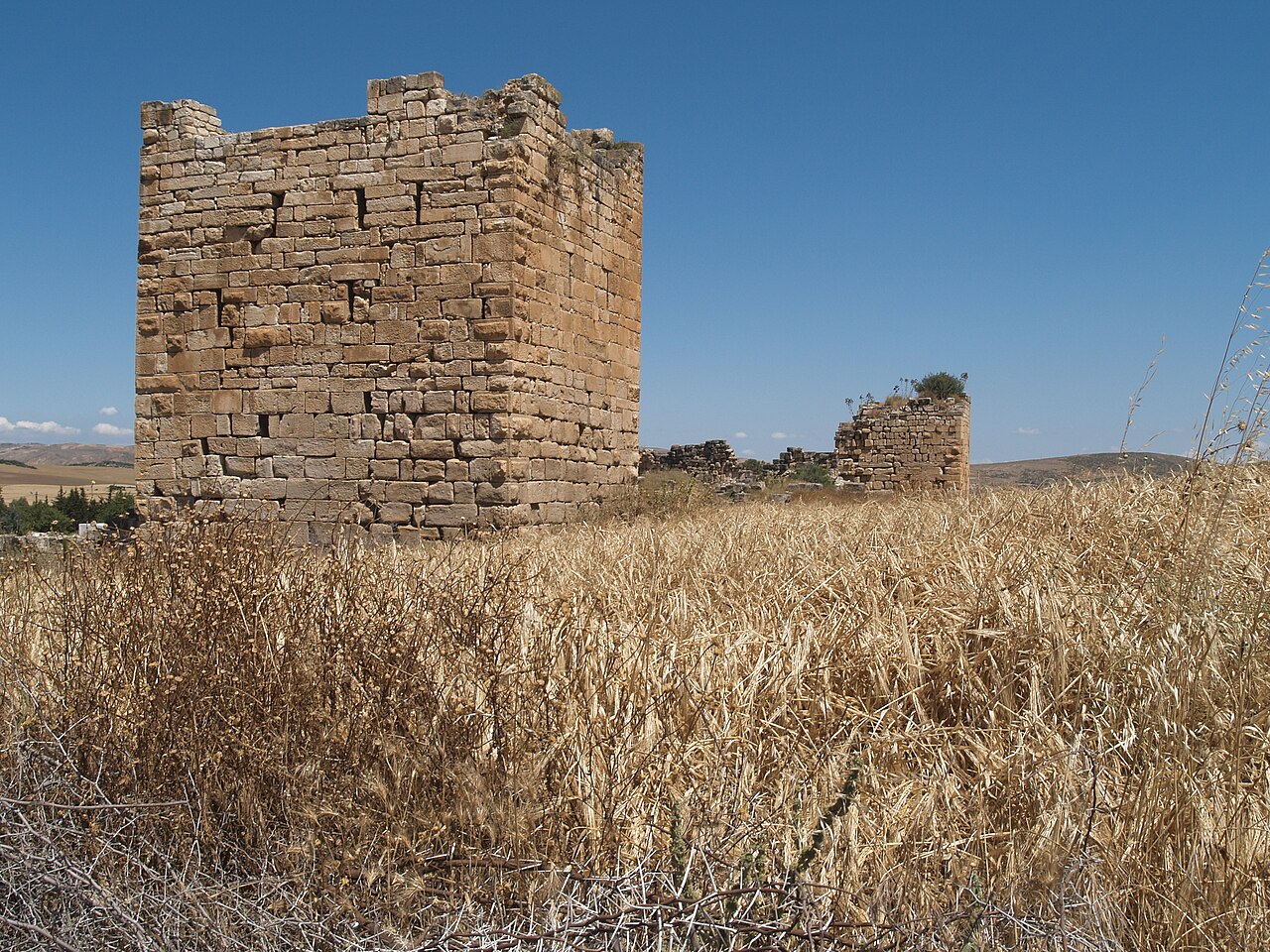
Photo by Graham Claytor / Institute for the Study of the Ancient World • CC BY 2.0
Preservation and current condition
Today, the Byzantine fortress of Aïn Tounga stands as a partially preserved ruin, with some sections of the bastioned walls still visible. The site offers valuable archaeological insights into Byzantine fortification strategies in North Africa. However, detailed studies and restoration efforts have been limited, leaving much of the fortress's original structure to be interpreted from the remaining ruins.
Significance in Byzantine military history
The fortress exemplifies the adaptation of Byzantine defensive architecture to the challenges of frontier warfare in the Mediterranean region. Its bastioned design predates the widespread use of similar features in later European fortifications, highlighting the advanced military engineering skills of the Byzantines. As such, the fortress of Aïn Tounga contributes to our understanding of early medieval fortification development and the geopolitical dynamics of the period.
Visiting the site
While the fortress is not a major tourist destination due to its remote location and limited facilities, it attracts historians, archaeologists, and enthusiasts interested in Byzantine architecture and North African history. Visitors should prepare for minimal infrastructure and access challenges, but the site offers a unique glimpse into the military past of Tunisia.
Frequently asked questions (FAQ)
- What is the historical significance of the Byzantine fortress of Aïn Tounga?
- The fortress represents Byzantine military efforts to secure North African territories during the early medieval period, showcasing advanced bastioned defensive architecture.
- Can I visit the Byzantine fortress of Aïn Tounga?
- Yes, but the site is remote with limited visitor facilities. It mainly attracts historians and archaeology enthusiasts interested in Byzantine fortifications.
- What architectural features define a bastioned fortress like Aïn Tounga?
- Bastioned fortresses feature projecting bastions along walls for enhanced defensive coverage, thick stone walls, and strategic gatehouses and towers.
Photo gallery

Information
Loading map...
Visitor reviews
No reviews yet. Be the first to share your experience!