Brandenbourg Castle
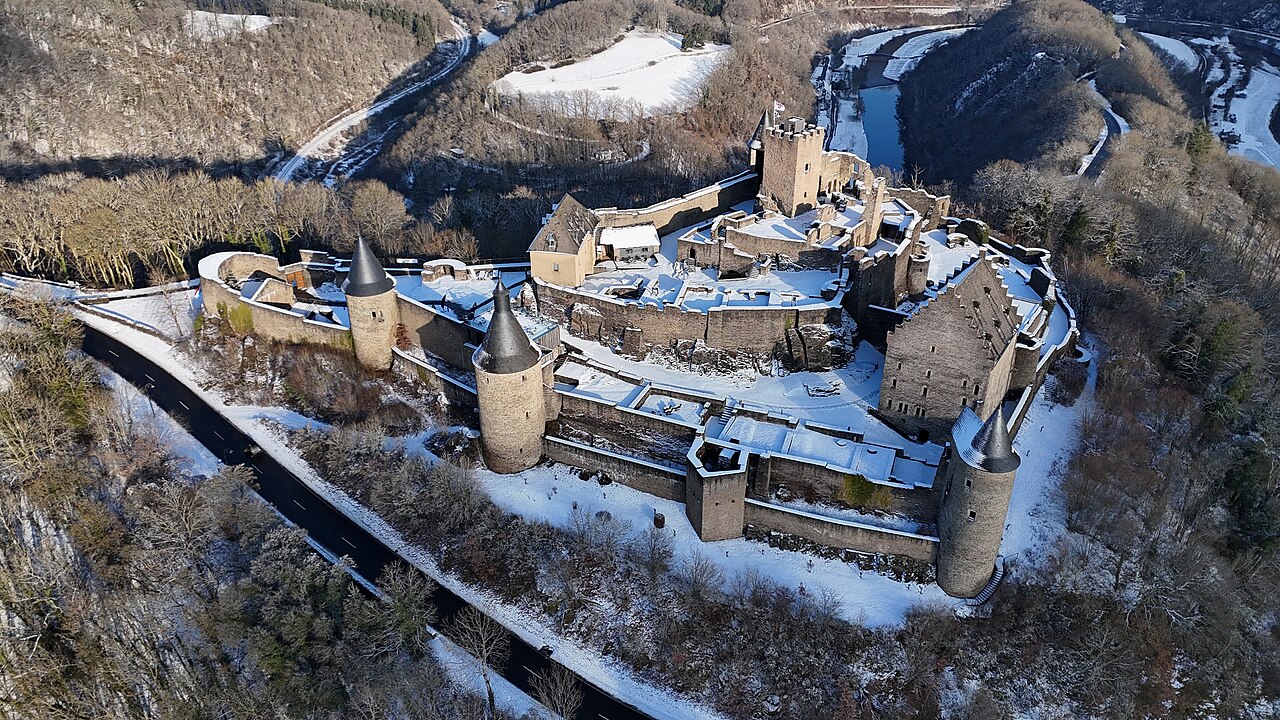
Brandenbourg Castle stands prominently on a wooded hilltop overlooking the tranquil valley of the river Blees in Luxembourg. This early medieval hill castle commands a strategic position above the hamlet sharing its name, situated on an ancient trade route connecting Vianden and Bourscheid. Its location atop steep cliffs on three sides provided formidable natural defenses, making it a significant military and administrative site throughout the Middle Ages.
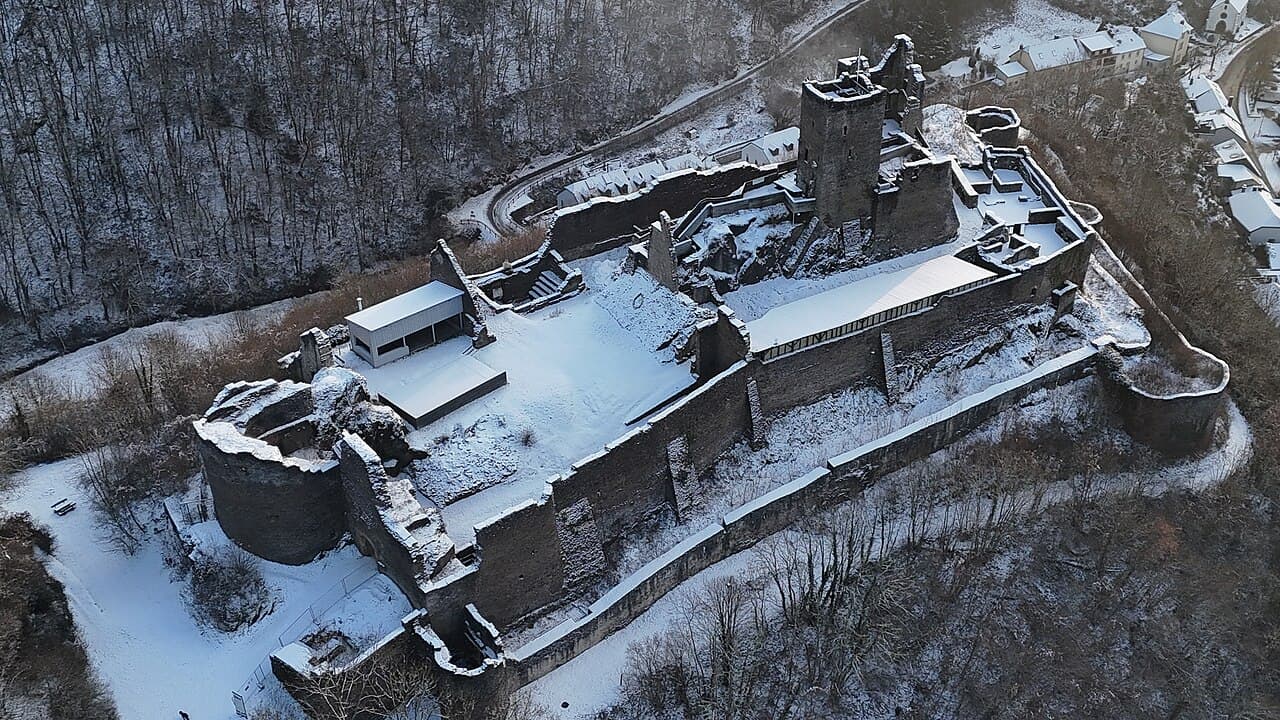
The origins of Brandenbourg Castle trace back to the 10th century, with archaeological evidence indicating that the site was initially fortified by a wooden structure during the 9th and 10th centuries. The first written record of the castle dates from 1244, mentioning Gottfried von Brandenbourg as the lord of the fortress. Originally, the castle consisted of a central defensive tower, or bergfried, rising to nearly 12 meters and originally comprising four floors, of which three remain today. This tower was accompanied by residential buildings and surrounded by an earthen rampart, emphasizing its early defensive purpose.
Medieval expansion and architectural evolution
During the 14th century, Brandenbourg Castle underwent significant expansion and transformation. A chapel was added, reflecting the castle's religious and social functions. The fortifications were enhanced with the construction of a northern forecourt built on a raised foundation, enclosed by a stone ring wall fortified with three towers. On the southern side, three half-towers were integrated into the curtain walls, increasing the castle's defensive capabilities.
In addition to above-ground structures, the castle features two-story vaulted cellars carved directly into the eastern and southern rock faces. These subterranean chambers provided secure storage and shelter, demonstrating the sophisticated use of the natural landscape in the castle's design.
15th and 16th-century artillery adaptations
The advent of gunpowder weaponry in the late Middle Ages prompted further modifications. In the 15th and 16th centuries, the castle was expanded to include a bailey, two additional towers, and curtain walls adapted to withstand artillery attacks. A large round artillery tower was constructed on the northern side to mount cannons and resist enemy fire. Four other towers were reinforced, moats deepened, and a drawbridge installed to control access. These enhancements illustrate the castle's adaptation to evolving military technology during the late medieval period.
Historical significance and ownership
Brandenbourg Castle played a strategic role in controlling the crossroads of important medieval routes: one from the River Sûre up into the Ardennes and another linking Bourscheid to Vianden. Its position allowed oversight of commerce and travel, contributing to its military and economic importance.
The castle changed hands multiple times after the original Brandenbourg dynasty ended in the late 13th century. It passed to Thierry von Neuerbourg, connected to the Counts of Vianden, and later to noble families including the Lords of Haraucourt, Salm, Kitzingen, Stassin, and Blochausen. Ownership eventually transferred to the du Fays – van Delft family, who leased the ruins to the state in 1997, facilitating preservation efforts.
In 1668, the castle was attacked by French forces but surrendered without significant resistance, marking the decline of its military relevance. It remained inhabited until the mid-18th century before being abandoned and left to decay. By the early 19th century, neglect led to its ruinous state.
Restoration and current condition
Conservation efforts began in the 20th century with basic consolidation work in 1936 and the 1950s. Since the 1980s, extensive restoration and archaeological excavations have been conducted to stabilize the ruins and uncover the castle's layered history. Discoveries include a well, a cannon, and evidence of earlier Roman wooden fortifications beneath the stone structures, highlighting the site's long-standing strategic importance.
Today, Brandenbourg Castle is a well-preserved ruin accessible to visitors during daytime hours. Restoration has respected the site's romantic and historic character, allowing exploration of the keep, subterranean chambers, curtain walls, and towers. The castle's evocative setting and architectural features make it a favored destination for those interested in medieval military architecture and Luxembourg's heritage.
Architectural features and layout
The castle complex spans approximately 35 by 95 meters, comprising the main castle and a lower courtyard or bailey. The bergfried remains a dominant feature, offering panoramic views and serving as a testament to medieval defensive design. The curtain walls, reinforced with multiple towers and half-towers, create a layered defense system typical of hill castles adapted to the topography.
The vaulted cellars carved into the rock are notable for their craftsmanship and functional design, providing cool storage spaces and secure refuge. The Gothic chapel ruins attest to the castle's role as a noble residence with religious functions. The presence of a drawbridge and deepened moats reflects the evolution of fortifications in response to artillery threats.
Cultural and cinematic significance
Brandenbourg Castle has captured the imagination of visitors and filmmakers alike. In 2004, it served as a filming location for the Hollywood movie George and the Dragon, showcasing its dramatic ruins and atmospheric setting. The castle's romantic allure, enhanced by its natural surroundings and historic ambiance, continues to attract tourists and history enthusiasts.
Its accessibility and ongoing preservation efforts ensure that Brandenbourg Castle remains a vital cultural landmark, offering insights into medieval fortification strategies and the historical narrative of Luxembourg.
Frequently asked questions (FAQ)
- How do I visit Brandenbourg Castle?
- Brandenbourg Castle is freely accessible during daytime hours. Visitors can explore most areas of the castle, including the keep and subterranean rooms, via established footpaths. It is recommended to wear sturdy footwear due to uneven terrain.
- What is the historical significance of Brandenbourg Castle?
- Brandenbourg Castle was a strategic medieval fortress overseeing key trade routes in Luxembourg. It evolved architecturally from a 10th-century wooden fort to a fortified stone castle adapted for artillery defense in the 15th and 16th centuries.
- When was Brandenbourg Castle built and expanded?
- The castle's origins date to the 10th century with significant expansions in the 14th century, including the addition of a chapel, and further fortifications in the 15th and 16th centuries to accommodate artillery.
- Can I access the castle's underground chambers?
- Yes, the castle features two-story vaulted cellars carved into the rock that are accessible to visitors. These chambers provide a unique glimpse into medieval storage and defensive architecture.
- Why is Brandenbourg Castle considered a hill castle?
- Brandenbourg Castle is classified as a hill castle due to its location atop a forested hill with steep cliffs on three sides, providing natural defensive advantages typical of hilltop fortifications.
Photo gallery

Information
Address
Ieweschtgaass, Luxembourg
Loading map...
Visitor reviews
No reviews yet. Been here? Write the first review and help other travelers!
Write the first reviewVisited this castle? Share your experience
Your review helps other travelers and adds first-hand knowledge to our encyclopedia.