
Şanlıurfa Castle
Şanlıurfa Castle stands as a monumental testament to the rich and complex history of the ancient city of Edessa, located in modern-day Turkey. Perched atop a natural hill known as Top Dağı or Nemrud Dağı, this hill castle commands a strategic vantage point overlooking the surrounding landscape and the contemporary city below. Its origins trace back to the 3rd century AD, making it a significant site that reflects the architectural and military evolution from antiquity through the medieval period.
The castle's earliest fortifications were constructed by the ancient kingdom of Osroene, which recognized the importance of controlling this elevated position. Around 201 AD, King Abgar VIII responded to the challenges posed by flooding in the lower city by erecting a grand Syro-Roman winter palace on the hilltop. This palace featured imposing architectural elements, most notably the two towering Corinthian columns approximately 15 meters high, which have endured as iconic symbols of the site and are locally referred to as the "Throne of Nimrod." These columns rise above the fortress's outer terrace walls and remain in their original placement, offering a striking visual link to the ancient past.
Architectural features and defensive design
The fortress occupies a roughly rectangular area measuring about 300 meters east to west and 80 meters north to south, situated on a hill rising some 30 meters above the surrounding terrain. Its design reflects a series of adaptations and expansions made over centuries to meet evolving military needs. The castle's outer defenses include a well-preserved moat on the southern, mountain-facing side, which reaches depths of at least 12 meters. This moat originated as part of the defensive trenches constructed during the reign of Emperor Justinian in the 6th century and was later expanded by the Byzantine general Georgios Maniakes in the early 11th century. The Crusaders further enhanced these defenses by enlarging the moat and reinforcing the walls to withstand sieges.
Within the castle's interior, archaeological investigations have uncovered traces of a medieval mosque, indicating the site's continued religious and cultural significance during Islamic rule. The main medieval gate likely corresponds to the current northern entrance, suggesting a continuity of access points through the centuries. Historical sources imply the existence of additional gates oriented towards both the city and the surrounding countryside, enhancing the fortress's control over key routes.
South of the two Corinthian columns lie the remains of the Crusader donjon, a fortified tower that served as a stronghold within the castle complex. This donjon was destroyed by the Seljuk Sultan Ala ad-Din Kai Kobad I after the Seljuk conquest in the 12th century, leaving behind fragments that provide valuable insight into Crusader military architecture and defensive strategies.
Historical significance and shifting control
Şanlıurfa Castle's history is marked by its control under various empires and rulers, reflecting the turbulent geopolitical landscape of the region. Initially fortified by the Osroene kingdom, the castle later became a focal point for Roman and Byzantine authorities. During the 6th century, Emperor Justinian's administration undertook significant hydraulic engineering projects, including redirecting the nearby Skirtos River, to protect the city from flooding and reinforce its defenses.
In the early medieval period, the fortress changed hands multiple times. The Persians, Byzantines, and various Muslim forces each held the castle at different times, underscoring its strategic value. In 1031, the Byzantine general Georgios Maniakes recaptured Şanlıurfa and strengthened its fortifications, enabling it to resist attacks such as those by Ibn Waṯṯāb in 1036 and the Seljuk leader Alp Arslan in 1071.
The castle briefly came under the control of Philaretos Brachamios in 1083 before passing to the Armenian ruler Thoros, who expanded the fortress until his assassination in 1098. Subsequently, Baldwin of Boulogne, a prominent Crusader leader, assumed control. The Crusaders held the castle for several decades, enhancing its defenses further until the Seljuk conquest in 1147, which resulted in the destruction of much of Edessa.
The Seljuk Sultan Ala ad-Din Kai Kobad I notably demolished the Crusader donjon, symbolizing the shift in power. Later, the castle may have seen modifications under the Seljuks, Artuqids, and Mamluks, though archaeological evidence is still being studied to clarify these phases.
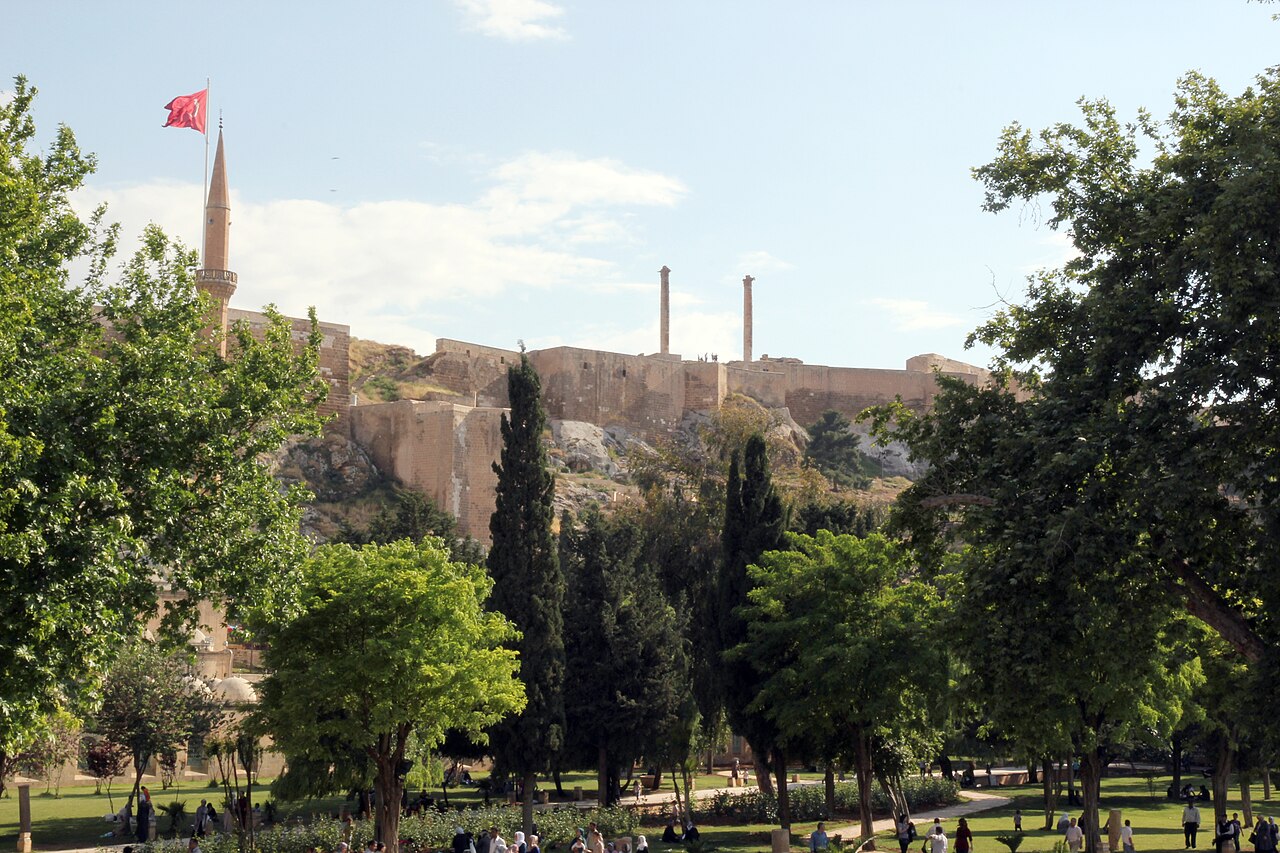
Photo by Klaus-Peter Simon • CC BY-SA 3.0
Preservation and restoration efforts
Today, Şanlıurfa Castle remains a prominent historical landmark, with ongoing restoration and archaeological work aimed at preserving its remaining structures and uncovering further details about its layered past. In April 2013, a significant partial collapse of an outer fortification wall occurred due to heavy rains, highlighting the challenges of conserving such ancient sites. Fortunately, no injuries were reported, and restoration efforts have continued to stabilize and protect the fortress.
The surviving elements, including the Corinthian columns, outer terrace walls, and the deep moat, offer visitors a tangible connection to the castle's multifaceted history. While many inner buildings have not survived, the site remains invaluable for understanding the architectural and military developments from the Roman era through the Crusader period and beyond.
Geographical and cultural context
Situated just south of the ancient sacred pond complex of Balıklıgöl, Şanlıurfa Castle's location underscores its cultural and spiritual significance in addition to its military role. The castle's elevated position on the hill provided not only defensive advantages but also a commanding view of the city and its environs, essential for controlling trade routes and regional power dynamics.
The castle's enduring presence reflects the rich tapestry of civilizations that have influenced Şanlıurfa and the broader region over millennia. It stands as a symbol of resilience and continuity, bridging the ancient world with the medieval and early modern periods.
Visitor experience and accessibility
Visitors to Şanlıurfa Castle can explore the imposing Corinthian columns and walk along sections of the fortress walls and moat, gaining insight into the site's defensive architecture. The castle's hilltop location offers panoramic views of the modern city and the surrounding landscape, making it a popular destination for history enthusiasts and tourists alike.
While some areas of the castle are under restoration, the site is accessible to the public, providing educational opportunities about the complex history of Edessa and the various cultures that have shaped it. Informational signage and guided tours help contextualize the architectural features and historical events associated with the fortress.
Frequently asked questions (FAQ)
- What is the historical significance of Şanlıurfa Castle?
- Şanlıurfa Castle is historically significant as a strategic fortress that has witnessed control by the Osroene kingdom, Romans, Byzantines, Crusaders, Seljuks, and others, reflecting the region's complex history.
- Can visitors see the ancient Corinthian columns at Şanlıurfa Castle?
- Yes, visitors can view the two towering Corinthian columns known as the "Throne of Nimrod," which date back to the Syro-Roman winter palace built around 201 AD.
- Is Şanlıurfa Castle accessible to the public?
- The castle is accessible to the public, allowing visitors to explore the fortress walls, moat, and columns, although some areas may be under restoration.
- When was the castle originally built?
- The earliest fortifications of Şanlıurfa Castle date back to the 3rd century AD, constructed by the ancient kingdom of Osroene.
- What defensive features does Şanlıurfa Castle have?
- Key defensive features include a deep moat on the southern side, outer terrace walls, and remnants of a Crusader donjon, reflecting multiple phases of fortification.
Photo gallery

Information
Website
Visit websiteLoading map...
Visitor reviews
No reviews yet. Be the first to share your experience!