
Žampach Castle
Žampach Castle stands as a significant medieval hill fortress located in the municipality of Žampach-Žamberk in eastern Bohemia, Czechia. Founded in the late 13th century by Bohemian settlers aiming to secure and develop a sparsely populated border forest region, the castle embodies the strategic and architectural characteristics of early Gothic fortifications in Central Europe.
The castle's earliest recorded connections date back to 1309, with ownership solidifying under Křesislav ze Žampachu by 1312. Its control passed through notable noble families, including the Lipé and Smojna clans, reflecting the feudal dynamics of the High Medieval period. The castle's history is marked by conflict, most notably during the mid-14th century when Jan ze Smojna, known as "Pancíř," used it as a base for raiding neighboring lands. This led to a decisive siege by King Charles IV around 1355–1356, after which the castle was integrated into royal administration and later granted to Čeněk of Potštejn.
The castle's role during the Hussite Wars
In the early 15th century, Žampach Castle became entwined with the religious and political upheavals of the Hussite Wars. Mikuláš Žampach of Potštejn, a prominent Hussite supporter, owned the castle during this turbulent era. The fortress was attacked and plundered by Catholic forces from Silesia in 1421 due to its owners' Hussite sympathies. Control of the castle shifted multiple times, illustrating the chaotic nature of the period. By 1429, it was reclaimed by Jan Žampach of Potštejn, reinforcing its strategic importance in the region.
Architectural features and layout
Constructed in the early Gothic style, Žampach Castle is perched atop a conical hill, a typical location for hill castles designed for defense and surveillance. Its layout is distinctly divided by a deep, rock-cut moat into two primary sections: the western outer bailey and the eastern main castle. The outer bailey was fortified with a robust stone wall and likely contained wooden structures for economic activities such as workshops and storage.
The main castle featured a compact but highly defensible core dominated by a tall, tower-like residential palace, oriented across the hilltop. Access was controlled via a southern gate, probably flanked by a defensive tower, and the entire core was enclosed by a continuous curtain wall. This design reflects typical medieval defensive strategies focused on layered fortifications and controlled entry points.
15th-century renovations and additions
Following damage sustained during the Hussite Wars, the castle underwent significant repairs and enhancements in the third quarter of the 15th century. New stone buildings, including a brewery and a water-powered mill, were constructed within the outer bailey, which was further subdivided by an internal wall to impede attackers. A new defensive structure known as the White Tower was erected to guard the castle entrance. The castle chapel, possibly built during this period, added a religious dimension to the fortress complex.
The residential palace was renovated, incorporating a stone corner block dated 1469, which remained until the late 18th century. Builders reused stones from earlier fortifications to strengthen newer constructions, illustrating adaptive reuse of materials common in medieval architecture.
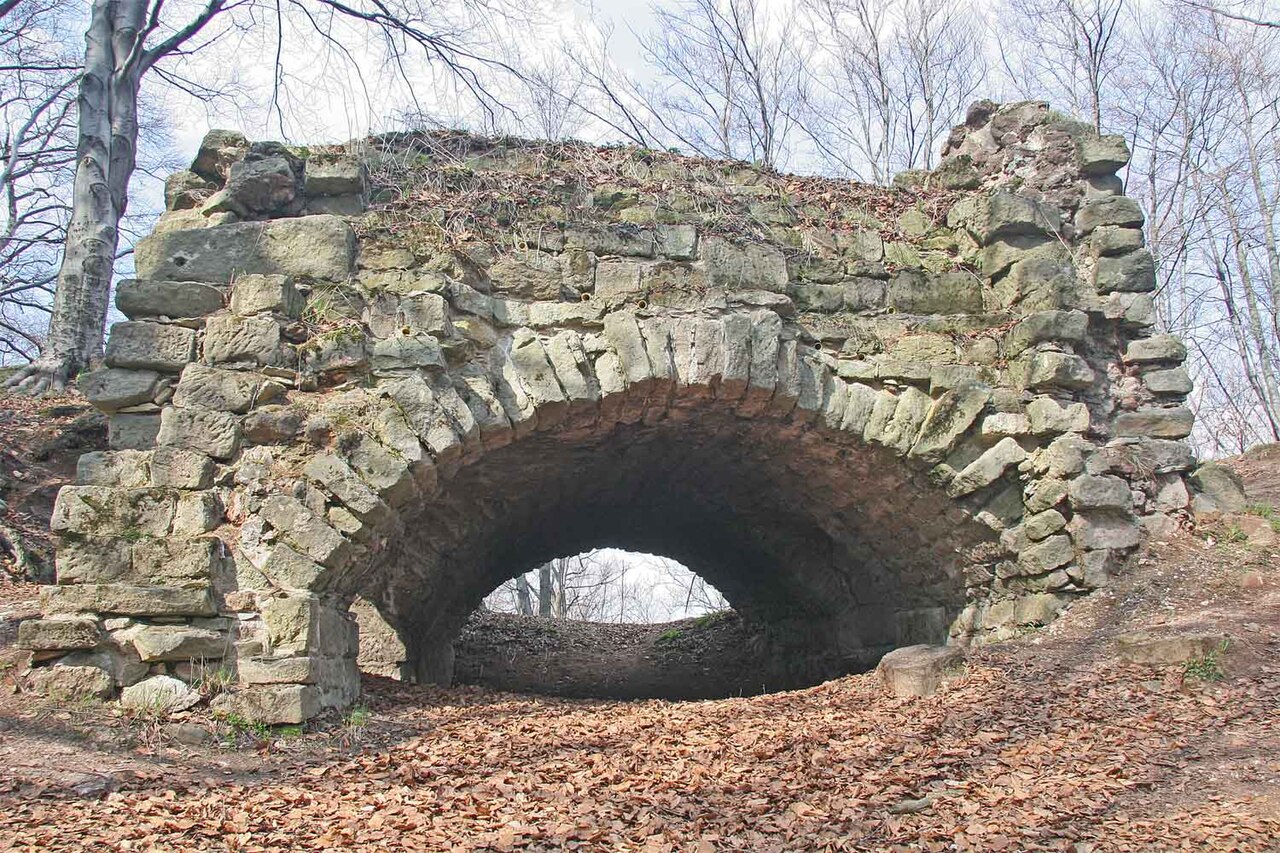
Photo by Zp at Czech Wikipedia • CC BY-SA 3.0
Decline and later history
By the mid-16th century, many of the castle's buildings had fallen into ruin. The outer bailey's structures were reduced to walls, the White Tower and chapel were heavily damaged, and the residential palace was dilapidated, as noted by contemporary observer Václav ze Šonov. A smaller fortification called Chudoba, documented in 1540, guarded the approach to the castle but was already in decline and likely disappeared by the 17th century.
Žampach Castle was also the site of a clandestine counterfeiting operation producing false coins until its discovery in 1542. This illicit activity likely had the tacit approval of the estate's administrators before the property was redeemed by Zdeněk Žampach of Potštejn in 1539.
The castle suffered further damage during the Thirty Years' War in the 17th century, with occupations by imperial and Swedish troops causing repeated harm in 1634, 1639, and 1648. After these events, the castle ceased to function as a residence or fortress and gradually fell into ruin.
The chapel and later modifications
The castle chapel, first mentioned in 1540 and used as a family crypt by the Bukovský family, was rebuilt by Jesuits in 1672 and dedicated to the Holy Cross. However, it was demolished sometime after 1787. From the 17th century onward, stones from the castle ruins were repurposed for local building projects, including a Jesuit residence nearby.
In the early 20th century, efforts were made to stabilize the ruins, including the addition of wooden footbridges and lookout towers, though these structures have not survived. Archaeological excavations between 1991 and 2002, led by Miroslava Cejpová, conserved historic masonry and improved access. Further landscape modifications occurred around 2011–2013, enhancing visitor experience.
Current state and archaeological significance
Today, Žampach Castle is a well-preserved ruin nestled within a heavily wooded area. Faint traces of the outer bailey walls and former economic buildings remain visible. Excavations have uncovered vaulted ground-floor rooms of the residential palace, remnants of a vaulted gate, and fragments of the northern curtain wall.
Archaeological finds include medieval pottery shards near the brewery and fragments of technical ceramics and copper sheets linked to the 16th-century counterfeiting workshop. Architectural fragments such as portal and window stones are preserved in a local lapidarium and the nearby Žampach chateau.
Modern preservation efforts include wooden safety barriers along steep slopes and informational signage guiding visitors from the surrounding park to the castle remains. Žampach Castle remains an important cultural and historical monument, reflecting the complex medieval and early modern history of eastern Bohemia.
Frequently asked questions (FAQ)
- How do I get to Žampach Castle?
- Žampach Castle is accessible by local roads from Žampach-Žamberk. Visitors can reach the site by car or on foot via marked hiking trails through the surrounding park.
- What is the best time to visit Žampach Castle?
- The best time to visit Žampach Castle is during late spring to early autumn when the weather is favorable and the wooded surroundings are most picturesque.
- Is there an entrance fee to visit Žampach Castle?
- Visiting Žampach Castle is free of charge. There are no ticket requirements, making it accessible to all visitors.
- What remains can I see at Žampach Castle?
- Visitors can explore the ruins of the outer bailey walls, vaulted rooms of the residential palace, remnants of the gate, and fragments of curtain walls. Informational signs help interpret the site.
- Can I learn about the castle's history on-site?
- Yes, informational panels are installed along the access routes and near the ruins, providing historical context and details about the castle's architecture and past.
Photo gallery

Information
Opening hours
Open year-round, dawn to dusk
Ticket prices
Free
Current owner
Municipality
Website
Visit websiteLoading map...
Visitor reviews
No reviews yet. Be the first to share your experience!